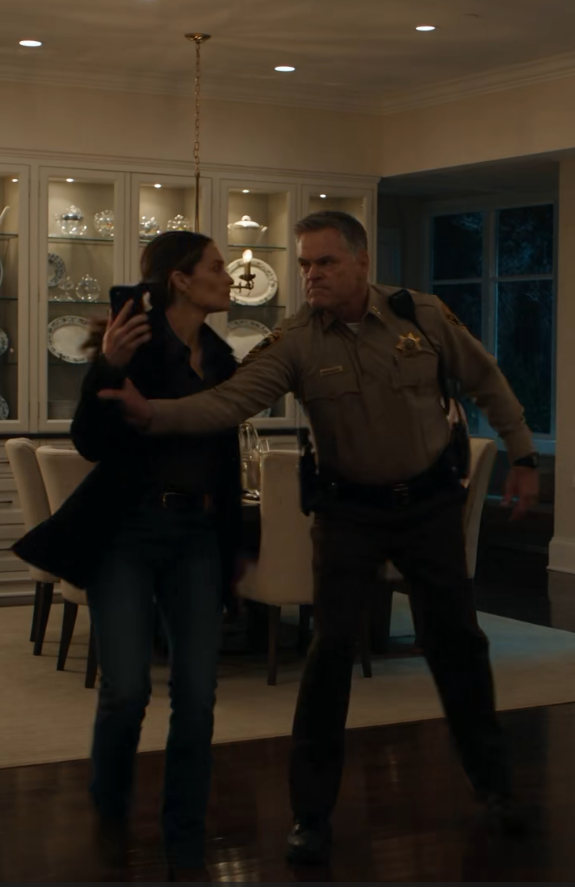
“You’re enjoying that word.”
“No, ma’am.”
“What did Frank photograph?”
“We recovered deleted images from his phone.”
That got my full attention.
My aide opened the folder.
Photographs lay inside.
My military credential.
The black encrypted phone on the dining table.
A partial image of the device serial marking.
My watch.
My coat pocket.
A photograph taken through the doorway while I stood by the window on the secure call.
I stared at that one.
Frank had photographed me before touching me.
He had followed instructions.
“How many were transmitted?”
“Three successfully before his device lost connection during the incident.”
“To whom?”
“Encrypted relay.”
“Can we identify destination?”
“Working it.”
I picked up the photograph of myself at the window.
My back was partially turned.
Frank had taken it from his chair.
That meant the confrontation had not been spontaneous.
He had already decided.
The humiliation I had felt on the floor shifted into something colder.
Not anger exactly.
Clarity.
He had put his gun to my head after participating knowingly in an operation to photograph restricted equipment.
Whatever story he told himself, there was a line between resentment and betrayal.
He had crossed it before I arrived.
My aide said, “There’s a question about your status.”
I knew what he meant.
“Whether I should step back.”
“Yes.”
“Recommendation?”
“That’s above me.”
“Coward.”
“Absolutely.”
I almost smiled.
Then I looked at the images again.
“Schedule the review.”
The security review was not punitive.
It was necessary.
A senior officer targeted through a family vulnerability had to be evaluated for continuing access and operational risk.
Rank did not exempt me.
If anything, it made the scrutiny more important.
That afternoon I sat across from a panel and described my decision to travel without visible security.
One official asked, “Did you believe your family situation justified reducing protective posture?”
“Yes.”
“Do you believe that decision was sound?”
“No.”
“Why did you make it?”
I could have given them language about urgency.
Family welfare.
Risk assessment.
Instead I said, “My mother sounded afraid, and I reacted as her daughter before I finished thinking as an officer.”
No one wrote for a moment.
Then the official asked, “Would you make the same choice again?”
“No.”
“What would you do?”
“Send local welfare support first. Maintain security coverage. Validate the situation independently.”
“Even with a parent?”
“Especially with a parent, now.”
That answer cost me something.
Not professionally.
Personally.
It meant accepting that the simple category of “home” no longer existed.
After the review, I returned to my office and found a voicemail from my mother.
Her voice was controlled.
“Maya, I know you’re busy. I… found something. Frank kept a second phone. I didn’t know about it. The police took it. They said somebody may call you. I’m sorry.”
A pause.
Then:
“I should have told you I missed you.”
The message ended.
I listened twice.
The second phone changed the case.
Frank had hidden it behind paint cans in the garage.
On it, investigators found the deeper communication history.
The manipulation had begun months earlier.
Messages praised Frank’s service.
Complimented his experience.
Suggested that “elite federal institutions” had become corrupt.
Fed him small pieces of real information about me.
Then false ones.
Each message did two things.
It validated Frank.
And isolated him.
You’ve always seen through her.
Her position has protected her from scrutiny.
Only someone close enough can expose what she’s become.
The language was almost embarrassing in its transparency when read all at once.
Delivered over months, to the right ego, it had worked.
The final exchanges were more explicit.
Frank asked what would happen after he photographed the device.
The response:
You will be recognized for exposing serious misconduct.
He asked whether he had legal authority to detain me.
The reply:
As a sworn officer, you know your authority better than anyone.
That sentence may have done more damage than all the others.
It gave him permission to tell himself he remained in control.
But one message mattered most.
Three days before my mother called:
If she resists, the incident itself will demonstrate abuse of power. Ensure there is a witness.
My mother.
The witness.
I read that message alone in my office.
Then I called her.
She answered on the first ring.
“Maya.”
“Did Frank tell you what to say if police came?”
Silence.
Then: “Yes.”
“What?”
“That you got angry. That you grabbed him. That he was forced to restrain you.”
“Before I arrived?”
“Yes.”
I closed my eyes.
“Why didn’t you tell me this last night?”
“I was ashamed.”
“That is not a useful reason.”
“I know.”
“Did you agree?”
“At first.”
“At first.”
“I thought he wanted to scare you.”
I stood.
“Scare me into what?”
“Stopping.”
“Stopping what?”
“Acting like we didn’t matter.”
I stared at the wall.
“Mom, I flew across the country because you told me you were afraid.”
“I know.”
“I canceled operational briefings.”
“I know.”
“I walked into that house alone because you asked me not to bring security.”
“I know.”
“So do not tell me I acted like you didn’t matter.”
She began crying then.
Quietly.
I let her.
After a while she said, “I wanted proof that if I needed you, you would come.”
The sentence was so selfish and so sad that for several seconds I could not answer.
“You could have asked.”
“I didn’t think you would.”
“You never gave me the chance.”
“No.”
That one word stripped away years of argument.
I sat down.
She said, “What happens to Frank?”
“I don’t know.”
“They’re talking about federal charges.”
“Yes.”
“Will they?”
“I’m not involved in charging decisions.”
“Would you stop them if you could?”
I thought about the gun.
The photographs.
The false report prepared in advance.
The classified call.
The missing album pictures.
“No.”
She breathed out.
“That’s what I thought.”
“Mom.”
“Yes?”
“You need to understand something.”
“What?”
“This is not revenge.”
“I know.”
“No, I don’t think you do. Frank wants consequences to mean somebody is punishing him. That lets him remain the center of the story. He made decisions. Other people will make decisions based on his. That is what consequence is.”
She said nothing.
I continued.
“And you made decisions too.”
“I know.”
“I’m not ready to decide what ours mean yet.”
Her voice thinned.
“Are you cutting me off?”
“I said I’m not ready.”
“That sounds like yes.”
“No. It sounds like I finally stopped making permanent decisions while angry.”
The silence on the line changed.
Then she said, “That sounds like something you learned in the Army.”
“No.”
I looked at the photograph of us from my West Point graduation, recovered from the box upstairs.
“You taught me that.”
She started to speak.
I ended the call gently.
“Good night, Mom.”
Three days later, Frank was charged.
The local charges centered on aggravated asNextlt, unlawful restraint, misuse of authority, and related offenses subject to final legal classification.
Federal charges focused on interference with protected federal communications and the unlawful acquisition and transmission of information connected to restricted government equipment.