Brooke looked at me.
I looked back at her.
"You don't have to," I said.
"I know." She was quiet for a moment.
"But I want to know what she has."
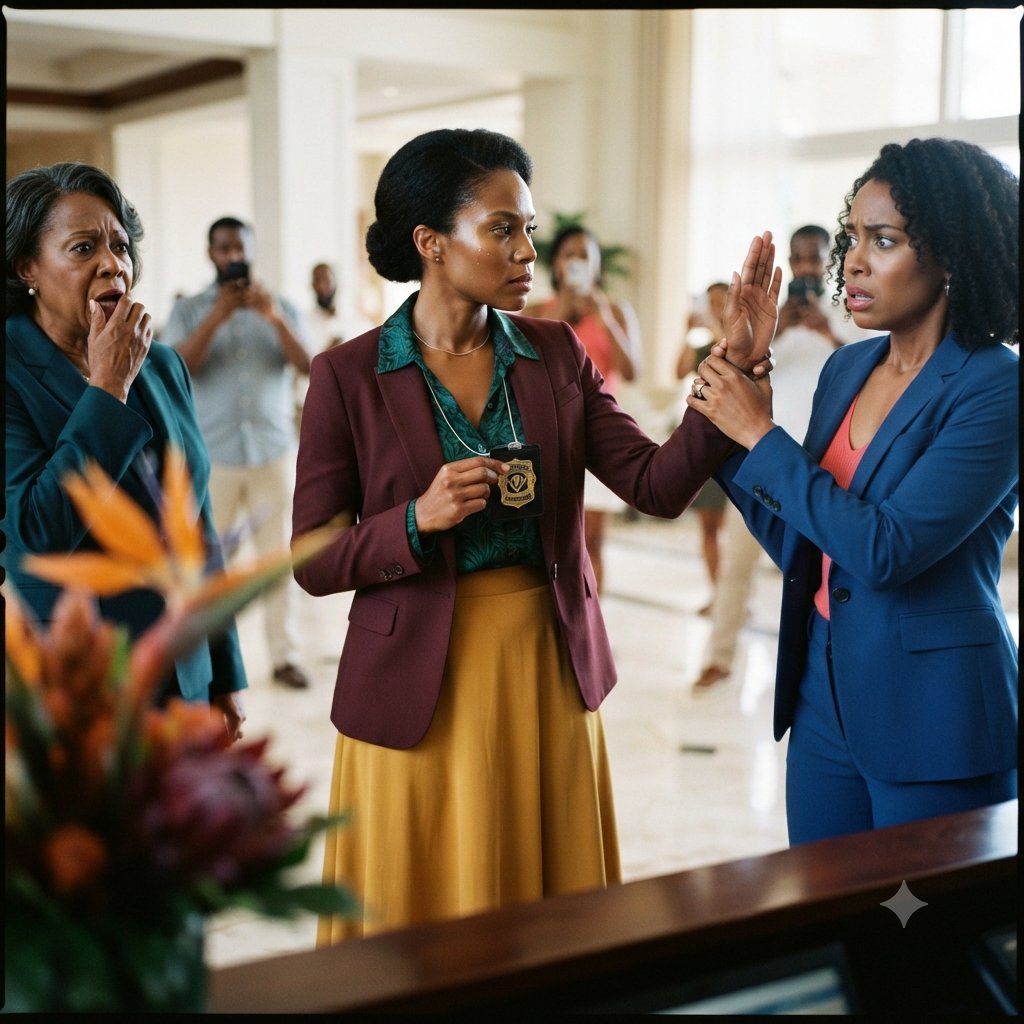
Detective Harlan led us to a small room near the back of the restaurant — a manager's office, barely large enough for a desk and four chairs.
Grant's mother was sitting in one of them.
She had her coat on.
Her handbag was in her lap.
She looked smaller than she had at the dinner table.
Her name was Vivienne.
I had known that for three years and somehow always thought of her as Grant's mother, as though she had no identity separate from him.
She looked up when Brooke came in.
She didn't look at me.
"I won't ask you to sit," Brooke said.
"Say what you have to say."
Vivienne's hands moved on her handbag.
She opened it slowly and took out an envelope.
It was sealed, slightly creased, like it had been carried for a long time.
She held it out to Brooke.
Brooke didn't take it immediately.
"What is it?"
"A letter." Vivienne's voice was different from what it had been at the dinner table.
Quieter.
The performance had gone out of it.
"From a woman named Carol Mathers.
She was married to Grant before you."
Brooke's hand came up slowly and took the envelope.
"He told me she was unstable," Vivienne said.
"He told me she had fabricated everything she said about him.
I believed him." She looked at the envelope in Brooke's hand.
"She sent me that letter two years ago.
After she heard Grant had remarried.
She wanted me to give it to you."
"And you didn't."
Vivienne said nothing.
"You kept it for two years," Brooke said.
"While he was doing to me what he did to her."
"I thought — " Vivienne stopped.
"I told myself it wasn't the same.
That she had exaggerated.
That you were different.
That he had changed." Her voice thinned.
"I told myself a great many things."
"Yes," Brooke said.
"I know how that works."
Vivienne looked at her hands.
"I'm not asking you to forgive me.
I know what I did and what I didn't do.
I just — I should have given it to you two years ago.
And I didn't.
And I have to live with that."
The room was quiet.
I watched my daughter stand there holding that envelope — the letter from a woman she had never met, a woman who had tried to warn her before she even knew she needed warning — and I watched something move through Brooke's face that I couldn't fully name.
Not forgiveness.
Not yet, and maybe not ever.
But something that understood the difference between a person who was cruel and a person who was a coward.
"Did you know about the money?" Brooke asked.
"My mother's accounts."
Vivienne hesitated.
"I knew he was — managing things.
He told me it was with her permission.
That she had asked him to help."
"She didn't."
"I know that now."
"You suspected it then."
Vivienne didn't answer.
Which was its own answer.
Brooke looked at her for a long moment.
Then she said, "I'm going to read this letter.
And then I'm going to find Carol Mathers.
And I'm going to make sure that whatever she went through is part of the record."
Vivienne nodded.
One small, defeated movement.
"Is there anything else?" Brooke asked.
"No."
"Then we're done."
Brooke walked out of the room.
I followed her.
Detective Harlan closed the door behind us.
In the hallway outside, Brooke stood holding the envelope with both hands.
"Are you all right?" I asked.
"There was another woman." Her voice was steady but thin.
"He did this before.
And she tried to warn his own mother.
And his mother kept the letter in her handbag for two years."
"Yes."
"She carried it with her.
For two years." Brooke looked at the envelope.
"She must have looked at it every time she opened her bag."
I didn't have anything to say to that.
Brooke slid the envelope carefully into her own bag.
"I'm going to find Carol.
She deserves to know that someone finally listened."
We walked back through the darkened restaurant toward the front.
The busboy was gone.
The lights over the bar were off.
The table where we had been sitting all evening was cleared, the glasses and plates removed as though the night had been tidied away.
Outside, the street was quiet.
The police vehicles were gone.
The unmarked car was gone.
A light rain had started, the kind that barely registers until you notice your coat is damp.
Brooke stood on the sidewalk and looked up at the rain for a moment.
"January," she said.
"He locked me out in the rain.
I stood on the porch for forty minutes before he let me back in."
"I know."
"I called you and told you I'd left my key inside."
"I remember."
She looked at me.
"I'm sorry I lied to you."
"You were protecting yourself."
"I was protecting the folder." She paused.
"But also you.
I didn't want you to be scared."
I reached out and put my arm around her.
She leaned into it the way she used to when she was very young and something had frightened her — not collapsing, just allowing herself to be held for a moment before she straightened again.
"Come on," I said.
"Let's go home."
She straightened.
We walked to the car.
And the rain came down soft and steady around us, the way it does when a long night is finally ending.