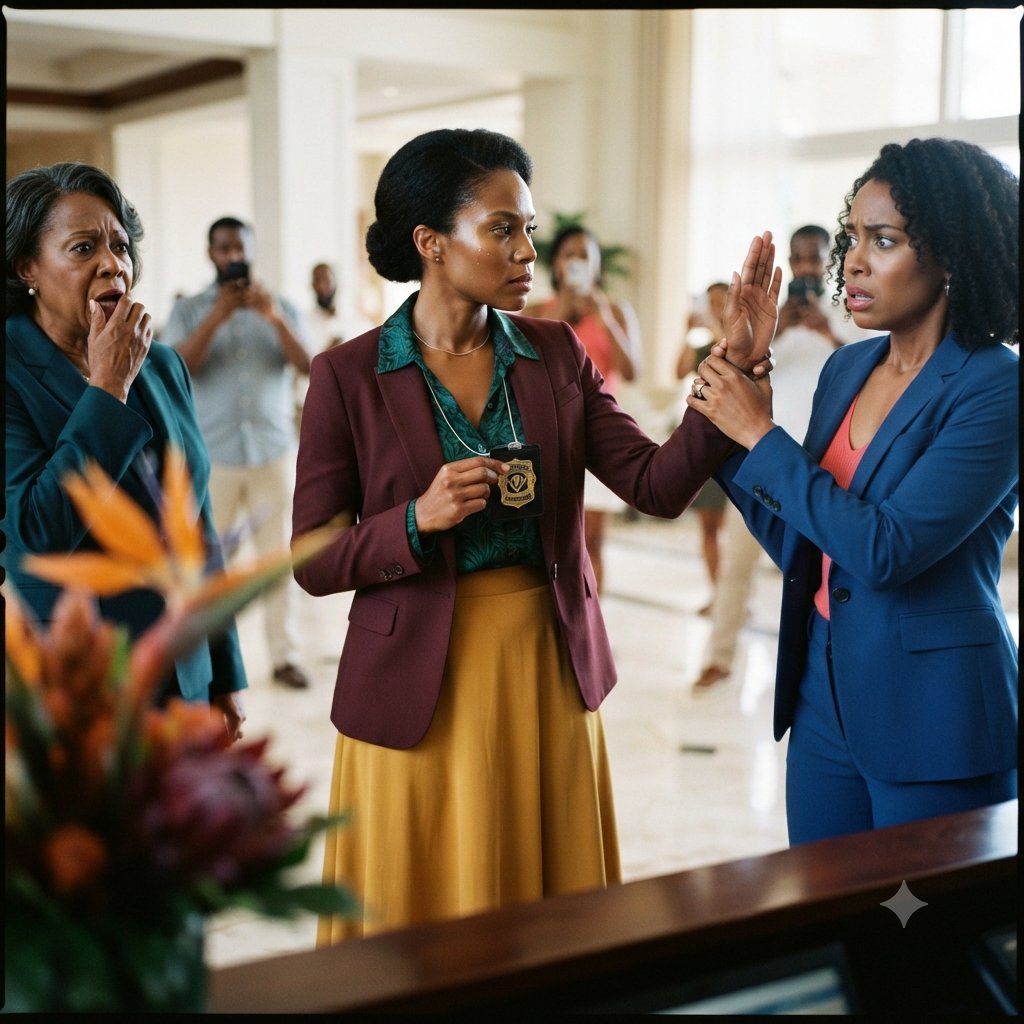
Grant's attorney arrived forty minutes later.
Her name was Diane Forsythe.
She was in her fifties, wore a dark coat over what looked like dinner clothes, and walked into the restaurant like she owned the building.
She went straight to Detective Harlan.
They spoke for less than two minutes.
Then she came to our table.
"I'd like a word with my client's wife," she said.
"I'm not his spokesperson," Brooke said.
"I'm not asking you to be." Diane Forsythe pulled out the chair across from us and sat down without being invited.
"I'm asking you to consider what the next seventy-two hours look like before you make any decisions you can't undo."
"She's already made her decisions," I said.
The attorney looked at me with the particular patience of someone who charges by the hour.
"Mrs.
Calloway, I presume.
Grant mentioned you might be present." She folded her hands on the table.
"Brooke.
You've given a statement.
That's your right.
But a recording made without the other party's consent has significant legal complications depending on the state.
I want you to understand that before — "
"It's a two-party consent state," Brooke said.
"I know.
I looked it up eight months ago."
Diane Forsythe's hands didn't move.
But something behind her eyes did.
"He was in my car," Brooke continued.
"Using my phone as a hotspot.
The recording was incidental.
My attorney has already reviewed the admissibility question."
"You have an attorney."
"I've had one for four months."
The silence between them lasted exactly long enough to be uncomfortable.
"Grant would like to speak with you," Diane Forsythe said finally.
"Privately.
Before this goes further."
"No."
"Brooke — "
"No." Brooke's voice didn't rise.
It just became very clear, the way a line drawn in ink is clearer than one drawn in pencil.
"Whatever he wants to say to me, he can say through counsel.
That's how it works now."
Diane Forsythe stood.
She looked at me once more before she left.
"You should know that Grant intends to contest the characterization of tonight's events.
He has his own account."
"So does the security camera," I said.
She left without responding.
Brooke exhaled slowly.
I watched her shoulders drop half an inch.
"Four months," I said.
"I needed to be ready.
I needed the folder to be complete.
I needed to know I could actually do it." She looked at the table.
"I almost stopped twice."
"What kept you going?"
She was quiet for a moment.
"January.
And then March.
And then a Tuesday in April when he told me that if I ever left him, no one would believe me because everyone already thought I was unstable." She paused.
"He said you thought so too."
My throat tightened.
"He told you I thought you were unstable."
"He said you'd told him I'd always been dramatic.
That you'd warned him before the wedding."
I had never said anything remotely close to that.
Not once.
Not to anyone.
"Brooke — "
"I know, Mom.
I know that now." She looked up.
"But for about six months, I believed him."
That was the thing about Grant that the restaurant and the police and the recording couldn't fully capture.
The physical part was real and it was documented and it was wrong.
But the other part — the part where he had spent years quietly rewriting the story of who Brooke was, who I was, who anyone around him was — that part left no bruises.
Detective Harlan came back to the table.
"We're ready for the formal statement, Brooke.
You can have your attorney on the phone if you'd like."
"I'd like that, yes."
He nodded and stepped back to give her space to make the call.
While she dialed, I looked out the front window again.
Grant was still outside, now seated in the back of the police vehicle.
Diane Forsythe stood beside it, speaking to him through the window.
I watched Grant's face as she talked.
Whatever she was telling him about the recording, about the financial crimes unit, about Brooke's four months of preparation — it was landing differently than he'd expected.
He turned and looked at the restaurant one more time.
I didn't move.
He looked away first.
Brooke's attorney picked up.
I heard her say, quietly and steadily, "Yes.
I'm ready.
Let's do this."
But then, just before Detective Harlan led her toward the back of the restaurant for the formal statement, his radio crackled again.
He listened.
His expression shifted — only slightly, but I caught it.
"What is it?" I asked.
He looked at me.
Then at Brooke.
"The second voice on the recording," he said.
"We have a name."