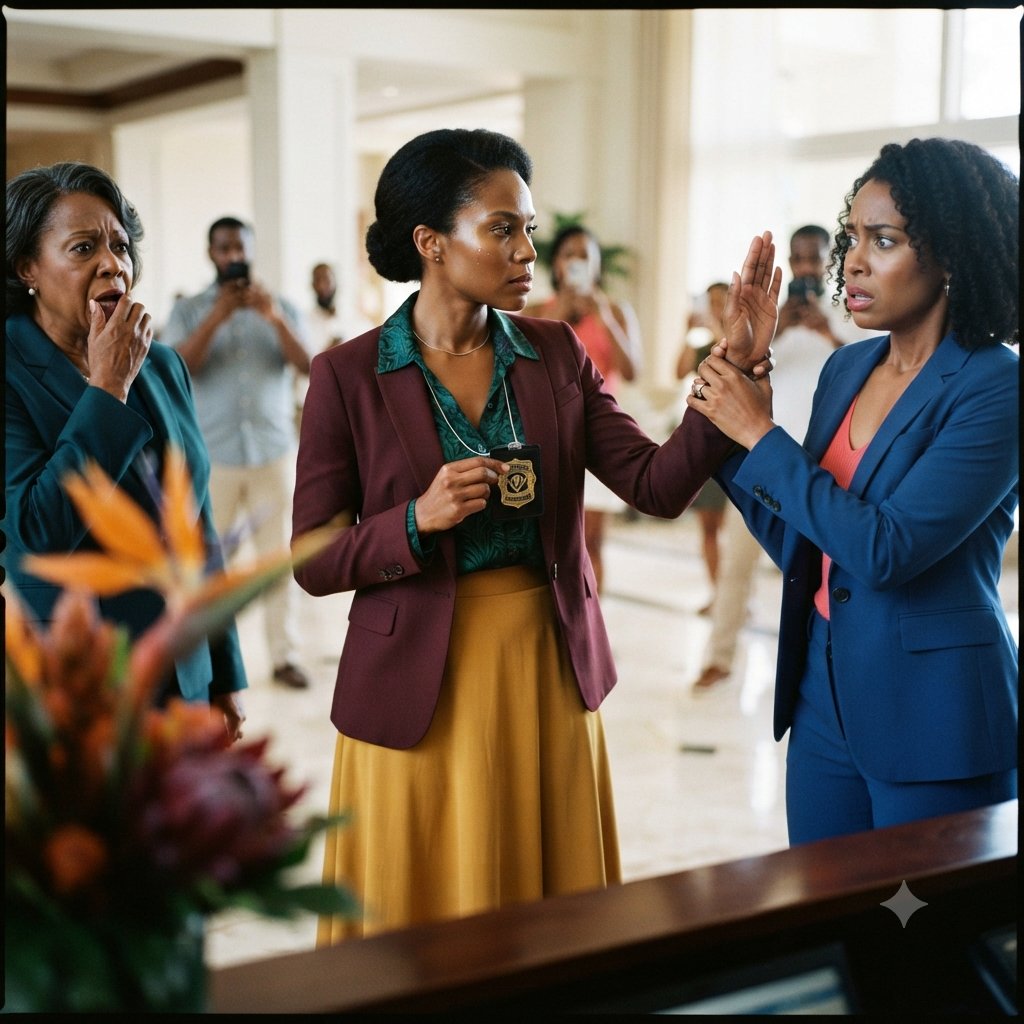
Beatriz was still at the villa when I returned that afternoon.
I had not expected that.
I had half-expected to find her gone — the wardrobe empty, the car missing, the box taken.
But her car was in the drive, and when I came through the front door she was sitting in the living room with her phone in her hand and an expression I had not seen on her face before.
She looked cornered.
"Tomás called me," she said.
"Or tried to.
His phone went to voicemail."
I set my keys on the table.
"They picked him up this morning," I said.
"Financial crimes unit.
They had the Malta documents, the Gibraltar statements, and the recording from last night.
They also had records from the two previous marriages — the one in Portugal and the one in France."
She stared at me.
"The French husband filed a report at the time," I said.
"It was never fully investigated because he couldn't prove intent.
We gave them the intent."
Beatriz stood up.
"You had no right—"
"I had every right." I looked at her calmly.
"You used my daughter to protect a fraud.
You put your hands on her life — her safety, her sleep, her sense of what she deserved — to buy yourself time to finish taking what wasn't yours." I set a folder on the coffee table between us.
"Señora Vidal's office prepared the separation agreement this morning.
It reflects what I offered you last night."
She looked at the folder.
She didn't touch it.
"No claim on the jointly held properties," I said.
"The freeze on the third transfer stands.
The Gibraltar account will be subject to the criminal investigation — I have no control over that now.
You leave the villa within forty-eight hours.
You do not contact Isabella."
"And if I don't sign?"
"Then we proceed through the courts with the full evidence package.
The footage.
The documents.
The recording.
Rosa's testimony.
The financial crimes investigation.
The records from Portugal and France." I paused.
"You are very good at this, Beatriz.
But you are not good enough to survive all of that at once."
She looked at me for a long time.
Then she picked up the folder.
She read it slowly.
I watched her face move through the pages — calculation, anger, something that might have been regret, and then finally a flat, closed expression that I recognized as the real one.
The one underneath all the others.
She reached the last page.
She looked up.
"I want it noted that I dispute the characterization of my conduct toward the child."
"It will not be noted," I said.
"Sign or don't sign."
Her jaw moved.
Then she picked up the pen from the table and signed her name in three places.
She closed the folder and set it down.
"You should know," she said, standing, "that I did not plan to dislike her."
I said nothing.
"She reminded me of myself at that age." Beatriz picked up her handbag from the chair.
"That's not an excuse.
I know that.
I'm simply telling you."
She walked past me toward the stairs.
"Beatriz."
She stopped.
"The passport with the other name," I said.
"Leave it on the bed.
The investigators will want it."
A long pause.
Then she continued up the stairs without answering.
I heard her moving above me — drawers, the wardrobe, the sound of a case being pulled from under the bed.
Efficient.
She had packed quickly before.
She knew how.
An hour later, her car left the drive.
I stood at the window and watched it go.
Rosa appeared behind me.
She stood at a respectful distance, the way she always did, hands folded.
"She's gone?" Rosa said.
"She's gone."
Rosa let out a breath.
It was a long one.
The kind that has been held for months.
"Rosa." I turned to look at her.
"I owe you an apology."
She shook her head.
"You didn't know, sir."
"I should have known sooner.
You tried to protect her when I wasn't here.
I won't forget that."
Rosa's eyes filled.
She pressed her lips together and nodded once, the way people do when they don't trust their voice.
"I'd like you to stay on," I said.
"If you're willing.
Isabella trusts you.
That matters more to me right now than anything else."
Rosa nodded again.
This time she managed: "Of course."
I looked back out the window.
The drive was empty.
The garden beyond it was still and gold in the late afternoon light.
The bags were gone.
The stone was clean.
My phone buzzed.
A message from Señora Vidal.
*Tomás formally charged.
Three counts.
Extradition request filed for the French case.
The Gibraltar account is frozen pending full investigation.
It's moving.*
I put the phone in my pocket.
Then I called Claudia.
She answered with noise in the background — children, something sizzling on a stove, a dog barking at something important.
"How is she?" I said.
"She ate two helpings of lunch," Claudia said.
"She beat my son at chess, which he is not handling gracefully.
And she fell asleep on the sofa twenty minutes ago with the cat on her feet." A pause.
"She's all right, Marcos.
She just needed to feel safe."
I sat down in the chair by the window.
"I'll come tomorrow," I said.
"She'll be here," Claudia said.
"Take tonight.
You sound like you need it."
She hung up.
The villa was very quiet.
Rosa brought tea without being asked, set it on the side table, and went back to the kitchen.
The sound of her moving around in there — familiar, ordinary, safe — was the most comforting thing I had heard in days.
I picked up the tea.
Outside, the garden was going dark at the edges.
The bougainvillea along the wall had gone deep red in the fading light.
The stone path where Isabella had dragged those bags was just stone again.
Smooth and ordinary and clean.
I sat there until the sky was fully dark.
Then I went upstairs, changed my clothes, and slept for the first time in two days.