NO ROOM FOR ME INSIDE, THE LITTLE GIRL WHISPERED – THEN THE BIKERS DID THE UNTHINKABLE
No room for me inside.
The little girl said it as if she were naming the weather.
Not crying.
Not begging.
Not even angry.
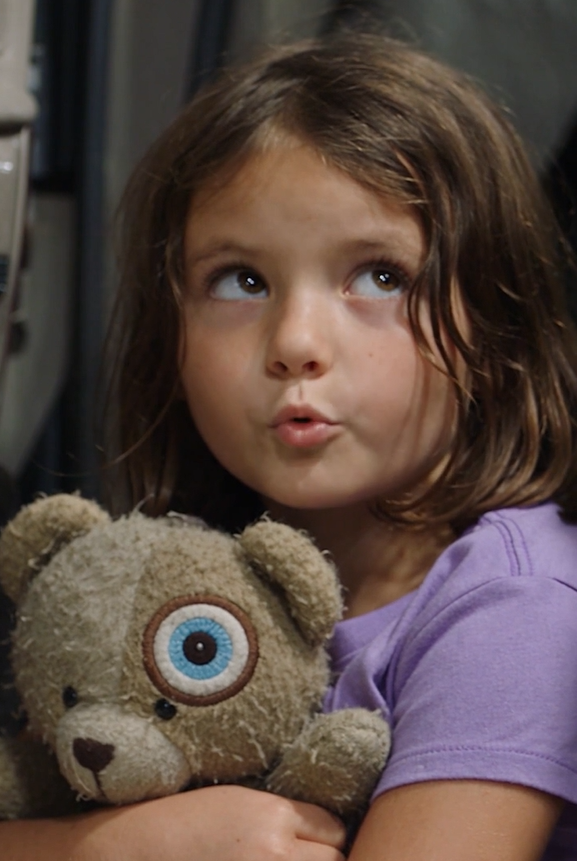
Just sitting in the back seat of a rusted Pontiac outside a dying gas station in the Central Valley, clutching a one-eyed bear to her chest while a stranger in a leather vest tried to understand how a child could sound that used to being unwanted.
Cade Mercer had heard terrible things in his life.
He had heard men scream in roadside wrecks.
He had heard engines fail at the worst possible second.
He had heard the small voice of his own daughter on a phone three years earlier, asking if he was coming, before the road and a drunk in a pickup made sure he never got there in time.
But those five words from Lena Brooks hit him harder than any of it.
No room for me inside.
The Rancho Fuel and Serve sat six miles east of Kingsburg, the kind of place people reached only when they had missed a turn, run out of options, or were trying not to think about where they were going.
Two pumps leaned under a sagging canopy.
A cooler hummed behind smeared glass.
Moths threw themselves into the fluorescent tubes above the pumps like they were trying to die in public.
Cade had not stopped for gas.
His Harley still had three quarters of a tank.
He had stopped because the road was not working on him anymore.
For three years, he had ridden at night when grief got too loud.
Sometimes the highway stripped the weight off him and scattered it across the dark.
Sometimes it only moved the weight from one part of his chest to another.
That Tuesday night, it had done nothing.
So he rolled into the gas station at 11:43, killed the engine, and stood beside the pump with the summer heat pressing against him like a hand.
That was when he saw the car.
A red Pontiac Grand Am, though the red had rusted and faded until it looked like an old wound.
It was parked wrong at the edge of the lot, angled toward the gravel as though the driver had stopped in a hurry or stopped caring.
The windows were fogged from the inside.
Not from cold.
There was no cold in the Central Valley in July.
It was breath fog.
Small, steady, living breath.
Cade did not move right away.
Years on the road had taught him that the wrong thing announces itself before it reveals itself.
He watched the car.
He watched the booth.
He watched the darkness beyond the lot where an apartment complex sat with blue television light flickering behind cheap blinds.
No one came out.
No one approached the car.
No one hurried across the asphalt with a bag of groceries and an apology.
After two full minutes, Cade walked over.
He chose the passenger side because he knew what he looked like.
Six foot two.
Two hundred and twenty pounds.
Leather vest.
Hard hands.
Gray in his beard.
The kind of face life carves when it is not done taking pieces.
He cupped his hands to the glass and looked inside.
The girl was curled across the back seat.
Brown hair tangled around her face.
Purple shirt with a cartoon horse.
Jeans torn at one knee.
No blanket.
A library book lay open beside her as if sleep had taken her in the middle of a sentence.
One arm was wrapped around a stuffed bear missing an eye.
She could not have been more than seven.
Cade felt something inside him go silent.
He knocked softly.
The girl woke all at once.
Not slowly.
Not sleepily.
Her eyes opened and began searching before the rest of her body even moved.
She pulled back from the window, then froze.
It was not simple fear.
It was assessment.
She looked at Cade the way a person looks at a locked door, a strange dog, a man raising his voice in another room.
Not deciding what he was.
Deciding what he might become.
Children were not supposed to look like that.
Cade lifted one hand, palm out.
Then he pointed to the door handle and raised his eyebrows.
He was asking.
Not ordering.
After three seconds, she reached across and unlocked the door.
Cade pulled it open and crouched so he was level with her.
Hey, he said.
You okay in here?
The girl clutched the bear tighter.
I am fine, she said.
You here by yourself?
My mom is inside.
Inside where?
She pointed toward the apartment building behind the station.
Cade looked at the units.
The nearest window showed a television flashing over a dark room.
No one was moving toward the stairs.
How long has she been inside?
The girl looked down at the bear.
Before it got dark.
It was almost midnight.
The dark had been complete for hours.
Cade pressed his tongue against the back of his teeth and kept his anger where it could not scare her.
What is your name?
Lena.
I am Cade.
He nodded toward the bear.
Who is that?
Captain.
Good name.
He lost his eye in a fight, Lena said seriously.
Still recovering.
Cade felt the smallest ache of a smile move through him, then vanish.
How old are you, Lena?
Seven.
She paused.
And a half.
He nodded as if the half mattered because it did.
It is hot out here.
Do you want water?
She studied him.
Are you going to take me somewhere?
No.
Are you going to call police?
I am going to make sure you are safe.
Those are not the same thing.
Her eyes sharpened.
They might be.
He held her gaze.
I know.
That was the first answer she seemed to believe.
He went into the booth, bought water and peanut butter crackers, and told the clerk to wake up enough to notice the child sleeping in the car.
The kid behind the plexiglass stared like someone who had been pulled out of a dream.
Cade put a twenty through the slot.
Call 911.
Tell them there is a child alone in that car.
Tell them she has been there since before dark.
Tell them possible neglect.
Then call again in twenty minutes if nobody shows.
The clerk swallowed and reached for the phone.
Cade returned to the Pontiac.
Lena accepted the water and crackers with a quiet thank you.
That hurt too, for reasons Cade did not want to examine.
Someone had taught this child manners.
Someone had cared enough once to make her say please and thank you.
That made the abandoned car worse.
It meant the ruin had not always been ruin.
Cade sat on the edge of the open door frame.
Not inside.
Not leaving.
Just there.
Lena ate slowly, in careful bites.
The bear sat in her lap like an injured soldier.
After a while, she said the words that would split his life into before and after.
There is no room for me inside.
Cade did not answer.
Some sentences need silence around them because anything spoken too quickly will insult them.