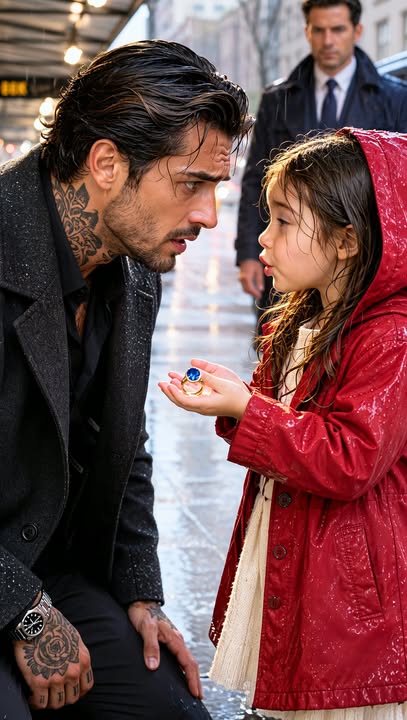
Alessandro looked inside.
The apartment was small enough that he could see almost everything from the doorway: a narrow kitchen with two mismatched chairs, a sofa covered in a faded quilt, a bookshelf bowed beneath old paperbacks, and a child’s drawings taped carefully along one wall.
There was no television playing.
No adult voice calling from the bedroom.
Only the soft, uneven sound of someone breathing.
Emma stepped out of her wet shoes.
“Mommy?”
No answer came.
She crossed the room and pushed open the door at the end of the short hallway.
Alessandro followed, stopping at the threshold.
Sophia lay beneath a pale blanket, her dark hair spread across the pillow.
She looked thinner than he remembered, though perhaps six years had changed his memory as much as they had changed her.
Her face was turned toward the window, where rain traced wavering lines down the glass.
A mug of water sat on the nightstand beside an empty medicine bottle.
Emma climbed onto the edge of the mattress.
“Mommy, I found somebody.”
Sophia stirred.
Her eyelids opened slowly.
For one confused second, her brown eyes rested on Emma alone.
Then they moved to Alessandro.
The color drained from her face.
He had imagined this moment more times than he could count.
In some versions, she shouted.
In others, she wept.
Sometimes she struck his chest and demanded to know why he had allowed her to disappear.
He had never imagined her simply staring at him as though he were a memory that had stepped out of the rain.
“No,” she whispered.
Alessandro’s hands tightened at his sides.
“Sophia.”
She tried to sit up, but the movement brought on a cough.
Emma immediately reached for the glass on the nightstand.
“Slowly, Mommy.”
Sophia took a small sip, then leaned back against the pillows.
Her gaze never left Alessandro.
“What are you doing here?”
“Emma found me.”
Sophia’s eyes shifted to her daughter.
“You went outside?”
“I needed medicine.”
A flicker of fear crossed Sophia’s face.
It was not anger.
It was the fear of a mother who had been too weak to protect her child from ordinary dangers.
“I told you to stay inside.”
“I did stay on the sidewalk.”
Alessandro glanced toward Marco, who was waiting in the hall with the driver.
“Call a doctor,” he said.
Sophia straightened.
“No.”
“You’ve been ill for three days.”
“I’ll be fine.”
“You can barely sit up.”
“And you’ve been away for six years,” she replied, her voice rough but steady.
“You don’t get to walk in and start giving orders.”
The words landed between them with the weight of everything she had never said.
Marco looked at Alessandro, waiting.
Alessandro had spent most of his life surrounded by people who obeyed him before he finished speaking.
But Sophia had always been the one person who reminded him that authority was not the same as being right.
He nodded once.
“Call the doctor,” he told Marco, quieter.
“Not an ambulance unless she needs one.
A private physician.
Someone who can come here.”
Sophia’s expression sharpened.
“I said no.”
“You also said you would be fine,” Alessandro answered.
“Emma told me you were burning with fever.
We’re going to have you examined.”
She looked toward the child.
Emma had lowered her head, clutching the sleeve of her jacket.
Sophia saw the same thing Alessandro did: the worry in the girl’s face, carefully hidden beneath obedience.
For the first time, Sophia’s resistance faltered.
“Just a doctor,” she said.
“No hospital.”
“Agreed.”
Marco stepped away to make the call.
Alessandro remained near the doorway.
He wanted to go to her, but six years had taught him that wanting something did not give him the right to take it.
Emma moved toward the kitchen.
“Do you have anything to eat?” he asked.
She nodded.
“Cereal.”
“Is that all?”
“There’s bread.”
Alessandro followed her.
The kitchen cupboards held a box of cereal with only a handful left, two cans of soup, and a jar of peanut butter.
He opened the refrigerator and found milk, half a lemon, and a container of rice.
He stared at the shelves.
Sophia’s voice came from the bedroom.
“Don’t look at it like that.”
“Like what?”
“Like you’ve discovered I failed.”
He closed the refrigerator.
“I’m not judging you.”
“You always were good at saying the right thing after making up your mind.”
He turned toward her.
“I haven’t made up my mind about anything.”
“That’s not true.”
Her breath caught, and she pressed her fingers lightly against her ribs.
“You walked in here with three men and an expression that says you’ve already decided what happens next.”
“Marco is security.”
“I know who Marco is.”
Alessandro looked at her more closely.
“You remember him?”
“I remember everyone who stood outside your office while you told me you had no secrets.”
The sentence was quiet, but it carried an old wound.
He had been twenty-eight then, ambitious, proud, and determined to separate his private life from the family business.
Sophia had believed him until the afternoon she found an envelope in his desk.
He remembered the envelope.
He remembered her holding it with both hands.
He had never understood why she had refused to let him explain.
Now, standing in her cramped kitchen, he wondered whether he had ever truly tried.
A knock sounded at the door.
Marco returned with a woman in her early sixties carrying a medical bag.
She introduced herself as Dr.
Elena Ruiz, a family physician who had treated members of the Moretti household for years.
She spoke gently to Sophia, examined her, asked questions, and listened to her lungs.
Emma sat on the sofa, hands folded in her lap.
Alessandro remained by the window, watching the rain.
After several minutes, Dr.
Ruiz turned to him.
“She has a respiratory infection and a fever.
Nothing suggests immediate danger, but she needs antibiotics, fluids, and rest.
If her breathing worsens, she goes to the hospital.”
Sophia looked as if she wanted to object.
Dr.
Ruiz raised one finger.
“That is not a negotiation.”
A faint, unwilling smile touched Sophia’s mouth.
“You sound exactly like my grandmother.”
“Then your grandmother was wise.”
The doctor wrote instructions and handed the prescription to Alessandro.
Sophia noticed.
“I can take care of it.”
“You can barely take care of yourself,” he said.
Her eyes flashed.
Dr.
Ruiz cleared her throat.
“Perhaps one of you can fill the prescription while the other makes sure she eats.”
Alessandro understood the diplomatic rescue and accepted it.
“I’ll get the medicine.”
“And food,” Dr.
Ruiz added.
“Simple food.
Soup, fruit, eggs.
Nothing complicated.”
“I know how to buy groceries.”
“I’m sure you do.”
She looked toward Emma.
“And you, young lady, are not responsible for keeping the whole household running.”
Emma glanced at her mother.
“I just wanted Mommy to get better.”
“I know.
But grown-ups are supposed to help with that.”
The little girl nodded solemnly.
Something tightened inside Alessandro’s chest.
Dr.
Ruiz packed her bag and spoke privately with Sophia before leaving.