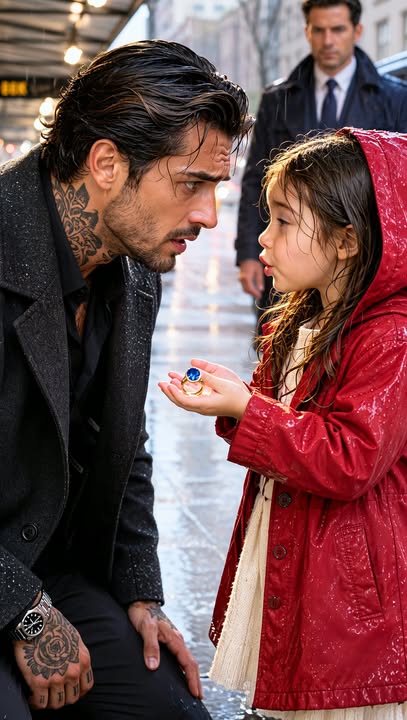
Love did not make his silence less frightening.
Love did not transform his family into a safe place for a woman carrying his child.
He looked toward the living room.
Emma was seated on the sofa, arranging the paper flowers from her bag beside a yellow cup.
She was humming softly, unaware that the shape of her life had just shifted.
“Does she know who I am?”
Sophia shook her head.
“She knows my name is Alessandro.
She knows I was someone important to you once.”
“Once?”
Sophia gave him a weary look.
“What was I supposed to say?”
“The truth.”
“The truth would have raised more questions than I could answer.”
“You could have told her I was her father.”
“You weren’t there.”
“I didn’t know.”
“I know.”
The repeated words hurt more than accusation.
Sophia returned the envelope to the drawer.
“I never wanted her to grow up believing she had been abandoned by you.”
“But you let her believe her father was dead.”
“Daniel was the only father-shaped person in her life.”
“Who was he?”
“A friend.”
“Your friend?”
“He helped me when I was pregnant.
He came to appointments.
He fixed the broken window.
He brought groceries when I was too sick to work.
He never asked me to pretend he was something he wasn’t.”
Alessandro looked down.
“And you named him as her father?”
“No.
Emma knew he loved her.
After he died, she asked where he went.
I told her he was in the sky because I didn’t have the heart to explain death to a four-year-old.”
“So she drew him.”
“She drew the person she missed.”
The answer settled heavily between them.
Alessandro had entered the apartment expecting to find evidence of betrayal.
Instead, he found a woman who had survived without him, a child who had formed an attachment to a kind man he would never meet, and years of silence built from fear rather than deceit.
He didn’t know what to do with that.
His phone buzzed.
Marco’s name appeared on the screen.
Alessandro answered.
“What is it?”
“I’m at the pharmacy.
They have the prescription ready.
The grocer is sending the order to the apartment.”
“Good.”
“There’s something else.”
Alessandro glanced at Sophia.
“What?”
“I ran the ring.”
Alessandro’s attention sharpened.
“Why?”
“Because I wanted to confirm the engraving before I assumed anything.
The jeweler’s records still exist.
The ring was purchased under your name fourteen years ago.”
“I know.”
“The jeweler also remembered who came with you.”
Alessandro felt the room grow colder.
“Who?”
Marco hesitated.
“Your mother.”
Alessandro said nothing.
Sophia looked toward him.
Marco continued.
“The jeweler said your mother selected the sapphire.
She told him it was a family gift.
He also said she returned to the shop six years ago.”
Alessandro’s gaze went to Sophia.
“Why?”
“She brought the ring back,” Marco said.
“Asked whether it could be reset.”
Alessandro’s grip tightened around the phone.
“Did she say why?”
“She said the woman who owned it had changed her mind.”
Sophia’s face had gone pale.
Alessandro ended the call.
“What did he mean?” she asked.
He walked to the dresser and looked at the drawer where she had placed the envelope.
“Did my mother know about you?”
Sophia’s expression changed.
Not surprise.
Recognition.
“You never asked her?”
“I had no reason to.”
“You should ask her now.”
“Sophia.”
She folded her arms around herself.
“The week I left, your mother came to see me.”
Alessandro went still.
“What?”
“She came to the apartment you rented for us.”
“What did she say?”
“She said you had made your choice.”
“I didn’t.”
“She showed me the agreement with Isabella.
She told me your family would never accept a child born outside a formal marriage.”
“That wasn’t her decision.”
“She said it was yours.”
“It wasn’t.”
“She said you had asked her to convince me to leave quietly.”
Alessandro stared at her.
“I never asked her to do that.”
“I know that now.”
“Why?”
Sophia looked toward the bookshelf.
“Because I found this.”
She crossed the room and removed a thin book from between two novels.
It was an old pregnancy journal, its cover faded and softened by use.
She opened it to the middle and pulled out a folded sheet of paper.
The paper was yellowed, but the handwriting was unmistakable.
Alessandro knew it immediately.
His mother’s handwriting.
Sophia handed it to him.
He unfolded the page.
There were only three sentences.
Sophia,
You were right not to trust him.
He knows about the baby and has chosen the Bellini arrangement.
He will deny it if you ask.
Leave before he convinces you that you and the child are an inconvenience.
At the bottom was his mother’s signature.
Alessandro read it twice.
Then a third time.
The rain continued against the window, steady and gray.
His mother had known.
Worse, she had lied—not only to Sophia, but to him.
He remembered the days after Sophia’s disappearance.
His mother had told him Sophia had left because she wanted a quieter life.
She had said, “Some women realize too late that they don’t belong in our family.”
He had believed her.
He had carried resentment toward Sophia for six years because of words his mother had planted in the space between them.
“Where did you get this?” he asked.
“Sophia’s father found it after I left.
He mailed it to me last year with the rest of my things.”
“Why didn’t you contact me?”
She looked at him for a long moment.
“Because by then, I had learned how to live without expecting you to come back.”
The sentence did not sound triumphant.
It sounded tired.
Alessandro lowered the letter.
His mother had taken his ring, rewritten his intentions, and allowed him to believe Sophia had abandoned him.
But even that revelation could not erase the truth that he had failed to look beyond his pride.
He had searched for Sophia, yes.
But when every door closed, he had stopped knocking.
He had accepted the first explanation that allowed him to keep moving.
Emma came quietly to the bedroom doorway.
“Is the doctor coming back?”
Alessandro folded the letter.
“No,” Sophia said.
“She said I need to rest.”
Emma looked at Alessandro.
“Did you get the apples?”
“They’re on the way.”
“Good.”
She seemed satisfied, then glanced at the paper in his hand.
“Is that about the ring?”
Alessandro crouched so they were at eye level.
“No.
It’s about something that happened a long time ago.”
“Before I was born?”
“Yes.”
“Were you there?”
He looked at Sophia.
“Yes,” he said.
“But I didn’t understand what was happening.”
Emma considered this.
“Then you should ask.”
The simplicity of the advice struck him harder than any accusation could have.
He glanced at Sophia.
“I have a lot to ask.”
“And I have a lot I’m not ready to answer.”
“That’s fair.”
She seemed surprised by his response.
He rose.
“I’m going to get the medicine myself.”
“You have people for that.”
“I know.”
“Then why?”
“Because I need a few minutes to think.”
Sophia’s expression softened by a fraction.
“Thinking has never been your problem.”
“No,” he said.
“Listening has.”
He walked toward the door.
Behind him, Emma called, “Alessandro?”
He turned.
“Will you come back?”
The question was small.
Uncertain.
It carried none of the power of a demand.
He looked at the child who had his eyes and Sophia’s careful way of studying a person before trusting them.
“Yes,” he said.
“If your mother allows it.”
Emma turned to Sophia.
“Can he come back?”
Sophia’s gaze met Alessandro’s.
For six years, he had wanted her to choose him.
Now he understood that choosing him was not something he could request as though the past had not happened.
She looked at Emma, then at the letter in his hand.
“Come back with the medicine,” she said.
“After that, we’ll decide.”
It was not forgiveness.
It was not an invitation into her life.
But it was a door left open.
Alessandro stepped into the hallway.
Marco was waiting beside the elevator, the prescription and a paper bag of groceries in his hands.
Before Alessandro could speak, Marco held out another envelope.
“This was in the mailbox,” he said.
“It’s addressed to Sophia.”
The envelope was cream-colored, sealed, and marked with a familiar black crest.
The Moretti family crest.
Alessandro took it.
There was no return address, only Sophia’s name written across the front in his mother’s unmistakable handwriting.
He looked back at apartment 403.
Inside, Sophia was sitting upright in bed while Emma arranged red apples on the table.
For the first time, the scene resembled something Alessandro had once dreamed of having.
But the envelope in his hand suggested that the past had not finished speaking.
He turned it over.
Across the seal, beneath the Moretti crest, someone had written four words:
**She was never the first.**
-END OF PART 2, –PRESS NEX PART IN BOTTOM OF PAGE TO READ NEXT PART