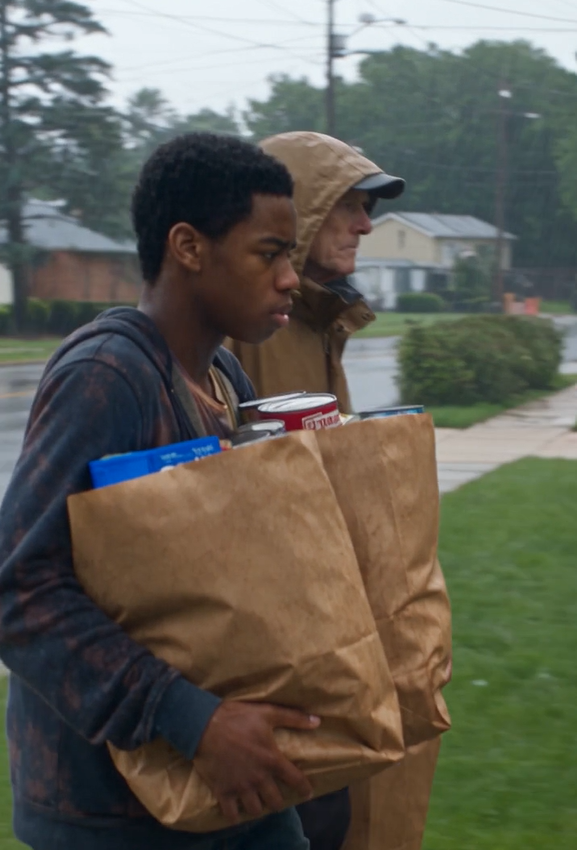
Poor Black Boy Carries Sick Old Man's — Then the Old Man Said, “I Know About Your Grandmother”
Chapter 1
Sir, are you all right? Let me help you carry these. The old man stood outside the grocery store, arms trembling under six bags, coughing so hard his body folded. Rain soaked his coat. Cans slipped from torn plastic and cracked against the pavement.
Mind your business, kid. He can barely stand. Not your problem. A woman laughed. Broke helping broke.
Classic. Solomon knelt in the rain, gathered every can, every jar, stacked the bags against his chest, holes in his shoes, empty stomach, $4 to his name. I got you, sir. Where's home? Thank you, boy.
2 Miles, six bags, pouring rain. He didn't ask for a single penny for helping. He simply didn't know that this act would change his life and his family's lives forever. At 7, he carried his mother's coffin flowers because no one else in the family could afford a second trip to the funeral home. At 12, he carried his grandmother's oxygen tank up four flights of stairs after the elevator broke and the landlord said fixing it wasn't worth the cost.
At 19, he carried two jobs, a stack of overdue medical bills, and a fear he never spoke out loud that one morning he would wake up and his grandmother wouldn't. Edna Mitchell was 74. She had raised Solomon since the night his parents died in the head-on collision on Route 9. He was five, she was 60. The social worker asked if she was sure a woman her age on a fixed income taking on a child.
Edna didn't blink. " That's my grandson, " she said. " Give me the papers. " For 14 years, she kept him fed, kept him in school, kept the lights on with her pension check and sheer stubbornness. Then her lungs gave out.
Chronic obstructive pulmonary disease, stage three. The doctor explained it calmly, like reading a grocery list. Edna would need supplemental oxygen around the clock. She would need medication that cost more per month than their rent. She would need, eventually, surgery.
And that number had so many zeros Solomon stopped counting. He dropped out at 16. Not because he wanted to, because the electricity bill was $340 and his grandmother's inhaler was $280 and there was no math in the world that made both numbers fit inside her $863 pension. By 19, Solomon worked two jobs. Mornings, he washed dishes at Hal's Diner on Franklin Street.
$8.25 An hour, no benefits, no breaks longer than 6 minutes. Afternoons, he delivered packages for a courier service that paid cash and didn't ask questions. Every dollar went into three envelopes taped under his mattress. Rent, medicine, food. Most months, the food envelope stayed empty.
He ate what Hal's threw away. Day-old rolls, soup that sat too long. He never told his grandmother. Their apartment sat on the fourth floor of a building that should have been condemned a decade ago. Water stains spread across the ceiling like bruises.
The hallway smelled like mildew and fried oil. The lock on the front door had been broken since January. Solomon wedged a kitchen chair under the handle every night, but the apartment had one thing that mattered, a window. Edna's bed sat beside it and on clear mornings, sunlight hit her face and she smiled. And for a few seconds, the rattling in her chest didn't sound so loud.
That was enough for Solomon. That smile, that window, that was the whole reason he kept going. The afternoon he met the old man, Solomon had just finished his delivery shift. His back ached. His shoes, the same pair for 11 months, had a crack in the left sole that let rainwater in with every step.
He had $4 in his pocket earmarked for the bus fare he would need tomorrow. No dinner tonight. He was cutting through the parking lot of Greenfield's Grocery when he saw him, an old white man, mid-70s at least, standing at the curb clutching six plastic bags. His knuckles were white. His arm shook.
A cough erupted from his chest, wet, deep, the kind that sounds like something tearing inside. One bag slipped. Cans scattered. The old man bent to reach them and nearly fell. People walked past.
A couple with a cart full of bags stepped around him without looking down. A teenager on a skateboard swerved and muttered something Solomon couldn't hear. A store employee stood at the entrance, arms folded, watching. Nobody helped. Solomon didn't think about it.
He didn't weigh the cost. He crossed the lot, knelt beside the man, and started picking up cans. " Let me get these for you, sir. " The old man looked up. His eyes were red-rimmed, watery. "
You don't have to do that, son. " " I know. " Solomon stacked the last can into the bag and lifted three bags onto each arm. " Where's home? " The man pointed east, "About 2 miles that way. " "
But it's raining, and you You look like you've had a long day yourself. " Solomon shifted the weight across his shoulders. Rain ran down his neck. " I'm good, " he said. " Let's go. "
They walked. 2 Miles, six bags, pouring rain. Solomon never complained once. He didn't know the old man's name, didn't know his story, didn't know that the quiet, trembling figure beside him owned more buildings than Solomon had ever entered in his life. All Solomon knew was that someone needed help and he could give it.
That was always enough. They didn't talk much for the first mile. The old man walked slowly, one hand gripping Solomon's arm for balance, the other pressed against his chest like he was holding something in place. Every few steps he coughed, a thick gurgling sound that made Solomon's stomach clench. The rain didn't let up.
Solomon adjusted the bags across his shoulders. The plastic handles dug into his palms, turning the skin white. Six bags, canned beans, bread, milk, cough syrup, three boxes of tea. Heavy, but Solomon had carried heavier. " What's your name, son? "
The old man asked between breaths. " Solomon. Solomon Mitchell. " " Walter. " He didn't offer a last name. "
You live around here? " " About 2 miles back, other direction. " Walter stopped walking. " You're telling me you're walking 2 miles the wrong way in this rain carrying a stranger's groceries? " Solomon shrugged. "
You needed help. " Walter stared at him for a long moment. Rain dripped from the brim of his hat. Then he shook his head and started walking again. " Your parents raised you right, " Walter said quietly. "
My grandmother, " Solomon said, "she raised me. " " Where are your parents? " " Gone. Car accident. I was five. "
Walter said nothing for a while, just the sound of rain and footsteps and his own labored breathing. " And your grandmother, she's well? " Solomon didn't answer right away. He shifted the bags to his other shoulder. The crack in his shoe let water seep in with every step, cold against his sock. "
She's sick, " he said finally. " Lungs. She needs a machine to breathe. Some days are better than others. And the bad days?
The bad days I sit by her bed and count her breaths until she falls asleep. Walter's grip on Solomon's arm tightened, not from weakness this time, something else. " You work? " Walter asked. " Two jobs.