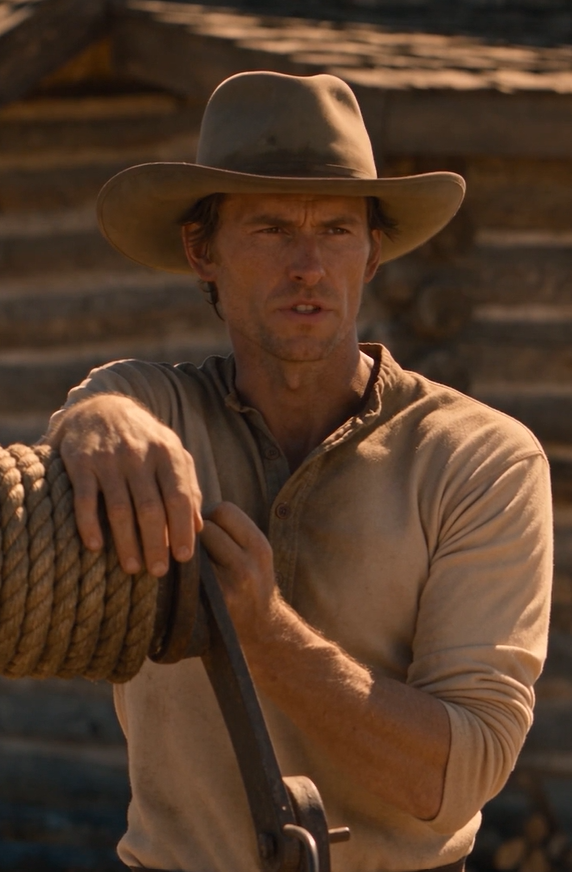
Poor Cowboy Offered Water to His Enemies—What Happened Next Changed Everything.
Four days after the cattle went missing, the whole story had grown teeth.
It happened the way these things always happen out here: not all at once, but in pieces, passed hand to hand across a bar top, over a fence line, in the hush before church, until by the time it reached Caleb's ears secondhand, it barely resembled the truth at all.
Six head of cattle had become a dozen.
A dozen had become an accusation, with his own name stitched right into the middle of it: the rancher who'd thrown open his well to raiders who couldn't be trusted, who might as well have handed them a rifle along with the water.
He rode into town on the fifth day because staying home and letting the story grow without him felt like a slower kind of dying than he had patience for.
The street went quiet when he passed. Not the ordinary quiet of a small town minding its business.
The other kind.
The kind where conversations stop mid-word and eyes track a man's back, like he's already been tried and convicted and everyone's just waiting on the sentencing.
He tied his horse outside the mercantile, felt the weight of stares pressing in from the porch of the saloon across the street, from the open door of the smithy, from behind a curtain in the window of the boarding house.
Inside the mercantile, the owner, a heavy-set man named Whit Farrar, who'd known Caleb eight years and sold him nails and flour and rope without a second thought, wouldn't quite meet his eyes now either.
"Caleb." A nod, tight, careful, like handling something that might go off. "Whit." A long pause. Too long.
"Heard you had visitors," Farrar said finally, folding a burlap sack with more attention than the task required.
"Out at your place." "Heard right," Caleb kept his voice level. "Dying of thirst.
Gave them water, same as I'd give any creature dying of thirst." "Some folks are saying different."
"Some folks weren't there." Farrar looked up then, and for just a moment something honest passed over his face.
Not apprehension, but fear. Plain and simple. The kind that made good men say things they wouldn't otherwise say.
"Larson's cattle are gone, Caleb. Real gone.
Man's got four kids and a wife with a fever and no beef to sell come winter. And the tracks.
The tracks head west. I heard. Folks are putting two and two together."
"Folks are putting two and two together and getting five," Caleb said, quiet, hard.
"I know those people didn't take Larson's cattle. I watched them ride out.
Half of them could barely sit their horses. They were that far gone from thirst.
A man like that doesn't rustle beef on his way home from nearly dying." Farrar didn't answer right away.
Wouldn't hold his gaze.
And in that silence, in that refusal to look him in the eye, Caleb understood something that settled cold and certain in his chest.
It didn't matter what was true. It only mattered what people were scared enough to believe.
He stood there a moment longer, surveying the shelves he knew as well as his own kitchen.
The same flour sacks. The same coils of rope.
The same tin of horehound candy Farrar's daughter liked to steal from when she thought no one was looking.
And felt, for the first time since he'd walked in, the strange vertigo of a familiar place turning unfamiliar, the ground shifting under him in a town he'd called home for eight years.
He was halfway back to his horse when a voice stopped him, smooth, unhurried, carrying just enough authority to make the whole street turn and listen.
"Mr. Whitlock." Caleb turned.
The man crossing the street toward him moved like someone used to being watched, used to being deferred to: broad-shouldered, silver at the temples, dressed a shade too fine for a working ranch.
Caleb had seen him around town a handful of times.
Reeves Hargrove owned half the grazing land east of the river, if the talk was to be believed, and had a way of being present at exactly the moments a man's reputation was coming apart at the seams.
"Colonel," Farrar's voice behind him, respectful in a way it hadn't been for Caleb. Colonel. Caleb filed that away.
Military man once. Something about the set of Hargrove's shoulders confirmed it before the title.
"Terrible business," Hargrove said, stopping a few feet off, hands loose at his sides, voice smooth as poured oil.
"Larson's cattle. Whole town's rattled." A pause, timed just so.
"And I understand you had Apache at your well not four days before it happened."
"I gave water to people dying of thirst," Caleb said. "Same as any decent man would." "Decent."
Hargrove let the word sit a moment, turning it over like he was examining it for flaws.
"I don't doubt your intentions, Mr. Whitlock. I truly don't.
But intentions and consequences are two very different animals, and out here, consequences are the ones that put food on a man's table."
His eyes flicked briefly toward the boarding house, toward Larson's wife, visible in the window, thin and pale with fever.
"That well of yours, the only deep one in 30 miles, I'm told, sits awful close to a lot of frightened families right now."
"You're threatening me, Colonel." Hargrove's smile didn't waver.
If anything, it warmed the way a man's smile warms right before he delivers the worst news of your life, wrapped up as a kindness.
"Not at all." He spread his hands. "All reasonableness.
I'm simply saying a man in your position might consider that some burdens are too heavy to carry alone.
I've made fair offers to lonelier ranches than yours.
Offers that let a man walk away with dignity and money enough to start somewhere the ghosts don't follow him quite so close."
The words landed exactly where they were aimed.
Caleb felt them land, felt the old grief in his chest flare up hot and raw, the way it always did when someone reached in and touched the wound without asking.
"That well's not for sale," Caleb said.
"Wasn't for sale last month when your man rode out to ask, and it isn't for sale now."
Something flickered behind Hargrove's eyes: brief, cold, gone before Caleb could be certain he'd seen it at all. "Of course."
Hargrove inclined his head, gracious as ever, already turning to go. "No, the offer stands, Mr. Whitlock. Circumstances change."
His gaze slid deliberate toward the gathered onlookers still watching from porches and doorways up and down the street.
"Sometimes faster than a man expects."
He walked away unhurried, the crowd parting for him the way water parts for a stone dropped in deliberately, precisely right where it will make the widest ripples.
Caleb stood there a long moment, jaw tight, watching him go, and understood with the same cold certainty that had settled in his gut the moment Doyle told him about the cattle that he had just met the man building the trap around him.
He didn't have proof, not yet.