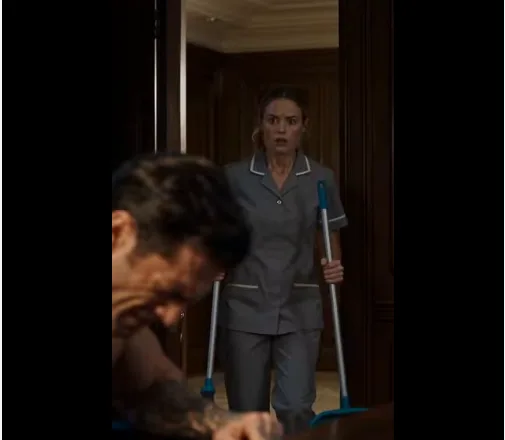
Rain hammered against the bulletproof windows of Danny Vance’s study, turning the glass into a gray blur of water and city lights. From the thirty-foot windows, Chicago looked distant and untouchable, all steel towers and red aircraft lights disappearing into the storm.
Danny had once ruled that city from the inside.
Now he watched it from a wheelchair.
Two years earlier, a sniper’s bullet had found him through the passenger-side door of his Mercedes. The shot had destroyed his spinal cord and taken his legs from him in a fraction of a second. His doctors had explained the damage in careful voices. His lawyers had spoken about liability. His men had spoken about revenge.
Danny had heard none of it.
What he remembered was the pavement.
Cold beneath his hands.
The impossible realization that his legs would not move.
The sound of his own breathing.
Everything after that had been paperwork, surgery, therapy, and anger.
The paralysis had become something he could understand. Steel braces. Transfer boards. Hydraulic lifts. A wheelchair that cost more than most people’s cars.
The pain was harder.
Sometimes his legs burned with an agony that had no physical source. His brain remembered movement even when his body could no longer provide it. A sensation would shoot through his knee or climb toward his hip, and Danny would grip whatever was nearest until the attack passed.
Doctors called it phantom pain.
Danny called it betrayal.
His body had betrayed him.
His family had betrayed him.
And, increasingly, he suspected the entire world had decided he was easier to love when he was powerful.
The study door opened.
Luke Mercer stepped inside carrying a folder.
Luke had been Danny’s second-in-command for eleven years. He was one of the few men who could enter the room without knocking twice, and the only one who could tell Danny something unpleasant without immediately regretting it.
“The physical therapist quit,” Luke said.
Danny didn’t look up from the financial report on his monitor.
“Good.”
“That makes three this month.”
Danny turned a page.
“He wasn't competent.”
“He said you threw a glass paperweight at him.”
“He talked to me like I was a child.”
Luke stared at him.
“You are aware that throwing things at medical professionals isn't generally considered part of rehabilitation?”
Danny's jaw tightened.
“They don't understand.”
“No,” Luke said quietly. “They don't understand what it's like to live inside your head.”
Danny looked at him then.
Luke's expression had changed.
“This place used to be your headquarters,” Luke continued. “Now nobody laughs here. Nobody stays longer than necessary. Your staff walks around like they're afraid to breathe.”
Danny's fingers tightened around the edge of his desk.
“Are you finished?”
Luke looked toward the enormous windows.
“It's a beautiful house.”
Danny said nothing.
“But you turned it into a tomb.”
Luke left before Danny could answer.
That same evening, Emma Carter arrived for her first night shift.
She was twenty-six, though exhaustion had carved shadows beneath her eyes that made age almost meaningless. She had spent the day working at a downtown diner, then crossed Chicago on two buses to reach the Vance estate because the night-cleaning position paid enough to make the commute worth enduring.
The money mattered.
Everything about Emma's life came down to money.
Her mother was in advanced-stage Alzheimer's care. The facility had been calling about an overdue balance. Debt collectors had started leaving messages before sunrise. Emma had learned to sleep with her phone on silent because hearing another stranger demand money was becoming unbearable.
The head housekeeper met her at the service entrance.
“You'll work the east and main floors,” the woman said. “Stay away from the west wing unless you're instructed otherwise.”
Emma nodded.
“And Mr. Vance…”
The woman hesitated.
Emma looked at her.
“Don't stare at him. Don't speak unless he speaks first. Don't touch anything in his study.”
Emma glanced at the bucket in her hands.
“Where should I start?”
The housekeeper blinked.
“The hallway.”
“Okay.”
An hour later, Danny found her on her knees scrubbing marble baseboards.
He stopped his wheelchair.
“Who are you?”
Emma looked over her shoulder.
“Emma.”
“That wasn't my question.”
“Night cleaning.”
Then she went back to work.
Danny stared.
People usually reacted to him.
Fear was the easiest response. Respect came second. Some people tried to hide their fear behind professionalism, but he had spent too many years reading faces to be fooled.
Emma looked tired.
Annoyed.
Busy.
Not frightened.
“Did nobody tell you who I am?” Danny asked.
She kept scrubbing.
“Yes.”
“And?”
Emma sat back on her heels.
“And you're making me nervous.”
Danny raised an eyebrow.
She sighed.
“Not because you're dangerous. Because if I don't finish this hallway before my shift ends, I'll miss my bus.”
For the first time in months, Danny almost smiled.
Almost.
“Finish the hallway.”
“That's what I was planning to do.”
She turned away.
Danny rolled back toward his study, wondering when the last person in his house had spoken to him like he was simply another inconvenient human being.
Over the following weeks, Emma became part of the mansion's rhythm.
She did not flatter Danny.
She did not fear his temper.
She did not pretend to understand his pain.
When he shouted at a cook, she kept working.
When a nurse quit, she cleaned the room afterward.
When Danny sent a glass crashing against a wall, Emma appeared ten minutes later with a broom.
Once, she stepped over a broken plate and muttered, “You know, buying new dishes every week is probably more expensive than therapy.”
Danny looked at her.
She kept sweeping.
He should have fired her.
Instead, he started noticing things.
The slight limp she tried to hide.
The way she pressed two fingers against her temple when headaches came.
The tremor in her hands after carrying heavy laundry baskets.
The habit of checking her phone every few minutes.
She was exhausted in a way Danny recognized.
Not physically.
Existentially.
Like she had been carrying something heavy for so long that putting it down no longer seemed possible.
Then, one Tuesday night, Danny's phantom pain returned.
He was alone in his study when the sensation struck.
His breath stopped.
His hand caught the edge of the desk.
The pain seemed to come from somewhere beneath his right knee and spread upward, fierce enough to make his vision blur.
He hated anyone seeing him like this.
Especially her.
The door opened.
Emma entered carrying a broom.
She froze.
Danny's shoulders were rigid. Sweat had gathered at his temples.
“Get out.”
She didn't move.
“Where's your medication?”
“Emma.”
“Kitchen or bathroom?”
“Kitchen. Left of the sink.”
She disappeared.
Thirty seconds later she returned with water and the prescription bottle.
Danny grabbed it and shook two pills into his palm.
Emma caught his wrist.
Danny looked down at her hand.
Nobody touched him without permission.
Nobody.
“Read the label,” she said.
“I know what it says.”
“One dose.”
“I need more.”
“You haven't eaten.”
“That isn't your decision.”
“No,” she said. “But I'm the person standing here.”
Her fingers tightened around his wrist.
“Take one.”
Danny stared at her.
Emma stared back.