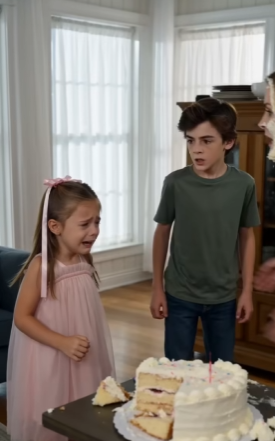
I caught her by the shoulders and shoved her back hard. She stumbled, hitting the hallway console table. A vase wobbled and crashed to the hardwood floor, shattering into dozens of ceramic shards.
The party guests were in a full panic now. Two of the neighborhood moms were herding their own children toward the back sliding glass door.
“Call 911!” I shouted over my shoulder to anyone who was listening. “Tell them there’s a hostile vehicle outside and an attempted kidnapping!”
“No!” Sarah shrieked. She looked utterly deranged, her hair matted with cake, her eyes wide with a frantic, animalistic panic. “No police! David, please, you don’t understand the people we are dealing with!”
I looked through the peephole.
A man in a dark grey suit was walking up my driveway. He didn’t look like a doctor, and he didn’t look like a confused driver. He moved with a cold, calculated efficiency, his eyes scanning the windows of my house. He reached into his jacket pocket and pulled out a heavy black smartphone, tapping the screen before raising it to his ear.
Instantly, a phone began buzzing from inside Sarah’s dress pocket.
She froze. The ringing seemed louder than the police sirens that I could now hear wailing faintly in the distance. Someone in the kitchen had already made the call.
The man on my porch stopped. He tilted his head, listening to the approaching sirens. Without a single change in his expression, he turned around, walked briskly back to the tinted SUV, climbed inside, and threw it into reverse. The tires squealed against the asphalt as the vehicle shot out of my driveway and sped down the suburban street, disappearing around the corner long before the first squad car turned into our subdivision.
I backed away from the door, my chest heaving. The immediate physical threat was gone, but the nightmare inside my house was just beginning.
I turned to look at my wife.
The absolute terror that had gripped Sarah’s face only seconds ago was melting away. As the red and blue flashing lights began sweeping across our living room windows, I watched her entire demeanor shift. Her breathing slowed. Her shoulders dropped. She reached up and smeared the frosting further down her cheek, purposefully messing up her hair, transforming herself from a trapped predator into a battered victim.
“What are you doing?” I asked, my voice dangerously low.
“I’m surviving, David,” she whispered coldly.
Two police officers came through the front door a moment later, finding a chaotic scene. A dozen terrified guests. A smashed vase on the floor. A woman covered in cake, crying hysterically by the stairs. And me, standing over an open suitcase filled with documents.
“Officers, please!” Sarah sobbed, her voice trembling perfectly. She stumbled toward the taller of the two cops, a female sergeant, holding her hands up in surrender. “He’s lost his mind! My stepson attacked me, and my husband is having a paranoid breakdown! He’s trying to lock us in the house!”
“Hold on, ma’am, take a breath,” the sergeant said, stepping between us and putting a hand on her radio. The male officer moved toward me, his hand resting cautiously on his utility belt.
“She’s lying,” I said, keeping my voice as calm and steady as humanly possible. I knew exactly how this looked. I was the angry husband shouting; she was the crying wife. “Officer, look at this suitcase. Look at the passports. She put a hospital wristband on my seven-year-old daughter with a fake name and tried to smuggle her out of the house into a waiting vehicle.”
The male officer looked down at the pink rolling bag. He saw the medical files. He saw the blue passport sitting on top. He reached down and picked it up, flipping it open.
His brow furrowed. He looked at the photo, then looked up at me.
“That’s my daughter,” I said. “Her name is Mia. The passport says Chloe Vance.”
The officer turned to Sarah. “Ma’am? Care to explain this?”
Sarah didn’t miss a beat. She let out a ragged, heartbreaking sob, burying her face in her hands. “It’s a prop!” she cried out. “It’s a stupid, terrible prop! David and I have been fighting for months. Mia has a chronic kidney condition, and David refuses to accept it. He’s in complete denial. I signed her up for an experimental clinical trial in Canada, and I was going to take her there myself because he won’t let her get medical care!”
I stared at her in absolute disbelief. “Mia does not have a kidney condition! She is perfectly healthy!”
“He’s delusional!” Sarah wailed, clutching the sergeant’s arm. “He won’t let her see real doctors! I had to use a pseudonym to register her for the trial so he wouldn’t cancel the appointments! The passport is a fake I bought online just so we could get across the border to the clinic. I was desperate to save my little girl!”
It was a masterclass in manipulation. It was so specific, so layered with fake medical jargon and maternal desperation, that the officers hesitated.
“Sir, does your daughter have a medical condition?” the male officer asked me, his tone shifting from suspicious to cautious.
“No!” I shouted, losing my temper for a fraction of a second before forcing it back down. “Call her pediatrician. Call the school. She is perfectly fine! This woman was packing a lockbox and a burner phone, and there was a man in an SUV waiting to take her.”
The officers spent the next hour separating us. They interviewed the guests, who could only confirm that Leo pushed Sarah into the cake and I stopped her from leaving. They hadn’t seen the SUV closely enough to get a plate.
When the male officer finally pulled me into the kitchen, his expression was grim.
“Mr. Vance,” he said quietly. “Here’s where we’re at. Your wife produced a notarized medical power of attorney giving her authority to make health decisions for Mia. She also produced an email chain with a clinic in Toronto discussing a pediatric trial for a ‘Chloe Vance.’ Now, the fake passport is a federal issue, and I’ve confiscated it. But as for domestic kidnapping? She’s your legal wife. Without a court order, she has a right to travel with her stepdaughter. This is a family court nightmare, not a street crime.”
“She was going to sell my daughter,” I said, the horrific realization finally solidifying in my chest.
The officer sighed. “I can’t arrest her for a custody dispute disguised as medical care. But I am ordering her to leave the premises for the night to de-escalate. We will file a report, and child protective services will follow up on Monday. Do not let the child out of your sight.”
I watched from the window as Sarah packed a duffel bag. She didn’t look scared anymore. The police escorted her to her car. Before she opened the driver’s door, she looked back at the house, making direct eye contact with me through the living room glass.