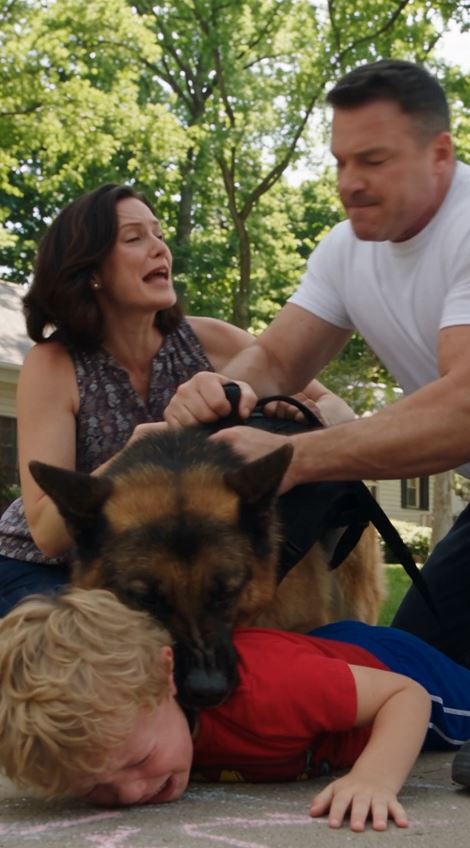
Harold Bennick had lived on Maple Street for thirty-one years, and in all that time nothing worse had happened than a stolen garden gnome and a squabble over a property line. Then, four months ago, someone had tried his back door at two in the morning while his wife was in the hospital with pneumonia, and Harold — sixty-six years old, alone in a dark house, heart going like a jackhammer — had lain awake until sunrise deciding he would never feel that helpless again. He'd bought a pistol the following week. He'd told no one, not even his wife once she came home, because he knew exactly what she'd say.
He heard Ethan's scream through his kitchen window and was out his front door before he'd finished the thought that something was wrong.
What he saw, jogging up the sidewalk with his heart already pounding, was a scene assembled entirely out of nightmare: a small boy pinned under a large dog, a mother clawing at the animal's harness, a father shouting a name that clearly wasn't working, and blood — Harold was almost sure he saw blood, though later he would not be able to say where, exactly, he thought he'd seen it — smeared across a sidewalk that had, an hour ago, only had chalk on it.
He did not see the hedge. He did not see the man crouched behind it, still as a photograph, waiting for the crowd to thicken so he could slip away in the confusion he himself had nearly caused. Harold saw only a dog killing a child in broad daylight, and thirty-one years of quiet suburban life collapsed into a single, roaring certainty: somebody has to stop this, right now, and I am the only one close enough.
His hand was already on the grip tucked into his waistband before he consciously decided to draw it. He'd practiced at the range exactly four times since buying it. He had never once pointed it at anything living.
"MOVE!" Harold's voice came out higher than he meant it to, cracking on the single syllable. "Get back — get your hands away from it, I've got a shot—"
Mia turned, and for the first time in the entire nightmare, real horror crossed her face — not for her son, but for her dog. "NO! Harold, don't, you'll hit Ethan, DON'T—"
But Harold wasn't looking at Ethan anymore. Terror does strange things to a person's vision; it narrows the world down to the one threat that seems solvable, and to Harold, in that moment, the pistol in his hand felt like the only solvable thing left. He raised it, arm shaking, sight wobbling across fur and fabric and a small red sneaker, and somewhere behind the boxwood hedge, the man who had caused all of this held perfectly still and allowed himself, for the first time in six minutes, a small and terrible smile.