Shadows over the Red Rocks: The Cowboy, the Chief’s Daughter, and the Map That Foretold Their Destiny.
The spring of 1873 softened the Arizona Territory for only a few precious weeks. Wildflowers—crimson monkey-flowers, golden poppies, and pale desert lilies—appeared between the jagged red rocks. Cottonwoods brightened the canyon floors in ribbons of translucent green, and cool winds moved through valleys usually punished by stifling dust and brutal summer heat.
Hidden beyond one of those winding sandstone valleys stood an Apache village led by Chief Whitehawk. It was a place of sanctuary, shielded by towering bluffs that kept out the wind and, for the most part, the encroaching shadows of the changing West.
That spring, an extraordinary gathering had drawn families from distant camps. Whitehawk’s only daughter, Ayana, was ready to choose the man she wished to marry.
The decision belonged entirely to her. In Whitehawk’s camp, no warrior could claim a chief’s daughter because of mere reputation, family influence, or sheer physical strength. Ayana would choose for herself, guided by her own mind and spirit.
Word had spread across the surrounding country like wildfire across dry brush. Soon, more than one hundred warriors had arrived. Some were exceptional hunters who could track a deer across bare limestone; others were respected horsemen who rode as if born in the saddle; several had earned widespread admiration for protecting their families during dangerous skirmishes along the border. Each man held a quiet hope that Ayana might see something in him worthy of sharing a life.
On the morning of the gathering, cooking fires burned throughout the sprawling village, sending plumes of sweet cedar smoke into the clear azure sky. Families formed a wide, eager circle around the central open ground. Chief Whitehawk sat beside several respected elders, his face a carved mask of quiet wisdom. Ayana remained nearby, serene and calm beneath the intense attention of hundreds of watchful eyes.
One by one, the men stepped forward to display their virtues. A young warrior named Kaelen demonstrated astonishing control of his mount, weaving through a impossibly narrow stretch between sharp rocks at a full gallop.
Ayana offered him a polite nod of thanks. Then, gently, she shook her head.
Another warrior, famed for his marksmanship, struck distant wooden targets with remarkable accuracy, his arrows whistling through the breeze to split the heart of each mark.
Again, Ayana declined with a quiet bow.
A third warrior spoke passionately about protecting the children and elders during a treacherous winter journey through the Mogollon Rim. The surrounding crowd murmured in warm approval.
Still, Ayana answered no.
Morning became afternoon. Ten men were rejected. Then twenty. Forty. Seventy. By late afternoon, as shadows began to stretch long and thin across the red earth, the number had passed one hundred.
Uncertainty rippled through the gathering. Nobody understood what the young woman was seeking. Even Whitehawk’s stoic expression grew thoughtful, his brow furrowing slightly as he looked at his daughter. Yet he never pressured her. The choice remained hers alone.
Part II: The Uninvited Stranger
Far beyond the high cliffs framing the village, twenty-eight-year-old Ethan Walker knew nothing about Ayana, Chief Whitehawk, or the tense ceremony unfolding in the canyon.
Ethan was a cowboy from a modest cattle ranch situated north of Tucson. He was a man of few words, built lean and tough from years of hard labor under the southwestern sun. He had spent nearly a week driving livestock toward a northern trading post when one of his strongest pack horses—a dependable bay—bolted into the scrub after being frightened by a sudden, rattling strike of a diamondback.
Leaving the rest of his trail outfit secured, Ethan had pursued the runaway mount immediately. The trail had led him across dry washes, through narrow canyons, and into entirely unfamiliar country. Hours later, exhausted, thirsty, and frustrated, Ethan spotted a thin trail of blue smoke rising beyond a grove of vibrant cottonwoods.
Hoping someone there might have spotted his bay, he approached cautiously, leading his tired trail horse by the reins. He stepped through the brush—and froze.
Dozens upon dozens of people were staring directly at him. The ambient chatter died instantly. Several young warriors immediately shifted their posture, hands dropping toward knife hilts and bows.
Ethan realized instantly that he had crossed an unseen boundary and entered a place where he was not invited. He stopped dead in his tracks. Slowly, deliberately, he removed his sweat-stained Stetson and raised his empty hands, keeping his movements smooth and unthreatening.
“I’m sorry,” Ethan said, his voice husky from dust. “I’m looking for a runaway horse. I didn’t mean to interrupt anything.”
Nobody answered. The silence was heavy, almost suffocating.
“I can leave,” Ethan added softly, taking a small half-step back.
Chief Whitehawk studied the intruder from across the central ring. The stranger was covered in a thick layer of yellow road dust. His leather boots were scuffed and worn down at the heels. His canvas shirt had been mended more than once with coarse thread. There was absolutely nothing impressive or grand about his appearance.
But Whitehawk noted what was not there: The man had not reached for the Colt revolver at his hip. He had not demanded answers. He had apologized before even understanding the nature of the gathering he had interrupted.
Whitehawk finally offered a single, measured nod. The stranger could remain at the edge of the circle.
Ethan took a slow breath, stepped beneath the cool shade of a broad cottonwood tree, and waited quietly, holding his horse’s reins.
The ceremony resumed, though an uneasy edge now hung in the air. The final warriors came forward as the evening sunlight turned the towering sandstone cliffs from orange to fiery gold. Each man brought something admirable—gifts of fine furs, tales of valor, promises of prosperity.
Ayana declined every single one.
Whispers spread like dry leaves in the wind. Perhaps the chief’s daughter desired no husband at all. Perhaps no living man could satisfy whatever quiet standard she held in her heart.
Ethan watched from the periphery, understanding almost nothing of the spoken dialect, sensing only that some weighty, ancient tradition was drawing to its close.
Then, Ayana stood up.
Every voice in the arena ceased instantly.
She walked slowly across the open, dusty ground. For a brief moment, her dark eyes swept past the long line of rejected suitors who had spent the day vying for her favor. Then she turned her body toward the edge of the grove.
Toward Ethan.
The cowboy blinked, looking reflexively behind himself, convinced she was staring at some hunter standing in the shadow of the trees. There was nobody behind him.
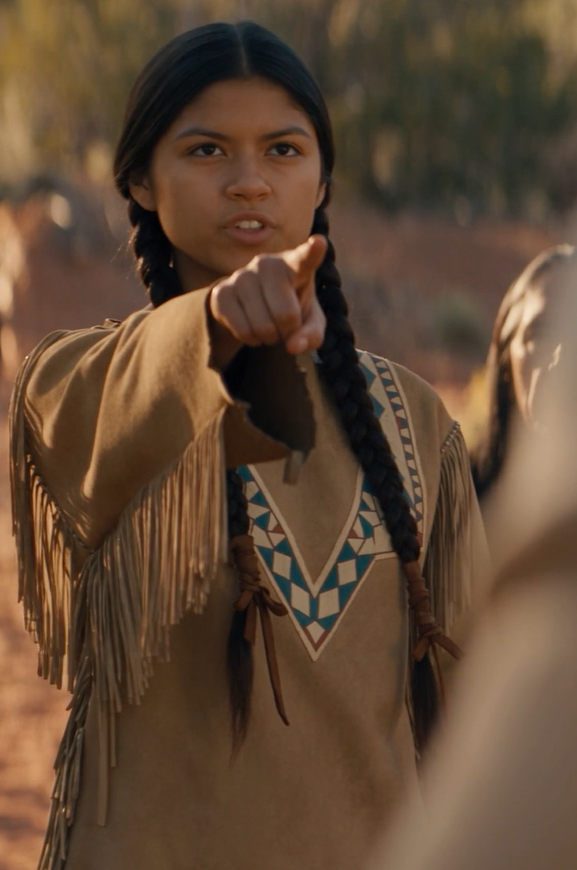
Ayana raised her hand and pointed her index finger straight at his chest.
“I want him.”
Part III: The Question That Silenced the Village
A silence fell over the valley so absolute that the rustle of the cottonwood leaves sounded like breaking glass.
Ethan nearly dropped his hat. Several young warriors stepped forward, staring at the dust-covered cowboy in utter, burning disbelief. Chief Whitehawk’s face revealed nothing, though his dark eyes narrowed slightly.
Ethan swallowed hard, his throat dry. “I’m sorry?” he stammered.