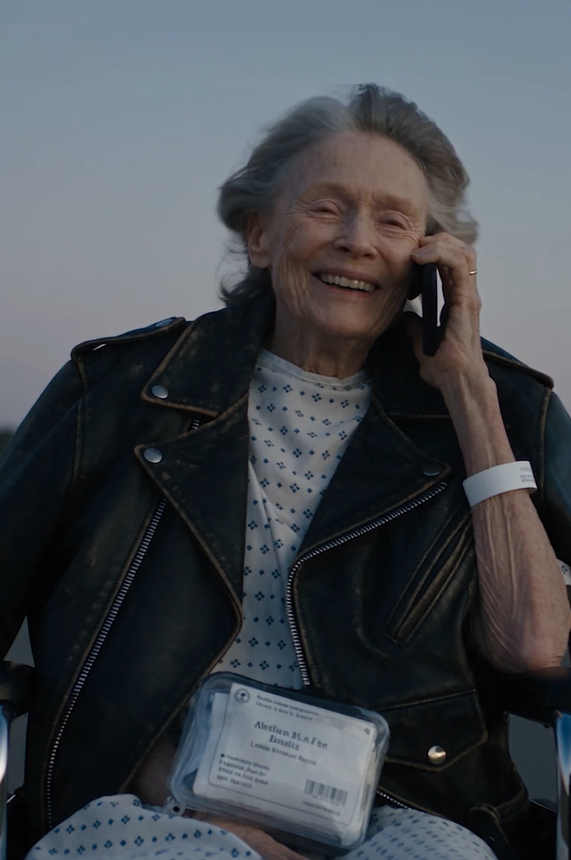
She stopped laughing the day she got her diagnosis. That was two years ago. I hadn't heard her really laugh since.
She was in room 412 at the county hospital. Stage four pancreatic cancer. Three weeks into what the doctors said would be her last stay. The chemo was done. Surgery wasn't an option. All that was left was managing pain and waiting.
She hated it. Every minute.
My mother was not a woman who waited. She rode on the back of a Harley for forty years. Married a biker at nineteen. Raised three kids in a house that always smelled like motor oil and leather. When my dad died nine years ago, something in her dimmed. When the cancer came, whatever was left went out.
By the end, she wasn't my mother anymore. Just a small gray woman in a hospital gown who stared at the TV and asked what time it was. I visited every day. Brought flowers. Books. Her favorite soup. She'd smile and say thank you. But her eyes were already somewhere else.
Then at 3:22 AM on a Tuesday, my phone rang. MOM.
I grabbed it. Heart pounding. This is the call. The one I've been dreading.
"Mom?"
Laughing. My mother was laughing.
"Sarah! Baby! I'm on a bike!"
"What? Mom, what are you talking about?"
"I'm on Ray's bike! We're on the highway!"
She held the phone out. The sound hit me like a wall. Motorcycle engines. Wind. Freedom. And my mother screaming with joy and then she said: "Your father's club, baby. They came for me. Walked right into the hospital and took me."
"They WHAT?"
"Eight of them. Ray came into my room and said 'Marie, Frank would kill us if we let you die in this bed. Get up. We're going for a ride.'"
Frank. My father. Dead nine years and his brothers still remembered.
"Mom, you have an IV. A central line—"
"They brought Linda. She's a nurse, remember? She's riding behind Gus with my medication bag."
They'd planned this. These crazy, beautiful bikers had planned a hospital extraction for my dying mother.
"I'm wearing your father's jacket," she said. Her voice dropped low. "I can smell him, Sarah. In the leather. After all these years."
Then she started crying. Not sad crying. The kind that happens when something beautiful breaks you open.
"I'm alive," she whispered. "For the first time in two years, I feel alive."
I sank to my kitchen floor and didn't know whether to call the police or not. Then I asked her: "Mom, where are you going? Where are they taking you?"
"To the coast, Sarah," she shouted over the roar of the V-twin engine. "We’re going to see the sunrise over the Atlantic. Just like your father and I did the summer we met. Don't worry about the doctors, honey. I’m finally home."
I stayed on the floor, the cold tile pressing against my knees, listening to the symphony of the road. I could hear Ray shouting jokes in the background, the rhythmic thrum of eight Harleys cutting through the night air, and my mother’s breath—shallow, yes, but stronger than it had been in months.
I didn't call the police. I didn't call the hospital. I sat there in the dark and waited.
Four hours later, my phone pinged. It was a photo.
It was grainy and overexposed, captured in the weak, purple light of dawn. My mother was sitting on the back of Ray’s Heritage Softail, the ocean spray misting her hair. She looked tiny in my father’s oversized leather jacket, but her face—it was radiant. She wasn't a patient anymore. She was Marie. She was the woman who had lived a thousand lives on two wheels.
She was leaning her head back, eyes closed, catching the first golden rays of the sun. In the background, the "brothers" stood like weathered gargoyles, their chrome gleaming, their presence a silent, iron-clad promise kept to a dead friend.
I got a call from the hospital administrator at 8:00 AM, frantic and threatening legal action. I let him talk until he ran out of breath. Then I told him, "She’s not a missing person. She’s exactly where she belongs."
They brought her back two days later.
They didn't sneak in this time. They rode right up to the main entrance, a thunderous procession that brought the hospital staff to the windows. Ray carried her inside. She looked exhausted, her skin almost translucent, but the light in her eyes hadn't gone out.
She passed away forty-eight hours later in room 412.
But she didn't die staring at a flickering TV or asking what time it was. She died with the scent of sea salt still in her hair and the lingering smell of my father’s leather jacket on her skin.
At her funeral, the front three rows weren't filled with people in black suits. They were filled with bearded men in denim and leather. Ray stood up to speak, his hands shaking as he held a small, weathered photograph.
"Frank told us once that the road doesn't have an end," Ray said, his voice thick. "It just turns into something else. We just wanted to make sure Marie had a good headstart."
As they lowered her casket, I didn't hear the silence of the cemetery. I closed my eyes and heard the roar of the engines, the rush of the wind, and my mother’s laugh—loud, wild, and finally, completely free.
.
.
Please follow us if you like this story 💫🙏💕