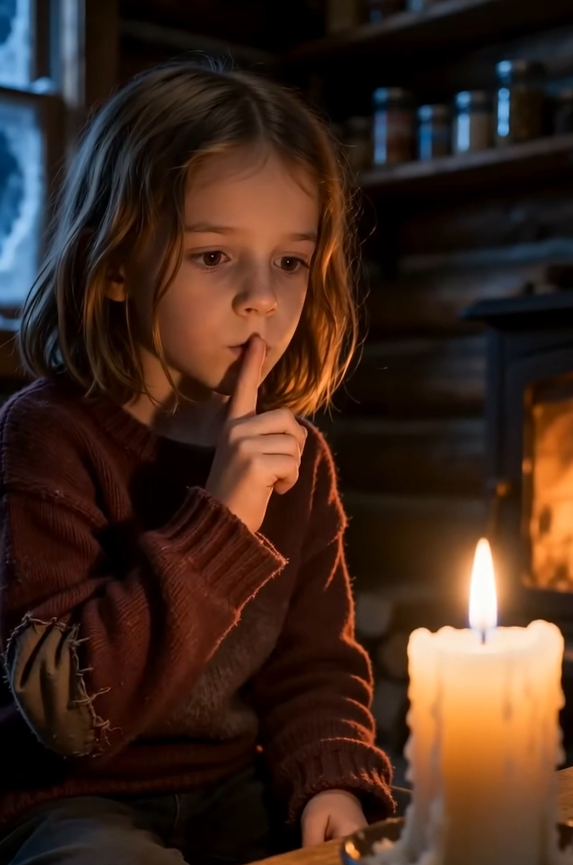
SHE TOLD SIX FROZEN BIKERS TO FOLLOW HER INTO THE BLIZZARD – THEN 150 RIDERS LEARNED WHY
The first thing Ryder Callahan saw through the blizzard was not a cabin, not a road sign, and not salvation.
It was a candle.
A single trembling flame burned in the white dark where no flame should have survived.
The mountain had already taken his Harley.
The storm had already swallowed the road.
His five brothers were behind him with dead engines, frozen hands, and the grim silence of men who understood when weather had stopped being weather and had become a verdict.
They were seventeen miles from the nearest town.
They had no working phones.
They had three damaged bikes, six exhausted bodies, and one brutal truth pressing down on all of them.
If they stayed on that shoulder much longer, the snow would cover them before morning.
Then the candle moved.
Not far.
Just enough to prove it was being carried by someone.
Ryder narrowed his eyes against the ice cutting across his face.
At first, he thought his mind had finally started inventing things.
Men did that in storms.
They saw lights where there were no lights.
They heard voices in the wind.
They mistook fear for instinct and instinct for hope.
But Tommy Briggs, who almost never spoke unless the world had left him no choice, lifted one gloved hand and pointed through the trees.
“Light,” he said.
That one word changed everything.
Ryder looked again.
The glow came from somewhere above the road, maybe a quarter mile up the slope, flickering behind thick trees and snowfall.
Too warm for a vehicle.
Too uneven for electricity.
Too alive to ignore.
Church stood beside him, collar iced white, beard stiff from frozen breath.
His real name was Charles William Beaumont, but nobody had used that name in decades.
He studied the slope with the expression of a man deciding whether hope was worth the risk.
“Cabin, maybe,” Jake Moreno said.
“Maybe empty,” Earl Hutchins muttered.
Ryder looked back at the road, but there was no road anymore.
Only a pale wound through the mountain, already closing.
Behind them, their Harleys sat crooked in the snow like animals that had tried to stand and failed.
Marco Vega had already found the truth in the fuel lines.
Not cold damage.
Tool marks.
Someone had touched their bikes before the storm.
Someone had cracked fittings, loosened seals, and created small failures designed to become fatal at exactly the wrong place and time.
It was sabotage.
Not a prank.
Not theft.
Not random.
The kind of precise damage done by a hand that expected the mountain to finish the job.
Ryder did not say that aloud again.
He did not need to.
Every man there had heard Marco say it once, and once was enough.
The storm shoved Ryder sideways.
Snow hammered the side of his face.
The little flame ahead wavered and held.
“We walk,” Ryder said.
No one argued.
They climbed single file through snow that swallowed their boots and burned their lungs.
Ryder broke the trail because Ryder always broke the trail.
He had done it in places hotter than this and uglier than this, though he was not sure any of those places had felt lonelier.
The pines bent around them.
The wind moved between the trunks like something searching.
Marco fell once, and Earl hauled him upright without a word.
Tommy kept turning his head toward the road behind them, watching the dark with the instincts of a man who had learned never to trust the place he had just left.
By the time they reached the porch, Marco’s fingers had gone beyond pain into a numb silence Ryder knew too well.
The cabin was smaller than expected.
One room.
Crooked roofline.
Uneven corners.
Hand-built, not professionally built.
The kind of place made by someone who had more love than tools.
A woodpile sat under a tarp that had half collapsed under snow.
The window was covered except for one narrow slit of orange light.
Ryder stepped onto the porch and knocked three times.
Not loud.
A loud knock in the middle of nowhere sounded too much like a threat.
He stepped back so whoever was inside could see he was not trying to force his way in.
Behind him, the other five men stood in leather, snow, and silence.
No matter how carefully they held themselves, six bikers on a lonely porch in a blizzard looked like trouble.
For a moment, nothing moved.
Then soft footsteps crossed the floor inside.
Small footsteps.
Ryder felt the realization before the voice came.
“How many of you are there?”
The voice belonged to a child.
Clear.
Calm.
Not frightened.
That made it worse.
Ryder swallowed.
“Six,” he said.
“Are any of you hurt?”
“Not yet.”
He forced the words out evenly.
“We will be if we stay out here.”
A pause followed.
Ryder heard a latch shift.
Then the child’s voice came again.
“I’m going to open the door.”
Another pause.
“Don’t come in fast.”
Ryder stared at the door.
“You’ll scare the fire,” she said.
The door opened.
She stood there holding the candle in both hands.
Eight years old, though Ryder would not learn the exact number until later.
Brown hair.
Dark eyes.
A wool sweater with a hole in one elbow.
Boots too large for her feet.
A face too composed for a child standing alone in a mountain cabin while six strange men froze on her porch.
She looked from Ryder to Church, then to Earl, Marco, Tommy, and Jake.
Her gaze moved like she was counting supplies, not strangers.
Then she said the sentence that would stay with Ryder longer than the storm.
“You’re going to die out here unless you come inside.”
So they came inside.
The warmth hit them like mercy.
The cabin was one room with a sleeping loft, a fireplace, a small stove, four mismatched chairs, shelves stacked with canned food, and a hand-drawn calendar on the wall.
The floorboards were worn smooth between the door, the stove, and the table.
Everything had a place.
Everything looked used, measured, rationed.
Nothing in that cabin felt accidental.
The girl closed the door, slid the bolt, and turned immediately to Marco.
“Your hands are frostbitten,” she said.
Marco blinked as if he had been accused.
The girl pointed to a chair.
“Sit there.”
Marco looked at Ryder.
Ryder gave him nothing.
Marco sat.
The girl soaked a cloth in lukewarm water near the stove, wrung it out, and wrapped his hands with careful pressure.
“Don’t warm them fast,” she said.
“That makes it worse.”
Marco was a mechanic who had argued grown men into silence over the wrong oil grade.
He looked at this tiny child wrapping his fingers and said only, “Okay.”
Ryder watched her work.
No panic.
No wasted motion.
No childish uncertainty.
She had done this before, or something close enough to it that she had learned the difference between helping and harming.
Church stood near the shelves.
His eyes moved over the cans.
Labels out.
Older cans in front.
Newer cans behind.
A rationing system.