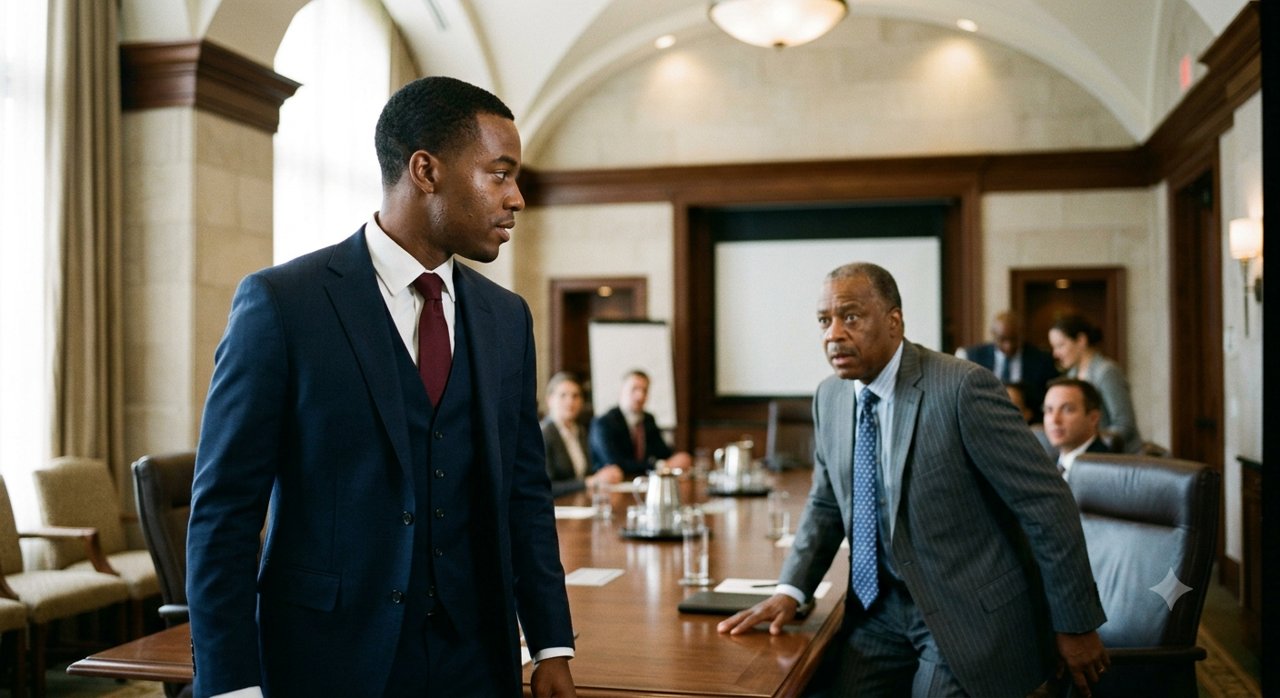
Patrick's office was on the fourteenth floor of a building that looked different at ten-thirty at night — the lobby half-lit, the security desk staffed by a single guard who checked her ID twice before letting her through.
Patrick was waiting by the elevator.
He looked like a man who had not expected his evening to go this way.
"Tell me what they filed," she said before the elevator doors had fully closed.
"Fraud," he said.
"Specifically, marital asset fraud and financial misrepresentation during the marriage."
"That's a civil matter."
"The fraud charge isn't."
She looked at him.
"They referred the case to the financial crimes unit," he said.
"Diane Marsh filed a supporting complaint on behalf of her client this afternoon.
The photographs, the transfer records, the investment account — all of it went with the filing."
"This afternoon," she said.
"While I was sitting in that living room."
"Yes."
The elevator opened.
She followed him down the corridor to his office.
The city spread out behind the windows, indifferent and bright.
"Sit down," he said.
She sat.
He opened his own folder on the desk between them.
"The gap you found in the records.
I need you to tell me exactly what happened in those three weeks."
"I moved funds.
Smaller amounts.
Through a third account."
"Whose account?"
She didn't answer immediately.
"Whose account?" he asked again.
"A friend's.
Someone I trusted."
"Does this friend know their account was used?"
She looked at the window.
"I need you to answer that question," Patrick said.
"No," she said.
"They didn't know."
Patrick leaned back in his chair.
He took off his glasses and set them on the desk.
That gesture, she realized, meant something.
She had seen lawyers take off their glasses before.
It never meant anything good.
"Then we have a third party who can be called as a witness," he said.
"And when they're called, they will tell the truth, because they have no reason not to.
And the truth will close the gap you thought you found."
She stared at the folder.
"I want to be honest with you," Patrick said.
"Not as your lawyer right now.
As someone who has been in this room with a lot of people over a lot of years.
The question is no longer whether they have enough.
They have enough.
The question is what you do with what comes next."
"What comes next," she repeated.
"They will offer you an opportunity to cooperate.
They almost always do at this stage.
It will come with conditions.
It will not feel fair.
But it will be better than the alternative."
She looked up at him.
"You're telling me to give up."
"I'm telling you to be realistic."
"There has to be something—"
"There was something," he said quietly.
"There were several somethings.
But the window for those closed some time ago." He paused.
"How long have you known this marriage wasn't working?"
She didn't answer.
"Because from what I can see in this documentation, they started building their case approximately one month after your wedding.
Which means they saw it before you finished planning it."
The room was very quiet.
"He knew," she said.
Not a question.
"He knew enough," Patrick said.
"And he waited.
And he was patient.
And now here we are."
She stood up.
She walked to the window.
Below her, the city moved in its ordinary nighttime rhythms — taxis, lit windows, a couple walking a dog on the pavement far below.
"What do I do?" she asked.
"Tomorrow morning," Patrick said, "I'm going to call Diane Marsh.
And we're going to find out what cooperation looks like."
She pressed her forehead lightly against the cold glass.
Behind her, she heard Patrick close the folder.
"There's one more thing," he said.
"The woman in the photograph.
The one from your wedding reception.
They know who he is.
And they've already spoken to him."
Her reflection looked back at her from the dark glass.
She barely recognized it.