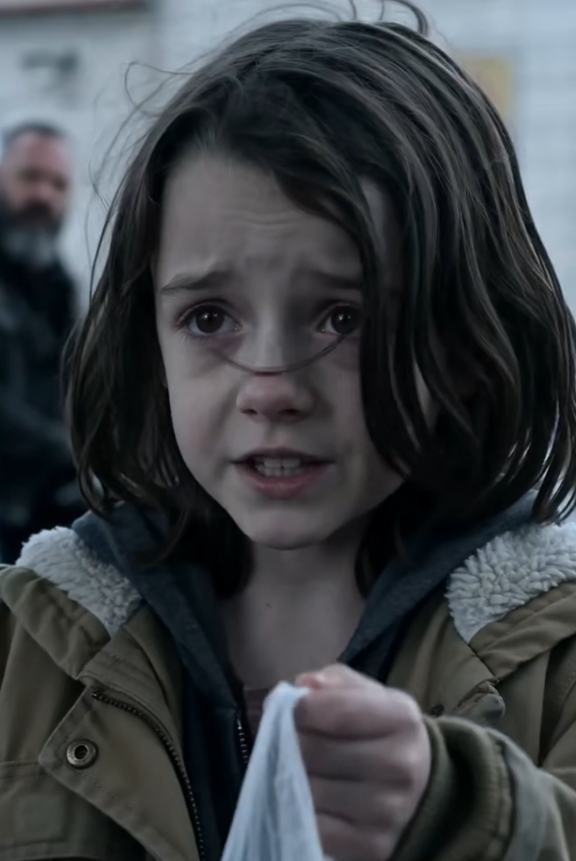
“SIR… DO YOU HAVE ANY FOOD?” A BAREFOOT GIRL ASKED A BIKER – THEN HIS CREW EXPOSED THE CHARITY THAT STARVED HER
The little girl should have been afraid of them.
Seven motorcycles had just rolled into the dying gas station on Route 9, loud enough to shake the windows and make every adult nearby pretend they suddenly had somewhere else to be.
But she did not run.
She stood barefoot on the frozen concrete, clutching an empty plastic bag like it still had some kind of purpose.
Her coat was too big, her hair was tangled, and her lips had turned pale from the cold.
Then she walked straight toward the biggest rider in the group.
He was a broad-shouldered man with weathered eyes, a scar cutting down toward his jaw, and a black leather cut that made strangers cross streets without realizing they had done it.
The girl looked up at him.
“Sir… do you have any food?”
The biker stared down at her.
The crew went silent.
The wind moved across the lot, cruel and sharp, lifting the edges of the empty bag in her small hands.
The man crouched so he was level with her.
He had spent years making peace with people fearing him before they knew him.
But this child did not look at him like he was dangerous.
She looked at him like he might be the last door left in a hallway of locked ones.
“You hungry?” he asked.
“Not for me,” she said quickly.
The answer came too fast, like she had rehearsed it.
“For my mom.”
The biker did not move.
The girl swallowed.
“She has not woken up.”
The name of the gas station was Sunridge Convenience Mart, though nothing about it felt sunny anymore.
The lottery sign out front was missing letters.
Two fuel pumps were wrapped in caution tape.
Inside, the coffee tasted like punishment, and the owner, Gus, kept the place open mostly because retirement had turned out to be lonelier than he expected.
Nobody stopped there unless they were running low on gas or options.
That afternoon, Cade Mercer and the Black Lantern crew were low on gas.
They had been riding for hours under a sky the color of old ash.
Delfield had not seen real sunlight in eleven days, and the cold had settled into the town like a bad decision nobody could undo.
By three in the afternoon, the temperature was sitting near twenty-two degrees.
The highway wind came across the lot with a bite in it.
Cade had just started filling his tank when he noticed the girl pressed between the ice machine and the side wall of the building.
She was small, maybe seven or eight.
Too thin.
Too still.
Too watchful.
Her sneakers were cheap canvas, soaked at the edges and useless against the cold.
She had no hat.
No gloves.
And that empty plastic bag.
At first, Cade only watched her from the corner of his eye.
He had seen that look before.
Not here.
Not in a gas station parking lot.
But somewhere dry and dusty and far away, in a place where children learned early that adults were not always rescue.
It was the look of someone who had already decided to do something dangerous, and was only waiting for the nerve to arrive.
Then she pushed away from the wall.
She walked toward him.
Every man in the crew noticed, even the ones pretending not to.
Darryl, Cade’s second, paused with his hand on the gas nozzle.
Fenwick stopped halfway to the store door.
Mack shifted his weight and looked from the girl to Cade.
Nobody spoke.
The girl stopped about six feet away.
Close enough to be heard.
Far enough to run.
“Excuse me,” she said.
Her voice was steady.
That was the part that cut deepest.
Cade looked down at her.
“Yeah?”
“Do you have any food?”
He asked if she was hungry.
She said it was for her mother.
Then she said her mother had not woken up.
“How long?” Cade asked.
“Since this morning.”
“Did you go in there?” he asked, nodding toward the convenience store.
The girl’s fingers tightened around the handles of the empty bag.
“He said he would call the police.”
Cade waited.
“I do not want police,” she added.
Her voice did not crack, but something behind it did.
“Last time they came, they took…”
She stopped herself.
She reset her face with a control no child should have needed.
“I just need food.”
Cade studied her.
“What is your name?”
“Laya.”
“I am Cade.”
She nodded as if introductions were simply another necessary step.
“How far is your place?”
She pointed down the side street beside the gas station.
“Maybe four minutes.”
“You walked here by yourself?”
“Yes.”
“In this cold?”
“Yes.”
Cade stood.
He removed the nozzle from his tank, hung it back on the pump, and looked at his crew.
Nobody asked what they were doing.
Darryl was already heading to his bike for the medical kit.
Mack was unstrapping a grocery bag from his rear rack.
Fenwick had turned away from the store.
Trace and Bishop were scanning the street in quiet habit, men who had learned long ago that trouble often announced itself by pretending not to be there.
Cade looked back at the little girl.
“Lead us.”
For one second, Laya hesitated.
Trust had clearly cost her before.
Then she turned and started walking.
Seven bikers followed a child through the streets of Delfield.
They did not ride.
They walked their machines beside them, engines low and rumbling, a slow metal procession moving past cracked sidewalks, bare trees, and houses where curtains shifted in windows.
A man standing on his porch saw them coming, looked once at Laya, then at the bikers, and went inside.
Two boys on bicycles pedaled away hard in the opposite direction.
Laya did not look back.
She led them three blocks east and one block south to a tired four-story apartment building with weeds growing through the parking lot cracks.
The front door did not close all the way.
The intercom panel had missing buttons.
The elevator was out.
Laya headed to the stairs like that was not worth mentioning.
Third floor.
Apartment 311.
The door was unlocked.
Inside, the cold hit Cade before anything else.
It was not the cold of a room where the heat had been turned down.
It was the kind of cold that meant the walls themselves had given up.
The window in the main room had a crack patched with old tape.
A mattress lay on the floor in the corner, piled high with blankets.
A folding table stood near the kitchen.
One chair had a leg repaired with electrical tape.
A small shelf held a few books, a stuffed bear, and a plastic cup with three crayons.
On the mattress, beneath the blankets, lay a woman.
She was young, maybe thirty, but hardship had put years on her face.
Her hair spread across a folded jacket that served as a pillow.
Her skin had a grayness Cade recognized before he wanted to.
She was breathing.
That was the first fact.