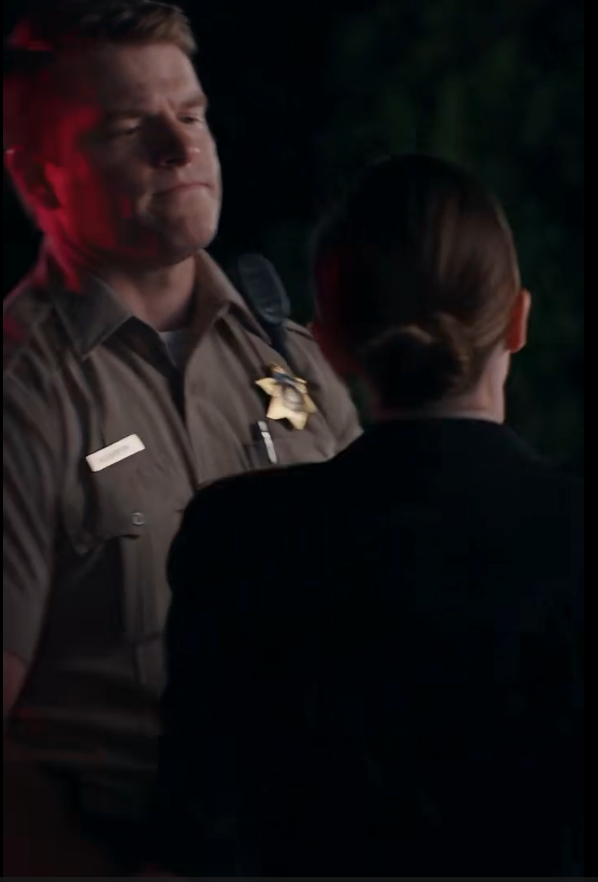
Chapter 16
Three weeks later, Officer Dylan Mercer appeared in federal court.
He looked smaller without the uniform.
Police Chief Voss sat two rows behind him.
Lieutenant General Hendricks was held separately under national-security procedures.
Elias Grant had begun negotiating.
Apparently men who spend their lives building secret networks become remarkably cooperative when confronted with the possibility of dying in prison.
Aaron Pike resigned from the Riverton Police Department.
He also testified.
His notebook contained sixteen vehicle numbers connected to suspicious stops.
Those records became part of the largest military procurement corruption investigation in decades.
General Rainer resurfaced forty-eight hours after Grant’s arrest.
He had gone exactly where my father said he would.
I learned the rest two months later.
My father had lived under six identities.
Three countries.
Two government protection programs.
He had worked secretly with a small counterintelligence team attempting to identify Grant.
He had never contacted us because every attempt risked exposure.
I understood the logic.
I did not forgive the cost.
Not immediately.
Maybe not completely.
Some wounds are too deep for dramatic reunions.
When we finally met, it happened in a secure house outside Washington.
No cameras.
No ceremony.
No flags.
I walked into a small living room.
An old man stood beside a window.
He had my father’s eyes.
But time had changed everything else.
His hair was white.
His shoulders were narrower.
A scar ran beneath his jaw.
He looked at me as if he were afraid I might disappear.
I stopped several feet away.
Neither of us spoke.
Then he saluted.
My breath caught.
He said, “Captain Carter.”
I almost broke.
“Dad.”
His salute trembled.
I crossed the room.
For seventeen years I had imagined what I would say if I could speak to him one more time.
I had planned speeches in my head without realizing it.
I would tell him about my deployments.
My first command.
My mistakes.
The soldiers I lost.
The medals I never cared about.
The night I nearly resigned.
The day I decided not to.
But when I finally stood in front of him, I said none of those things.
I hit him.
Not hard.
A fist against his chest.
Then again.
“You were dead.”
“I know.”
Another hit.
“You were dead.”
“I know.”
Then I was crying.
So was he.
And for the first time since I was eleven years old, my father held me.
“I’m sorry,” he whispered.
I believed him.
That did not make everything okay.
But it was a beginning.
Epilogue
Six months after the traffic stop, I returned to Riverton.
Not for revenge.
Not for a court hearing.
Not for an investigation.
The police department had invited me to speak to a new academy class.
I nearly declined.
Then Pike called.
“You should come.”
“Why?”
“Because Mercer isn’t the whole department.”
He was right.
Systems fail when good people stay silent.
They recover when good people stop doing that.
So I went.
I stood before thirty-one recruits in a plain Army uniform.
No medals.
No ceremonial jacket.
No dramatic entrance.
I told them exactly what happened.
I told them about the stop.
The insults.
The handcuffs.
The phone call.
I told them how a patrol officer’s arrogance exposed a seventeen-year conspiracy.
Then I told them something they did not expect.
“This story is not about hating police.”
The room was silent.
“It is about what happens when authority stops accepting accountability.”
I looked across the faces.
“A uniform does not make you honorable. A badge does not make you right. Rank does not make you trustworthy. What matters is what you do when nobody has enough power to force you to behave correctly.”
Near the back, Aaron Pike stood in civilian clothes.
He had entered federal investigator training.
He looked uncomfortable when I noticed him.
Good.
Some guilt should remain uncomfortable.
Afterward, a recruit approached.
“Captain?”
“Yes?”
“Can I ask something?”
“Sure.”
“What happened to Officer Mercer?”
I looked toward the windows.
Rain had begun falling outside.
“He pleaded guilty.”
“How much time?”
“Enough to understand consequences.”
The recruit nodded.
Then asked, “What happened to the general?”
“Hendricks?”
“Yes.”
“Prison.”
“And Director Grant?”
“Waiting for trial.”
He hesitated.
“What about your dad?”
I smiled faintly.
“He’s learning how to be alive again.”
The recruit looked confused.
I did not explain.
I left the academy at sunset.
My car was parked outside.
Different vehicle.
Different road.
Different life.
Before getting inside, I noticed a man leaning against a dark sedan across the parking lot.
My father.
He had insisted on coming.
Officially, he was still restricted from appearing publicly.
Unofficially, he had become terrible at following instructions.
I walked over.
“You’re not supposed to be here.”
“I was told the same thing about your promotion ceremony.”
I stopped.
“What?”
He smiled.
“I watched.”
My chest tightened.
“You were there?”
“Across the street.”
I stared at him.
“You saw me get promoted?”
“Yes.”
“Why didn’t you tell me?”
“I’m telling you now.”
I shook my head.
“You are unbelievably irritating.”
“So your mother says.”
We started walking toward the car.
Then he stopped.
“There’s something else.”
I sighed.
“There is always something else with this family.”
He reached into his coat and handed me a small envelope.
Cream-colored.
My name written across the front.
I stared at it.
“Where did you get this?”
“Rainer.”
My pulse changed.
“The original?”
“No.”
“What is it?”
“Something he intended to give you after Grant was caught.”
I opened it.
Inside was a single sheet.
One paragraph.
Naomi,
If you are reading this, then Marcus was right about one last thing. You were never selected for Project Aegis because of your promotion.
You were selected before the ceremony.
I looked at my father.
“What does that mean?”
He nodded toward the letter.
I kept reading.
Your record qualified you, but your identity made you uniquely valuable. Carter Protocol was designed to preserve evidence.
Project Aegis was designed to preserve people.
And its first operational commander has already been chosen.
Below the paragraph was an appointment order.
My name.
My rank.
A classified command designation.
And a date.
The date was six months before the traffic stop.
I stared at it.
“They chose me before any of this happened?”
My father nodded.
“Who chose me?”
He smiled.
“I did.”
I looked up so quickly my neck hurt.
“You?”
“Yes.”
“You were part of Aegis?”
“I created the first version.”
My mouth opened.
Nothing came out.
He looked toward the road.
“For seventeen years, I stayed dead because I thought hiding was the only way to protect you.”
His eyes returned to mine.
“I was wrong.”
The sunset caught the edge of his face.
“The next system shouldn’t hide people from danger.”
He tapped the paper.
“It should make sure danger can’t hide from them.”
I looked again at the appointment order.
At the signature line.
There were three signatures.
General Rainer.
Adrian Vale.
And the third:
Marcus Carter.
My father had selected me six months before the worst night of my life.
Not because he knew I would be targeted.
Not because he wanted to use me as bait.
Because after seventeen years of watching from shadows, he believed I had become the one person capable of finishing what he started.
I folded the paper.
“So the traffic stop really was an accident?”
He smiled sadly.
“Not an accident.”
“A trap?”
“Yes.”
“For me?”
“No.”
I frowned.
He looked back toward the academy.
“For Grant.”
I froze.
“What?”
“Rainer leaked your Aegis selection intentionally.”
My stomach dropped.
“He knew they would target me.”
“He believed they would watch you.”
“They handcuffed me.”
“He never expected Mercer.”
“You’re saying my promotion—”
“Was real.”
“The envelope?”
“Real.”
“The leak?”
“Deliberate.”
I stared at him.
Anger and disbelief collided.
“You used me.”
“No.”
“You just said—”
“We gave Grant a piece of information.”
“A piece of information about me.”
“Yes.”
“You knew he would act.”
“We hoped he would expose himself.”
“And you didn’t warn me.”
“If we warned you, Grant would have known.”
I stepped back.
For several seconds I could not speak.
Then I understood the final piece.
The one nobody had told me.
Carter Protocol had not merely reacted to my traffic stop.
Someone had been waiting for it.
Not Grant.
My father.
Rainer.
Vale.
The honest side of the investigation had spent years trying to make Grant move.
And the night I drove home wearing newly pinned captain’s bars, he finally did.
The stop had been real.
Mercer’s hatred had been real.
The danger had been real.
But the larger board had been set months earlier.
My father watched my face carefully.
“I told them one condition.”
“What?”
“If you were ever in genuine danger, the operation ended immediately.”
I laughed bitterly.
“Excellent system.”
“I know.”
“You owe me seventeen years and one terrible night.”
“I know.”
“That’s a large debt.”
“I have time.”
I looked at him.
An old man who had once been a ghost.
A father I had mourned.
A soldier who had disappeared to keep a family alive.
A man who had made terrible choices for reasons I understood more than I wanted to.
Finally, I opened the passenger door.
“You’re buying dinner.”
He smiled.
“Fair.”
“And you’re telling Mom everything.”
His smile disappeared.
“That seems excessive.”
“Get in the car.”
“Yes, Captain.”
I started the engine.
For a moment, neither of us moved.
Then I looked at the road ahead.
Six months earlier, six hateful words had turned an ordinary drive into a federal incident.
They exposed corrupt officers.
Destroyed a criminal network.
Reopened my father’s death.
Returned him to my life.
And placed a new future in my hands.
Mercer had believed he was humiliating a woman he could control.
Grant had believed he was watching a trap close around me.
Neither man understood the truth.
The trap had never been designed for me.
My father fastened his seat belt.
I shifted into drive.
And as we pulled away from Riverton, I finally understood why Carter Protocol carried our name.
It was never about power.
It was never about rank.
It was never about revenge.
It was built for the moment when someone in authority decides the truth can be erased—and discovers, far too late, that someone was already watching.