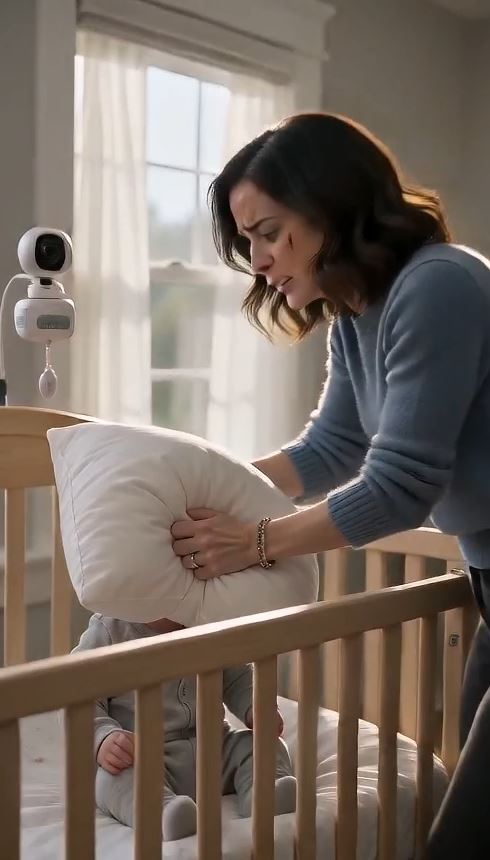
Three years after I ran into the nursery and found a pillow over my baby brother’s face, I was twenty.
Leo was almost four.
Dad was forty-four.
Grandpa was sixty-three.
Valerie was forty-two.
The nursery incident no longer controlled every day.
That took time.
For the first year, any baby-monitor notification made Dad jump.
Even after we changed systems.
Any loud thump upstairs made Grandpa stand.
I hated wooden table lamps.
Ridiculous.
Not the lamp’s fault.
Eventually objects became objects again.
The replacement lamp was metal.
Not because we feared weapons.
Because Dad liked it.
That distinction mattered.
The baseball bat went back to the garage after police released it.
I nearly threw it away.
Then kept it.
At twenty, I played in a casual college game with it.
My friend asked:
“Why are you staring at that thing?”
I said:
“Long story.”
Then hit badly.
Normal object.
New use.
The baby monitor recordings remained in the case archive.
We did not keep copies on family phones.
No one needed instant access to the worst night of our lives.
Dad retained necessary legal copies through counsel.
Evidence is not a family video.
Grandpa completed probation.
His misdemeanor case closed according to the plea.
He finished anger management.
He claimed he learned nothing.
Then demonstrated the opposite repeatedly.
At a family barbecue, a drunk cousin shoved another man.
Old Grandpa would have inserted himself physically.
New Grandpa called security at the venue.
I noticed.
He noticed me noticing.
“Don’t.”
I smiled.
No speech.
He had changed enough.
My own use of force that night was reviewed and deemed justified under defense-of-others principles.
For months, people called me a hero.
I hated it.
I had been terrified.
I grabbed what was closest.
I hit once.
Then got my brother.
Bravery sometimes looks impressive only after terror is edited out.
What mattered to me was not the lamp.
It was the next move.
I went to Leo.
Rescue before revenge.
That distinction stayed.
Dad changed too.
He stopped treating conflict as something to smooth over.
If a caregiver canceled a medical appointment:
Why?
If someone described an accommodation as excessive:
Explain.
If a professional raised concern about family safety:
Document.
Investigate.
Do not panic.
Do not dismiss.
The family became more comfortable with uncomfortable questions.
Ironically, that made us calmer.
Leo’s visual impairment remained.
No miracle surgery.
No sudden sight.
He could perceive light.
Some contrast.
Large movement close to him.
His functional vision varied with lighting and fatigue.
He learned through other senses.
His hearing became a tool, not a superpower.
We refused to turn disability into magic.
He was good at some things.
Bad at others.
At almost four, he could identify everyone in the family by footsteps.
Except Grandpa when Grandpa wore new shoes.
That caused an argument.
“Who?”
“Grandpa.”
“No.”
“Yes.”
“Wrong shoes.”
Grandpa looked personally betrayed.
Leo touched his trousers.
Then watch.
“Grandpa.”
“See?”
Dad said:
“He literally had to verify you.”
Grandpa ignored him.
Leo liked music.
Hated mashed potatoes.
Loved elevators.
Feared dogs that barked without warning.
Could navigate our downstairs hallway with his cane.
Still walked directly into the couch occasionally when someone moved it.
We learned:
Do not move the couch casually.
Guests thought this was restrictive.
It was information.
The location helped him map space.
When furniture had to change, we taught him the new layout.
No tragedy.
No inspiration speech.
Accessibility was mostly planning.
Dad dated again eventually.
Not quickly.
Her name was Rachel Foster.
She met me first.
Then Grandpa.
That may have been unfair.
If she survived Grandpa, she earned the next stage.
Leo met her after eight months.
She approached him.
Then remembered the rule.
Stopped several feet away.
“Hi, Leo. I’m Rachel.”
Leo tilted his head.
“You Dad friend?”
Rachel laughed.
“Yes.”
He reached toward her voice.
She let him choose the distance.
Small thing.
Huge difference.
Dad did not ask Rachel to become Leo’s mother.
Nobody filled vacancies that way anymore.
Valerie existed.
Complicated.
Restricted.
Real.
Rachel could become whatever relationship naturally formed.
At twenty, I understood something about the story Valerie had tried to build around me.
She had wanted professionals to see me as reckless.
Immature.
Potentially dangerous.
Part of that was manipulation.
Part of it borrowed credibility from something true.
I was seventeen.
I had been in a school fight.
I got irritated.
I left laundry everywhere.
I drove too fast.
I was not a saint.
That did not make her allegations true.
A person can have flaws without being guilty of the flaw someone assigns them.
That lesson helped me later in college.
Someone criticizes you.
Do not ask only:
Am I imperfect?
Of course.
Ask:
Is this specific claim true?
Valerie had counted on everyone blurring those questions.
The monitor separated them.
Video did not show:
perfect Evan.
It showed:
Evan enters.
Sees danger.
Intervenes.
Rescues baby.
Gets attacked.
Shields baby.
Facts.
That was enough.
Leo eventually learned about the camera in a simple way.
At almost four he asked why there was a photograph of the old nursery in Dad’s legal folder.
Dad answered:
“When you were a baby, someone hurt you in that room.”
“Who?”
“Your mom Valerie.”
Leo knew the name vaguely.
“Why?”
“We don’t know every reason.”
“Ev there?”
“Yes.”
“Grandpa?”
“Yes.”
“Dad?”
“I came after.”
Leo thought.
“Camera?”
“Yes.”
“Camera saw?”
“Yes.”
He nodded.
Then asked for crackers.
That was enough at four.
Truth does not have to arrive all at once.
It only has to stop being lied about.
Years later he could ask more.
We would answer.
No surprise revelations.
No one would wait until he was seventeen and hand him a box marked:
THE WORST NIGHT OF YOUR LIFE.
He deserved gradual ownership of his own story.
Dad once asked me:
“Do you wish the monitor hadn’t recorded?”
I understood why.
The footage was terrible.
But without it, we still had injuries.
Witnesses.
My statement.
Grandpa.
Physical evidence.
Valerie’s own words.
The case would not have vanished.
Still, the recording ended certain arguments before they began.
I said:
“No.”
Dad nodded.
“Me neither.”
Then he added:
“I hate that sentence.”
So did I.
The camera saved us from ambiguity.
It did not save Leo.
People did.
Technology documented.
Human action protected.
Important distinction.
Three years after the attack, we removed the baby monitor mount entirely.
Leo was almost four.
No crib.
No need for that camera.
Dad stood on a ladder.
Unscrewed the bracket.
I held the screws.
Grandpa stood beneath us giving useless advice.
“You’re stripping it.”
“I’m not.”
“You are.”
“Mark.”
“I’m just saying.”
Leo sat on the floor listening.
“What doing?”
“Taking down old camera.”
“Why?”
“You don’t need it.”
He considered.
“Can keep screw?”
Why?
Nobody knew.
“Yes.”
Dad handed him one large safe mounting cap instead of the tiny screw.
Leo held it.
Turned it in his fingers.
Then put it in his toy truck.
History immediately demoted to cargo.
Dad patched the holes.
Painted over them.
Not to erase.
Because walls need paint after hardware comes down.
When he finished, there was no mark.
Grandpa looked.
“Crooked.”
“The wall?”
“The paint.”
“You cannot have crooked paint.”
“You managed.”
I started laughing.
Dad threw the roller cover at him.
It missed.
Everyone laughed.
Leo heard us.
“Again.”
“No.”
“Again!”
Dad picked up the dry roller cover.
Tossed it gently at Grandpa.
Grandpa caught it.
Leo laughed harder.
A room that once held screaming now held a ridiculous family throwing painting supplies.
That was not redemption.
Rooms do not need redemption.
We did.
That evening Leo walked from his bedroom into the hallway.
Cane tapping lightly.
Tap.
Sweep.
Tap.
He reached the corner.
Paused.
“Ev?”
I was sitting at the top of the stairs.
“Here.”
His whole face brightened.
He moved toward my voice.
Three years earlier, he had grabbed my shirt because he was terrified and could not see who held him.
Now he knew.
Not because the world had become perfectly safe.
It never would.
Because he had learned the sound of people who returned.
Dad.
Grandpa.
Me.
The specialists who kept appointments.
Teachers who announced themselves.
Friends who learned not to grab.
A family rebuilt not around pretending danger never happened, but around predictability after it did.
Leo reached me.
Held out one hand.
I took it.
“Downstairs?”
“Yep.”
“Crackers?”
“Obviously.”
We started down.
Slow enough for him.
Not because he was weak.
Because stairs deserve attention when you cannot see them clearly.
Halfway down he stopped.
“Ev.”
“What?”
“You stay?”
I knew what he meant.
Not forever.
Not sacrifice college.
Not become his parent.
Just:
Are you here right now?
“Yeah.”
He squeezed my hand once.
Then kept walking.
That was all.
The End