Part I — The Line
The officer’s hand stopped six inches from my briefcase.
That distance was the only thing separating four hundred jobs from a security protocol designed to erase the most valuable data my company owned.
“Don’t touch it,” I said.
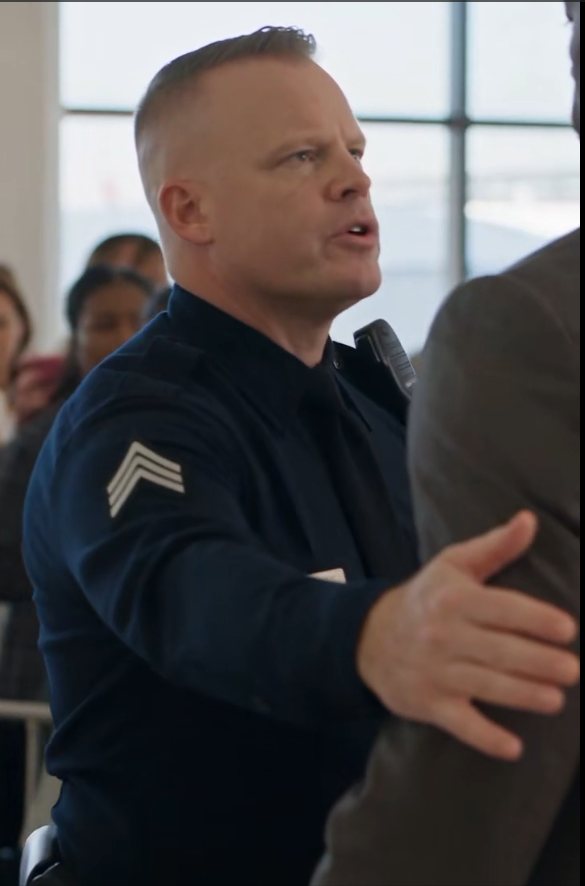
Officer Davies looked at me as though I had just confirmed whatever suspicion he had already decided to believe.
Behind him, the gate agent stood beside the boarding scanner, one hand frozen above the keyboard. Beyond the glass, Flight 427 waited at the jet bridge. Passengers had started moving around us in that careful way people do when they want to watch trouble without admitting they are watching.
Davies glanced toward the leather case in my right hand.
“Open the bag.”
“No.”
His eyebrows moved slightly.
I kept my voice level.
“It has already cleared TSA screening. I’m not consenting to another search.”
A man in a gray suit waiting behind me lowered his phone from his ear. Two passengers near the windows turned fully toward us. The gate agent looked from Davies to me.
The final boarding announcement had not yet sounded, but the numbers in my head were already running.
3:15 p.m.
Flight 427.
Seat 1A.
San Francisco.
Vanguard Logistics.
Four hundred and twelve employees.
The formal server cutoff was 8:00 p.m. Pacific, but that number was misleading. The integrity verification and authentication handshake could take close to two hours under load. I had less than five hours to get the sealed drive connected to Vanguard’s mainframe if I wanted any margin at all.
Fifteen years of work had been compressed into a hard drive inside a cedar-scented briefcase.
The drive held our final source-code repository, cryptographic signing credentials, and the digital authorizations necessary to block a hostile takeover that had been constructed with enough legal sophistication to look harmless until it was almost complete.
If the package did not reach our servers in time, the equity firm trying to acquire Vanguard could exercise provisions that would shift voting control before our board could stop them.
People would call it a transaction.
My employees would call it losing their retirement accounts.
Davies stepped closer.
“I’m giving you a lawful order.”
“No,” I said. “You’re giving me an order. Those aren’t automatically the same thing.”
The gate agent inhaled quietly.
Davies noticed.
His face changed.
Not dramatically. That was what made it worse. His mouth tightened, and the conversational part of the encounter disappeared.
“ID.”
I handed him my driver’s license again even though he had already looked at it.
He studied the photograph.
Then my face.
Then the photograph.
“Marcus Hayes.”
“Yes.”
“Chicago address.”
“Yes.”
“First class to San Francisco.”
I looked at him.
“That’s what the boarding pass says.”
He turned the license over.
“Purpose of travel?”
“Business.”
“What kind of business?”
I could feel the old reflex rising in me—the urge to over-explain so a man with authority would have fewer excuses to misunderstand me.
I had learned that reflex at seventeen.
Detroit.
Cold rain.
My cheek against the roof of a police cruiser while an officer kept asking why I was walking through my own neighborhood at night.
Matched a description.
They had used that phrase three times.
No apology when they let me go.
No report I ever saw.
My grandfather had picked me up afterward. He had not shouted. He had not threatened lawsuits. He had driven home with both hands steady on the steering wheel.
At a stoplight, he had tapped the Omega Seamaster on his wrist.
“You keep time,” he had said. “Don’t let somebody else keep your dignity.”
Years later, when he died, the watch became mine.
Now it sat beneath the cuff of a Tom Ford suit that cost more than my grandfather had earned in months when he first bought it.
Davies handed back my license.
“What kind of business?”
“I’m the founder and CEO of Vanguard Logistics.”
Something close to amusement passed over his face.
“Sure.”
The word landed harder than if he had called me a liar.
I could hear phones coming out around us.
Not many.
Enough.
I slipped my license into my wallet.
“You can verify that in thirty seconds.”
“I’m not interested in Google.”
“You asked.”
“I asked what was in the bag.”
“And I answered.”
“Proprietary technology.”
“Yes.”
“Source code?”
I paused.
That had not been the phrase I used.
Davies noticed the pause and leaned into it.
“So there is electronic material in there.”
“There is nothing illegal in this briefcase.”
“Then you shouldn’t have a problem opening it.”
The logic was familiar because it was designed to sound reasonable.
I looked at his nameplate.
DAVIES.
Then at the body camera on his chest.
“Officer Davies, am I being detained?”
Several heads turned at the question.
His jaw shifted.
“I’m conducting an investigation.”
“That wasn’t my question.”
The gate agent took a half step toward us.
“Officer, his boarding pass scanned as valid. I can confirm—”
Davies held up a hand without looking at her.
“Stay out of this.”
She stopped.
I saw embarrassment move across her face and then disappear beneath professional training.
Davies looked at me again.
“You’re not boarding that aircraft until I know what’s in the bag.”
“The bag cleared federal screening.”
“I don’t care.”
“I do.”
He moved closer.
Peppermint gum.
Coffee.
The faint synthetic smell of his uniform shirt.
“Last chance, Hayes.”
His hand drifted toward the restraints on his belt.
“Open it.”
I thought of the tamper seal beneath the case lining.
The drive itself could survive a fall, heat, water, and most attempts at physical intrusion. What it could not distinguish was intent. If the seal registered an unauthorized opening sequence without my biometric authorization, the encryption controller could initiate a destructive wipe.
No source code.
No signatures.
No second chance.
I tightened my fingers around the handle.
“I respectfully decline.”
Davies’s radio crackled.
Then the terminal speakers came alive.
“Final boarding call for Flight 427 to San Francisco.”
My watch read 3:18.
Davies reached for the briefcase.
I moved it behind my leg.
Not fast.
Not aggressively.
Just enough.
His expression hardened.
“Do not pull away from me.”
“You haven’t told me I’m under arrest.”
“I’m telling you now to put the bag on the ground.”
“On what basis?”
“You’re interfering with an investigation.”
“Into what?”
He stared at me.
For the first time, he had no immediate answer.
I heard someone behind us say, very quietly, “Wow.”
Davies looked toward the sound.
A passenger lowered his phone.
That was the moment the encounter changed.
Until then, Davies had seemed to believe the space around us belonged to him.
Now he realized it had witnesses.
“Put the bag down,” he repeated.
I looked at the gate agent.
“Please note the time.”
Her eyes met mine.
“Sir—”
“Please.”
She glanced at the monitor.
“Three nineteen.”
“Thank you.”
Davies grabbed my left forearm.
Not violently.
Firmly enough to make the choice for me.
“Turn around.”
I did not resist.
My briefcase remained in my right hand.
“What am I being arrested for?”