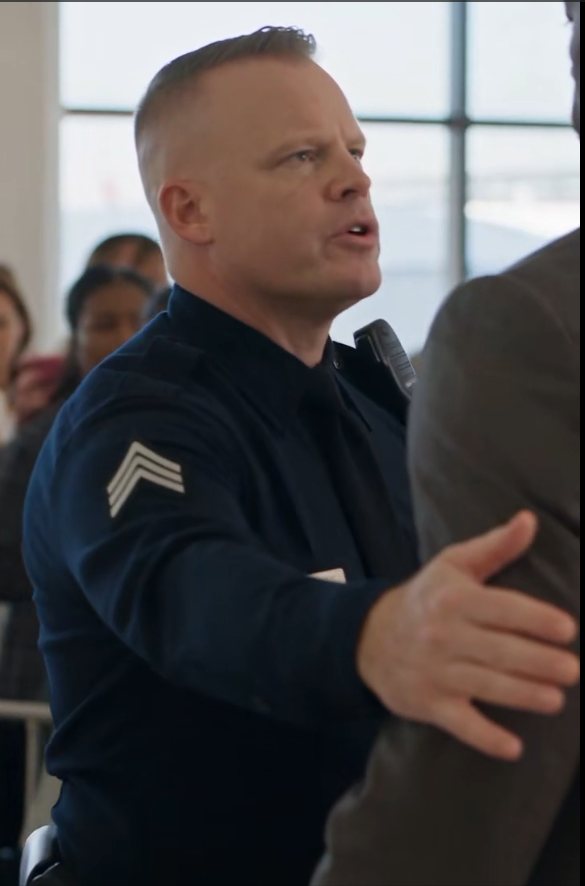
“No.”
I nodded.
“You’re right.”
That seemed to surprise him.
“I don’t.”
I looked toward the glass wall, where travelers continued past without knowing exactly what was happening inside.
“But I know what you did.”
The distinction mattered.
It kept me from making myself omniscient.
It left him nowhere to hide.
Davies’s shoulders lowered slightly.
“I made a mistake.”
I waited.
He looked at the floor.
“I should not have stopped you without a clearer basis.”
It was the first truthful sentence I had heard from him.
But it was incomplete.
“And the report?”
His jaw tightened again.
“I wrote it badly.”
“No.”
He looked up.
“You wrote something that wasn’t true.”
Parker finally spoke.
“Officer.”
He looked at her.
She did not need to say more.
Davies turned back to me.
“The statement was inaccurate.”
I nodded.
“That’s better.”
His face showed resentment.
Maybe shame.
Probably both.
I did not need him transformed.
Real people rarely transform because someone delivers the right speech.
“I’m sorry you missed your flight,” he said.
I looked at the screen.
Verification: 41%.
“That’s not the thing you need to be sorry for.”
His mouth tightened.
Parker stepped toward the door.
“That’s enough.”
Davies turned.
Before he reached the door, I said, “Officer Davies.”
He looked back.
I nodded toward the empty place on his shirt where the body camera had been.
“You were protected today by the same camera that protected me.”
He frowned.
“How?”
“If there had been no recording, this would be your word against mine.”
He looked at me for a long second.
Then left.
Parker stayed.
“You didn’t have to talk to him.”
“I know.”
“Why did you?”
I sat down.
“Because if this turns into a headline about a racist cop and a Black CEO, everyone will pick the part that confirms what they already think.”
“And what do you want them to pick?”
“The facts.”
Parker studied me.
“That may be optimistic.”
“No.”
I looked at the verification bar.
“It’s slower.”
She almost smiled.
“Fair.”
At 5:21, my lawyer called.
“Marcus, we have another problem.”
“Go.”
“The equity firm filed notice with the board claiming the delivery clause required successful authentication before 8:00 Pacific.”
“That was always the requirement.”
“They’re arguing the physical delay demonstrates Vanguard failed to maintain control of the credentials.”
“They know about the airport?”
“Everybody knows about the airport.”
“How?”
“Your name is trending.”
I closed my eyes.
Of course it was.
“What are they asking for?”
“Emergency board vote at seven thirty Pacific.”
“Before the cutoff?”
“Yes.”
“They want control before we can complete.”
“Exactly.”
“Can they?”
“They can try.”
“What do we need?”
“Verified signatures. Then I can seek an injunction if they move early.”
“Do it.”
“I can’t until verification finishes.”
I looked at the screen.
56%.
“Then be ready.”
I ended the call.
Parker had heard enough to understand.
“They’re using the delay.”
“Yes.”
“Can your company sue the department if the takeover succeeds?”
I looked at her.
“That isn’t the question.”
“It might be later.”
“If four hundred people lose their jobs, money from a lawsuit five years from now won’t put the same pensions back.”
Parker nodded.
The room returned to quiet.
Verification: 61%.
Then 62.
At 5:34, the screen flashed.
ERROR: INTEGRITY REVIEW REQUIRED.
My engineer swore.
I leaned forward.
“What happened?”
“Physical intrusion log.”
“The amber event.”
“Yes.”
“Can you clear it?”
“Not remotely.”
My mouth went dry.
“What does that mean?”
“It means the system is refusing final authentication because the drive registered a physical event before transfer.”
Claire whispered, “But the seal was intact.”
“I know,” the engineer said. “It doesn’t care. It saw abnormal pressure.”
I looked at the briefcase.
Davies’s hand.
The detention counter.
The latches.
“What clears it?”
A pause.
“Marcus.”
“What clears it?”
“Manual executive attestation.”
“Fine.”
“Not fine.”
“What?”
“It requires you to certify the physical chain of custody remained secure.”
I stared at the screen.
It had not.
The drive had left my possession.
It had been held by airport police.
If I certified uninterrupted personal custody, I would be lying.
If I refused, the system would not authenticate.
My lawyer joined the call.
“What’s going on?”
Engineering explained.
My lawyer went quiet.
Then he said, “Marcus, the case was in official custody the whole time.”
“That isn’t what the attestation says.”
“It asks whether the chain remained secure.”
“It asks whether authorized personnel maintained custody.”
“Airport police are authorized law enforcement.”
“Not authorized Vanguard personnel.”
He exhaled.
“Marcus.”
“No.”
“You’re not falsifying anything. You observed the seal intact.”
“I didn’t observe it while I was in the detention room.”
“Parker did.”
“She isn’t an authorized custodian.”
My lawyer lowered his voice.
“If you refuse the attestation, this may fail.”
I looked at Lieutenant Parker.
She understood before I said anything.
“You want me to document custody?”
“It won’t satisfy the system.”
“What will?”
“My certification.”
She looked at the screen.
“Can you truthfully certify that nobody opened it?”
“Yes.”
“Can you certify the seal remained intact?”
“Yes.”
“Then what is the problem?”
“The certification also says it remained under authorized control.”
“And it didn’t.”
My lawyer said, “Marcus, this is exactly the kind of technical language courts interpret reasonably.”
“That is what people say right before they ask you to sign something that does not mean what it says.”
“Four hundred jobs.”
“I know how many employees we have.”
“Then make the call.”
There it was.
Not the airport.
Not Davies.
Not the crowd.
Not the equity firm.
Me.
A box on a screen.
YES.
NO.
Had the drive remained under authorized control?
If I clicked yes, I might save Vanguard.
I might also preserve the company by making the first false certification of my career.
A lie could become discoverable later.
A board could use it.
A court could use it.
The equity firm could use it.
Even if nobody ever found out, I would know.
I touched my grandfather’s watch.
He had worked three jobs.
He had been denied loans without explanation.
He had bought a house on a street where neighbors took years to stop looking at him like an intruder.
He had never taught me that dignity meant winning.
He had taught me that it meant knowing what you refused to trade even when losing was expensive.
I clicked NO.
My lawyer cursed.
Claire looked at me.
Parker did not move.
The screen changed.
AUTHENTICATION DENIED.
For several seconds, nobody spoke.
Then my engineer said quietly, “There may be one more option.”
I looked at the screen.
“Tell me.”
Part V — The Choice
The option was ugly.
Which meant it was probably real.
The system could accept a compromised-chain transfer if an independent evidence log proved two things: the drive had not been opened, and every custody event from the moment it left my control to the moment it returned had been continuously recorded.
Parker understood immediately.
“Body camera.”
“Yes,” my engineer said through the speaker. “If the video is timestamped and cryptographically exportable.”
“It is.”
My lawyer came alive.
“Can that satisfy authentication?”