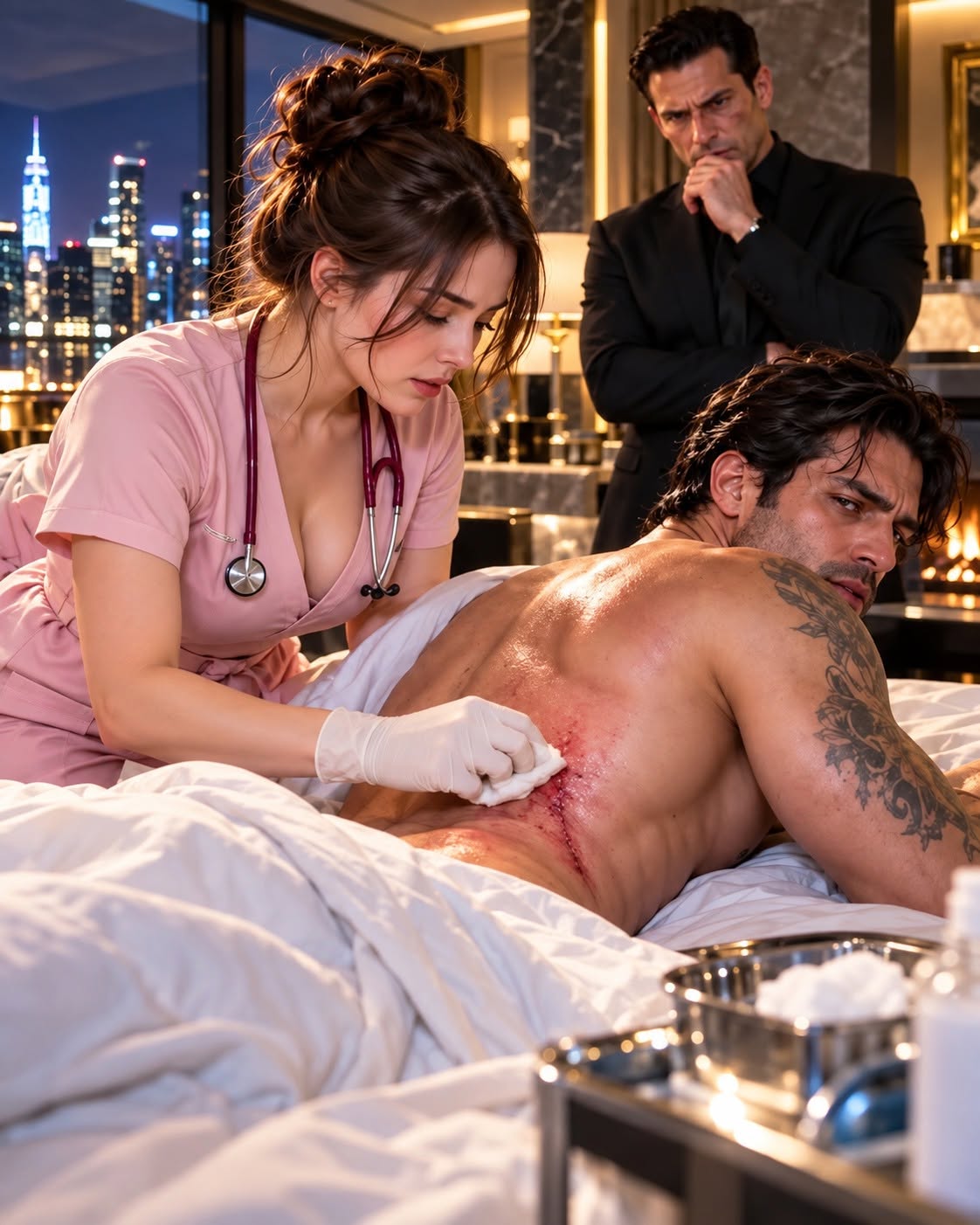
Luca Ferraro, the chief of security with a broken nose and the posture of a retired prizefighter, stood by the doorway with one hand tucked neatly beneath his tailored black jacket. He had warned me that Gabriel Moretti might attack me the very second he regained consciousness. He had warned me that the last nurse lasted nine hours, the one before her six, and that Moretti had once hurled an antique crystal lamp clean through a reinforced window because someone had dared to touch his shoulder while he slept.
I didn’t care. At thirty-six, I had spent enough years in high-trauma emergency rooms and chaotic private wards to know that terror was just a noise people made when they didn't know what else to do with their hands.
“You have five minutes to leave before he wakes up,” Luca repeated, his voice a low, gravelly rumble that was supposed to intimidate me.
I kept washing my hands at the wet bar sink, letting the scalding water run over my knuckles until the skin turned pink. “Your security perimeter is leaking, your ventilation is trapped in a loop of stale air, and your patient is septic. If you want me out, you should have hired someone incompetent.”
The departing nurse rushed past me, giving me a look that hovered somewhere between pity and sheer horror. “Good luck. You’re going to need a miracle.”
The elevator doors chimed, swallowing her up and descending into the depths of the building, leaving me alone with Luca and a dying mafia kingpin.
“I offered to double her pay,” Luca muttered, his eyes narrowing as he watched me dry my hands with a crisp paper towel.
“Triple mine,” I replied evenly, turning to face him. “Though you won't have to spend a dime if he expires in the next twenty minutes.”
Before Luca could formulate a scathing retort, a low, guttural growl vibrated from the king-sized bed in the center of the sprawling master suite.
Gabriel Moretti was awake.
Photographs and intelligence dossiers in police briefings never quite captured the sheer physical presence of a man like Gabriel. At thirty-nine, he was powerfully built, possessing a broad, imposing frame, scarred knuckles, and jet-black hair plastered to his forehead by fever sweat. He looked less like a patient and more like a cornered wolf—battered, bleeding, but terrifyingly lethal even on the brink of collapse.
His eyes snapped open. They were the color of cold river slate, clouded by delirium yet instantly sharp enough to pin me to the spot.
Before I could take a single step forward, his hand shot out across the sheets with blinding speed. His fingers locked around my wrist like a steel vise, the pressure instantly bruising my skin.
Luca’s hand twitched beneath his jacket, his weapon half-clearing leather.
“Don’t,” I snapped, my voice dropping into a register of absolute, unyielding calm.
Gabriel didn’t blink. His grip tightened until the bones in my wrist ground against each other. “Who sent you?” he rasped, his voice raw and torn from days of fever.
“My agency.”
“Who?”
“Midwest Private Care.”
“You’re lying.”
“You’re delirious, Mr. Moretti. And if you break my radius, you won't have anyone left to check your IV.”
Confusion momentarily pierced the dark fog of his fever. His fingers dug deeper before loosening just a fraction. “You smell like antiseptic.”
“I’m a nurse. It would be deeply concerning if I smelled like gasoline.”
The sheer audacity of my tone seemed to short-circuit his brain for a second. “Listen to me very carefully,” I continued, leaning in just enough to meet his fever-bright gaze without flinching. “Your pulse is sitting at a dangerous 140 beats per minute, your oxygen saturation is plummeting, and your body temperature is currently cooking whatever rational judgment you have left. You can crush my wrist, or you can give me ten minutes to figure out why you’re slowly dying in a room full of expensive furniture.”
Something flickered in the dark depths of his slate-colored eyes. It wasn't trust—men like Gabriel Moretti didn't know the meaning of the word—but it was a sharp, calculating curiosity.
Slowly, deliberately, his fingers uncurled from my wrist.
Luca let out a slow, audible breath he had been holding. “He... he usually doesn’t let go.”
“Everybody lets go eventually,” I said, stepping past him toward the IV pole and the monitor banks.
I checked his oxygen saturation. Eighty-six percent. Dangerously low. I adjusted the flow valve on the nasal cannula, but before the oxygen could properly flood his system, Gabriel suddenly winced, his entire body arching off the mattress in a spasm of pure agony.
“My back,” he hissed through clenched teeth.
“Your shoulder?” I asked, referencing the official wound report.
“My back.”
“Where?”
“Lower.”
Luca frowned from the doorway, stepping closer despite his hesitation. “He’s complained about that area since the clinic.”
I froze, my hands hovering inches above Gabriel’s hospital gown. “What clinic?”
“The private surgical center downtown. Dr. Adrian Vale removed the bullet fragment three weeks ago after the ambush at the restaurant.”
My mind raced back to the initial intake notes provided by the agency. The official narrative was simple: Gabriel Moretti had been ambushed outside a private dining club, a single bullet had entered near his left shoulder blade, passed cleanly through soft tissue without hitting bone or major vessels, and he had been discharged the same night.
So why was he paralyzed from the waist down? Why was he septic?
“The report says the bullet passed through,” I said sharply, my eyes darting between Luca and the patient.
Luca hesitated, shifting his weight from one foot to the other—a subtle tell that he was hiding something vital. “A fragment remained near the wound. Dr. Vale went back in two weeks ago to extract it.”
My stomach dropped like an elevator losing its cables. I remembered scanning the family tree in the background dossier. Gabriel’s younger cousin, Vincent Moretti, was the one who had arranged the private surgical center, managed the medical staff, and insisted on keeping Gabriel away from public hospitals.
“I need to examine the surgical site,” I said, reaching for the edge of the blanket. “Roll him onto his side.”
Luca took a sharp step backward, his face hardening into an expression of absolute refusal. “No.”
“What do you mean, no? He’s developing systemic shock. If there’s an infection or internal bleeding—'
“Nobody touches his back,” Luca interrupted, his voice dropping into a lethal warning.
I looked down at Gabriel. Even through the suffocating haze of his fever and pain, something profoundly human and terrifying flickered across his face—fear. A cold, stark terror that didn't belong on the face of a Chicago mafia boss.
“Why?” I demanded, looking straight at Luca.
Neither man answered. The silence in the penthouse grew deafening, broken only by the rhythmic, mechanical beep of the cardiac monitor.
Deciding that my license and my patient's life mattered infinitely more than their underground paranoia, I slipped my hands carefully beneath Gabriel’s broad shoulders and hips, ignoring Luca’s warning hiss, and gently rolled him onto his right side.
That was when the horrifying truth was laid bare under the harsh overhead exam light.
There wasn't one surgical scar on his back.
There were two.
The primary scar from the initial gunshot wound sat high near his left scapula, clean and healing. But several inches lower, situated directly over the lumbar spine near the lower thoracic vertebrae, was a second, smaller, jagged incision. It had been recently stitched, but the skin around the edges was already angry, swollen, and leaking a dark, foul-smelling fluid.
That location had nothing to do with a stray bullet fragment. No projectile had entered there.
My breath caught in my throat. My medical training screamed at the impossible horror of what I was looking at. Someone had performed a deep-tissue spinal procedure on Gabriel Moretti while he was sedated—an operation designed not to heal, but to cripple.
I looked up at Luca, whose face had instantly drained of all color, leaving him looking like a ghost under the expensive chandeliers.
“Luca,” I whispered, the words tasting like ash in my mouth. “Someone operated on him twice.”
Gabriel’s eyes slowly fluttered open. The feverish haze seemed to part for a fraction of a second, replaced by a cold, murderous clarity. He stared past me at the wall, and in a voice barely above a dry, rattling whisper, he uttered the one name that made the security chief stagger backward as if he’d been physically struck.
“Vincent.”