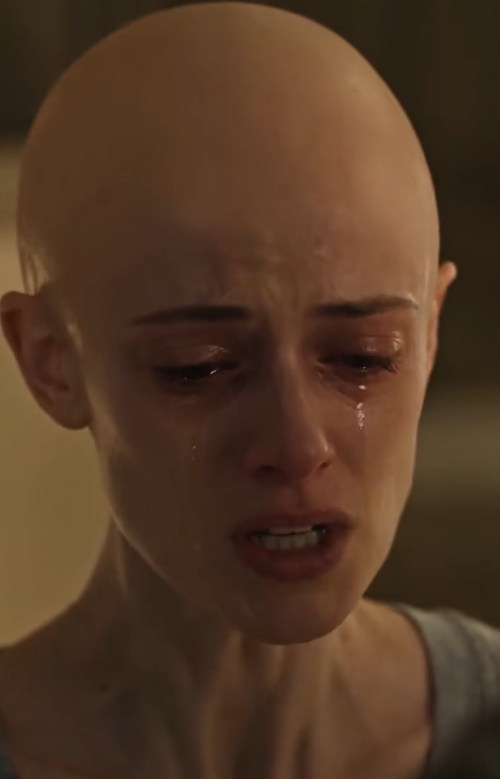
CHAPTER 4: THE ASHES OF LIES
Claire finished her intensive treatment phase in December.
The same month in which Margaret expected the investment to recover.
It didn't happen.
Nor did it matter anymore.
The results: clinical remission.
Follow-up care.
No one said "cured forever."
Life after cancer doesn't come with background music for a finale.
There were check-ups.
Fear before lab results.
Fatigue.
Hair growing back.
Claire gradually gave up the beanie.
First at home.
Then at the supermarket.
One day she returned to the mansion to have dinner with David.
She hadn't moved back in.
She walked into the kitchen.
The same sink.
She stood there.
David saw her.
— Are you okay?
— Yes.
— I remembered.
— Me too.
She touched the countertop.
— How strange.
— Do you want to go somewhere else?
— No.
— I want it to stop being the place from that afternoon.
David cooked poorly.
Claire corrected him.
— Don't add more salt.
— You're not in charge.
— Then eat trash.
— Now that is coercion.
They laughed.
Later:
— I want to come back.
David set down his spoon.
Didn't rush.
— To live here?
— Yes.
— When?
— In January.
— Okay.
— But the guest room is still available.
David:
— Of course.
— And if things change…
— You can leave.
— Without it meaning the marriage is over.
— Yes.
Claire:
— Good.
She moved in.
Not an instant restoration.
Couples therapy.
Conversations.
Some ugly ones.
David admitted he hated his mother.
Later, less so.
Claire admitted that a part of her missed Margaret during her check-ups.
— That makes me feel like an idiot.
David:
— No.
— She took care of you.
— Yes.
— And she manipulated you.
— Yes.
— You can miss the care without wanting to return to the dynamic.
Claire:
— Look who went to therapy.
— I hate it.
— It shows.
Margaret had limited contact.
Claire agreed to monthly messages.
Nothing medical unless Claire shared it.
Nothing about the trust.
Nothing about the marriage.
Simple rules.
Margaret broke one once:
*Is David taking good care of you?*
Claire replied:
*Do not evaluate him through me ever again.*
Margaret:
*You're right. I'm sorry.*
She didn't repeat it.
A small change.
---
DAVID AND THE UNIFORM
David left the Army two years later.
Not because of Claire.
Not directly.
His contract cycle was ending.
He had already thought about retiring to a civilian job.
Before the manipulation, he might have renewed.
Afterward, he reconsidered.
Claire:
— I don't want you saying you left because of me.
— No.
— Are you sure?
— Yes.
— I like the work.
— But I want a different pace.
— That's on me.
— Good.
He put away his uniform.
The bag he brought that afternoon remained in the closet for years.
One day Claire said:
— Throw it away.
— It's good.
— It smells like an airport.
— That's not a thing.
— It is.
They washed it.
David started working in civilian logistics management.
Fewer trips.
Not zero.
The first time he had to go to Chicago for three days, Claire grew tense.
— Not because of you.
— I know.
— Because of back then.
— Do you want me not to go?
Claire thought about it.
— No.
— I want to know the flight details.
— And if anything changes, I want you to tell me.
— Yes.
— Not your mother.
— Definitely.
They laughed.
Margaret was rebuilding her relationship with her son separately.
Not through Claire.
David saw her once a month.
The first meetings were uncomfortable.
Margaret:
— How is Claire?
David:
— Ask her yourself if she wants to talk.
— Okay.
— And you?
— Fine.
Silence.
Later, they spoke about Henry.
Not money.
Their marriage.
Margaret:
— Your father made decisions without me.
— And I hated it.
— Then I did the exact same thing.
David:
— Yes.
— I thought that if I made better decisions, it was justified.
— Yes.
— Do you think I was a bad wife?
David:
— I'm not going to judge forty years based on this.
— A bad mother?
— You did something terrible to me.
— That, you did.
Margaret:
— You're not answering.
— Because you want a label that tells you who you are.
— I can't give you that.
— You have to live with the facts.
She nodded.
Harsh.
But more useful.
---
THE PROJECT THAT WASN'T WORTH A MARRIAGE
Three years later, Riverside Quay was completed.
Another investor bought it.
The buildings were sold.
Ironically, the project proved profitable for the new owner.
Margaret saw the news.
Sent a message to David:
*In the end, it worked.*
He didn't reply immediately.
Later:
*Yes.*
She wrote:
*Sometimes I think that if we had just held out for six months…*
David closed his phone.
An old pattern.
He called her.
— Mom.
— I know.
— No, listen to me.
— That the project worked out later doesn't turn what you did into the right decision.
— I know.
— You just wrote «if we had held out».
— You're right.
— There was no «holding out».
— It was money.
— Yes.
— Claire had cancer.
— I was deployed.
— You forged communications.
— I don't want a financial outcome to rewrite that.
Margaret wept.
— Sometimes I still want to prove that I wasn't wrong about the investment.
— You can be right about the investment and completely wrong about everything else.
Silence.
— That's worse.
— Yes.
Because she couldn't say: bad project, bad decision.
The reality was far more uncomfortable: the project was perhaps good.
The method was intolerable.
That forced a confrontation with actual ethics.
Not results.
---
THE GLASS OF WINE
Five years after his return, Margaret came back to the mansion for Christmas.
The first time.
Claire had invited her.
David:
— Are you sure?
— Yes.
— It doesn't mean everything is fixed.
— I know.
— If I regret it, she leaves.
— Yes.
Margaret arrived.
No robe.
A simple dress.
Brought dessert.
Walked into the kitchen.
Stopped.
The same spot.
Claire by the sink.
Now hair down to her shoulders.
Strong.
Margaret:
— I can leave.
Claire:
— No.
— I was just thinking.
— Me too.
David walked in with wine.
Looked around.
No one knew what to say.
Margaret pointed at the sink.
— That day, you were holding a cup.
Claire:
— Yes.
— A blue one.
— We broke it later.
David:
— I broke it.
Claire:
— Accidentally.
— How convenient.
Margaret smiled.
Then paused.
— Claire.
— Yes.
— There's something I never said properly.
Claire waited.
— I didn't isolate you because I thought you were weak.
— I did it because I knew that if you and David spoke directly, my control would be over.
Silence.
— That's an even uglier truth.
Claire nodded.
— Yes.
— But it's far more useful than «I wanted to protect you both».
Margaret:
— I know.
— Thank you.
Not "I forgive you."
Thank you for the precision.
David poured wine.
Claire took water.
Margaret raised her glass.
— I'm not going to make a toast.
David:
— A miracle.
They laughed.
Dinner.
Not a perfect family.
But a table where no one filtered messages.
---
# CHAPTER 14 — THE EMAIL CLAIRE WROTE AND NEVER SENT
Claire wrote an email to Margaret years later.
She didn't send it.
*Margaret:*
*For a long time, I thought the worst part was believing David was going to abandon me for being sick.*
*It wasn't.*
*The worst part was that you started to seem more reliable to me than my own experience.*
*When David wrote something affectionate before you deleted it, you told me he was just being kind out of guilt.*