The biker put a loaded gun in front of my teenage daughter and said, "Pick it up."
I almost called the police. My heart hammered against my ribs like a trapped bird, and the air in the kitchen felt heavy, as if the oxygen had been replaced by lead. But my husband, David, grabbed my arm. His grip was firm, his knuckles white. He leaned in and whispered, "Let him talk."
Her name is Grace. Six months ago, she was an honor student. Volleyball captain. The kind of kid who volunteered at the animal shelter on weekends and came home smelling like puppy shampoo and hay. She was our sun, the center of our gravity.
Then she met a boy named Derek.
Within three months, the sun began to set. Grace dropped volleyball. Her grades, once a source of pride, collapsed into a sea of red ink. She stopped coming home on time. Then she stopped coming home at all some nights, leaving us to pace the living room floor until the milkman arrived.
We found pills in her backpack. Not prescription. Little blue tablets in a plastic bag. She said they were a friend's. Then she said everyone does it. Then she stopped bothering to lie. We tried everything. We took her phone. We grounded her. We tried family therapy, individual therapy, and even an intervention that ended with her slamming the door so hard the hallway mirror shattered. We begged, we screamed, we cried, we bargained with a God we hadn't spoken to in years.
Nothing worked. She looked at us like we were strangers—or worse, like we were the jailers in a prison she never asked to be in.
The night I found her unconscious on the bathroom floor, I thought she was dead. Her skin was the color of skim milk, and her lips were tinged with a terrifying shade of blue. The paramedics said she was lucky. Another hour, they said, and she wouldn't have made it.
She was released from the hospital on a Tuesday. By Thursday, she was texting Derek again, her thumbs flying across the screen with a frantic, desperate energy.
That’s when David called Ray.
Ray is David’s older brother. They hadn't spoken in two years. Not because they were fighting, but because they simply lived different lives. David was an accountant with a mortgage; Ray rode with a motorcycle club out of Tucson. He’d been on the road for thirty years, a man of leather, chrome, and silence.
David called him because we were out of options. We were watching our daughter slide off a cliff, and our hands were too slick with tears to catch her.
"She's going to die," David told him over the phone, his voice breaking. "My daughter is going to die, and I can't stop it."
Ray drove fourteen hours straight. He showed up Saturday morning, the low growl of his Harley announcing his arrival before he even hit the driveway. He walked in wearing a weathered leather vest, road dust coating his boots. He hadn't slept, and his eyes were bloodshot, but they were sharp.
He walked into the kitchen where Grace was sitting. She barely looked up from her phone, her shoulders slumped in that defiant, "I don't care" posture she’d perfected.
Ray sat down across from her. He didn't say hello. He didn't offer a hug. He reached into his jacket and placed a heavy, black handgun on the table between them.
I gasped, my hand flying to my mouth. David started to move toward the table, his instincts screaming.
"Sit down," Ray said. He didn't look at us. He looked at Grace.
"Ray, what the hell—" David started.
"Sit down, brother. Let me handle this."
We sat. I was shaking so hard I had to tuck my hands under my thighs. Grace had finally looked up from her phone. Her eyes were wide, the pupils dilated with a mix of fear and sudden, sharp curiosity.
Ray stared at my daughter for a long, heavy moment. The silence in the room was suffocating. Then, he leaned forward, his voice a low, gravelly rasp.
"This gun," Ray said, "is a lot like those pills you’re taking, Grace."
He pushed the weapon an inch closer to her. "Pick it up."
Grace hesitated, her breath hitching. "I... I don't want to."
"Pick it up," Ray repeated, his voice devoid of anger but heavy with a terrifying kind of authority.
Grace reached out, her fingers trembling as they brushed the cold steel. She lifted it an inch off the table. Her hand shook so violently the barrel rattled against the wood.
"It’s heavy, isn't it?" Ray asked.
Grace nodded, her face going white.
"That's the weight of a choice," Ray said. "You think those blue pills are an escape. You think they make the world go away. But they’re just like this trigger. Once you pull it, there’s no taking it back. There’s no 'sorry' that fixes a hole in your head, and there’s no 'sorry' that fixes a heart that stops beating because of a chemical."
He leaned closer, his eyes locking onto hers, forcing her to look away from the weapon and into the face of a man who had seen the dark side of the road.
"I’ve buried three brothers from my club in the last five years, Grace. Strong men. Tough men. Men who thought they were in control. One day they were riding next to me, laughing into the wind, and the next, I was throwing dirt on their coffins because they thought they could dance with the devil and not pay the band."
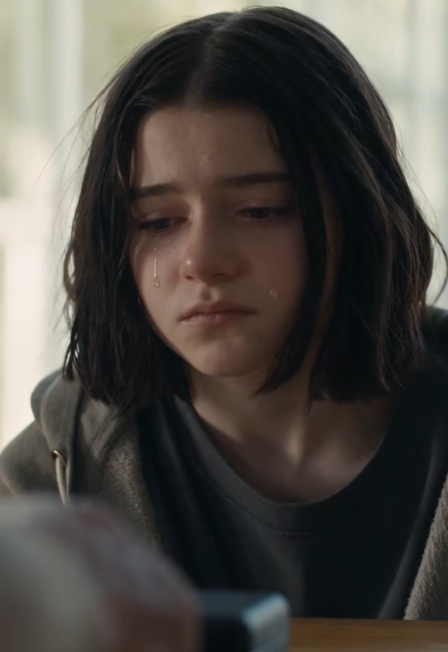
A single tear escaped Grace’s eye and tracked through the pale makeup on her cheek.
"You look at your mom and dad," Ray gestured toward us without breaking eye contact with her, "and you see enemies. You see people trying to take away your 'fun.' But I look at them and I see people who are already mourning you. They’re walking ghosts, Grace. They’re dying while you’re still breathing."
Ray reached out and gently took the gun back, tucking it away. The room felt lighter the moment it disappeared, but the weight of his words remained.
"Derek doesn't love you," Ray said bluntly. "The pills don't love you. They’re just ghosts waiting to claim another one. I drove fourteen hours because I’m tired of burying people I love. I’m not gonna bury my niece."
He stood up, his joints popping. He walked around the table and did something I hadn't seen anyone do to Grace in months. He didn't grab her or shake her. He simply put a large, calloused hand on top of her head, the way he used to when she was five years old.
"You’re a captain, Grace. Start leading yourself."
Ray stayed in our guest room for three days. He didn't lecture her again. He just sat on the porch and let her sit near him in the quiet.
It wasn't an overnight miracle. There were still withdrawals, still screams, and still a long road of rehab ahead. But that morning in the kitchen, the spell was broken. For the first time, Grace didn't see her parents as the problem—she saw the "weight" she had been carrying.
A year later, Grace isn't a volleyball captain anymore, but she’s volunteering again. Not at the animal shelter this time, but at a youth center, talking to kids who are looking for those little blue tablets.
And every time she feels the world getting too heavy, she calls her Uncle Ray. They don't talk about much—just the road, the wind, and the simple, beautiful weight of being alive.
.
.
Please follow us if you like this story 💫🙏💕