The Boy in the Black Car
On the night the rain finally fell on the Whitfield empire, a silver-haired patriarch opened a black car door and found a small boy waiting for a father he had never been allowed to name.
Chapter 1 — The Marenello Arrival
On the night the rain finally fell on the Whitfield empire, a silver-haired patriarch opened a black car door and found a small boy waiting for a father he had never been allowed to name.
Victor Whitfield did not get out.
Rain drummed on the black roof above him, hard enough to blur the gold-lit entrance of the Marenello Hotel into a watercolor of columns and chandeliers.
The chauffeur had already stepped away beneath the porte-cochère, but Victor remained in the rear seat with one hand on the chrome handle and the other resting over the silver ring on his finger.
For one thin, traitorous second, he saw a small palm against dark glass.
Then lightning tore open the sky, and the reflection was only his own face: silver hair, neat gray goatee, eyes that had outlasted rivals, markets, funerals, and every private consequence he had paid to keep private.
“Mr. Whitfield?”
Marco asked from the front passenger seat.
Victor released the handle.
“What?”
“The gala is waiting.”
“The gala can wait.”
Marco turned just enough for Victor to see his dark profile.
His black high-collar shirt made him look less like security than a shadow cut loose from the night.
“Celeste is already inside.”
That was why Victor had come.
The Whitfield Foundation gala filled the hotel every year with donors who praised his generosity beneath crystal chandeliers.
They would drink champagne, bid against one another for polished charity, and applaud the empire that bore his name.
They did not know the foundation had begun as a bargain made in a hospital room decades earlier.
They did not know that every smiling photograph of Victor beside Celeste Whitfield had become, over time, another wall around a story neither of them dared tell.
Victor stepped onto the wet stone.
Marco came around the SUV, holding an umbrella over him.
Victor waved it away.
Rain darkened the shoulders of his tailored gray suit and spotted the maroon shirt beneath it.
He preferred the cold sting.
It reminded him that the evening was real.
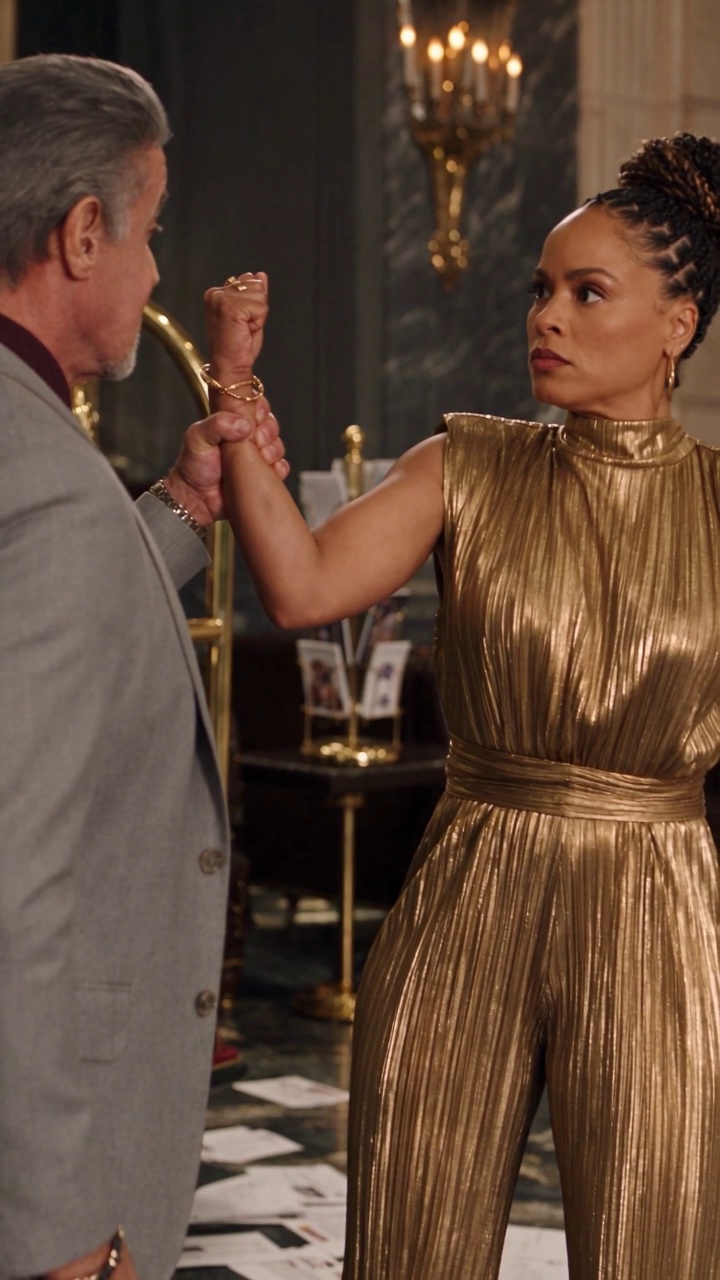
Across the lobby’s glass doors, a woman in gold stood near a brass luggage cart loaded with monogrammed brown bags.
Her metallic sleeveless jumpsuit caught every lamp in the room.
Hair twisted into a braided topknot, gold hoops at her ears, one bracelet gleaming at her wrist, Celeste looked as if she had dressed for conquest rather than a charitable dinner.
She watched him without moving.
Victor had once mistaken stillness for loyalty.
He no longer made that kind of error.
“Any change?” he asked Marco.
“Not from the message you received.”
“Say it.”
Marco’s jaw tightened.
“She wants the private meeting before your remarks.”
“She has wanted things from me for thirty years.”
“This time she named a condition.”
Victor stopped beneath the stone archway.
The rain hissed behind them.
Inside, a string quartet was playing something bright and expensive.
“And?”
“She said you would understand it when you saw her.”
Victor looked through the glass at Celeste.
The calm on her face was not peace.
It was preparation.
He had built Whitfield from a single warehouse and a loan nobody expected him to repay.
He had learned that threats came loud from weak men and quiet from dangerous ones.
Celeste had always been dangerous when she was quiet.
“Did you sweep the room?” he asked.
“Twice.”
“Her people?”
“Visible ones are accounted for.”
Victor glanced at him.
“Visible ones.”
Marco gave no answer.
He did not need to.
Every room had unseen people.
Every family did too.
The glass doors opened before Victor reached them.
Warm air swept over him, carrying perfume, waxed marble, and the faint sweetness of flowers arranged in towering white displays.
Guests turned in practiced increments as he entered.
Smiles appeared.
Hands lifted.
A few people began to clap, then stopped when they saw his expression.
Victor acknowledged no one.
Celeste waited by the luggage cart, a manila envelope tucked beneath one arm.
It was ordinary, almost laughably so beside the designer bags and the gold pooling over her body.
Yet Victor watched it more closely than he watched her.
“You’re late,” she said.
“I own the night.”
“You own the microphones.
There’s a difference.”
Marco took position a step behind Victor’s right shoulder.
Celeste’s eyes moved to him.
“Still keeping him close.”
“Still trying to make that sound like a flaw.”
Her mouth almost smiled.
“I’m trying to make you remember what it costs.”
A waiter passed behind them with a tray of champagne.
Victor caught the waiter’s startled glance, then looked back at Celeste.
“You requested this meeting.
Tell me why.”
“Not here.”
“This is your stage.
Use it.”
For the first time, something in her polished expression gave way.
Not fear.
Anger, quickly buried.
“You made everything public,” she said softly.
“Your company.
Your charity.
Your repentance.
You stood on every platform you could buy and let strangers call you a good man.”
Victor’s fingers closed around the braided bracelet at his wrist.
“Careful.”
“No.
You be careful.”
Her gaze dropped to the envelope.
“There are truths that do not become less true because they were sealed away.”
The quartet finished.
Applause rose from the ballroom beyond the lobby, then faded as a hotel attendant announced that the foundation chairman had arrived.
Victor heard none of it clearly.
He heard only the old phrase Celeste had used: sealed away.
“What do you want?” he asked.
Celeste shifted the envelope into both hands.
“A conversation without your audience.”
“And if I decline?”
Her gold bracelet clicked against the paper.
“Then I stop protecting the version of you that built this place.”
Marco leaned forward by half an inch.
Victor raised one hand, stopping him.
Celeste watched the gesture and understood it for what it was: permission withheld, not weakness.
Victor looked past her at the ballroom doors.
Beyond them waited donors, cameras, trustees, and a speech drafted to make him look merciful.
Behind him waited rain and the SUV.
Between those two worlds stood his estranged wife, holding a cheap envelope as though it were a weapon.
“Fine,” he said.
“You have five minutes.”
Celeste’s smile returned, small and victorious.
“No, Victor.
I have as long as it takes.”
She turned toward a private corridor beside the ballroom.
Victor followed.
Behind him, the Marenello’s glass entrance doors closed with a soft, final click.