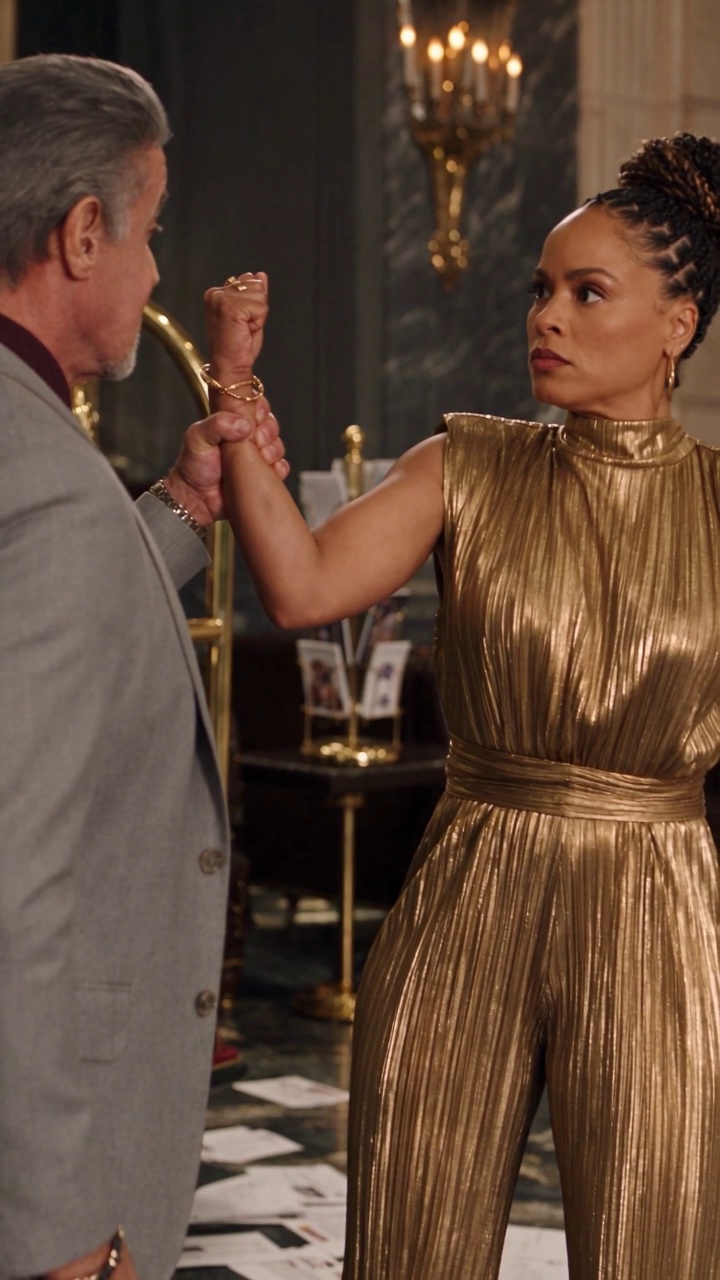
Chapter 3 — Thunder at the Porte-Cochère
Thunder rolled beyond the hotel roof, low enough to tremble through the stone columns.
Victor Whitfield turned from the glass doors and walked toward the black SUV without asking Marco to follow.
Marco did anyway, one silent step behind and half a pace to Victor’s right.
Rain blew in beneath the porte-cochère, stippling the black paint of the waiting vehicle and darkening the cuffs of Victor’s gray trousers.
The photograph rested inside his jacket, its hard edges pressing against his chest with every breath.
For seven years, a child had existed beyond the reach of his name.
Victor had built companies out of bankrupt warehouses and bad neighborhoods.
He had negotiated through strikes, funerals, and boardroom betrayals without letting his hands shake.
But now his right hand would not settle at his side.
The silver ring on his finger caught the chandelier light spilling through the lobby doors.
Behind them, gala music continued as if the hotel had not split open.
Laughter rose and fell beneath the marble ceiling.
Glasses touched.
People who had never been denied anything important in their lives were still celebrating the Whitfield Foundation’s generosity.
Victor stopped beside the SUV.
Its rear windows were so dark they reflected only the columns, the rain, and a distorted shape of his own silver-haired head.
For one sick second, there was nothing else.
Then a small palm struck the glass from inside.
Victor did not move.
Another palm joined it.
A boy’s face emerged from the tint, close enough that Victor could see the wet tracks beneath his eyes.
Short curls framed a round, frightened face.
He wore a peach polo shirt, rumpled at the collar, and khaki pants.
His mouth opened, but the glass swallowed the first sound.
Marco’s gaze swept the driveway.
“The driver’s gone.”
“Of course he is.”
Victor’s voice was almost calm.
The boy stared at him through the window.
Not at the suit, not at the ring, not at the expensive car or the hotel.
At his face.
The child searched it with an ache Victor understood before he wanted to.
Victor stepped closer.
The boy’s breath clouded a small circle in the tinted glass.
His fingers spread wider, as though he could push through the barrier if he wanted hard enough.
“Are you my grandfather?” he whispered.
The question was barely audible beneath the rain.
It landed with more force than any accusation Celeste had ever thrown at him.
Victor saw a younger man in the boy’s eyes—not clearly, not as a face, but as a wound he had spent too long calling closed.
He had once believed distance could be a kind of protection.
Leave the dangerous rooms shut.
Leave old mistakes unnamed.
Let money smooth the roughest edges for people who did not deserve to carry them.
But a child was sitting alone in the back of a locked car, asking a stranger whether he belonged to him.
“Yes,” Victor said.
The boy blinked hard.
“For real?”
Victor put his palm against the glass opposite the child’s.
The window was cold between them.
“For real.”
The boy’s lower lip folded inward.
He fought the tears with a discipline no child should have learned.
Then his face broke, and a sob shook his small shoulders.
Marco moved toward the rear door, but Victor lifted one hand.
He needed no one to make this motion for him.
No one to stand between him and the consequence that had been waiting, alive and frightened, on the other side of a locked door.
From the lobby, the glass doors hissed open.
Celeste stood beneath the gold sconces in her metallic jumpsuit, her braided topknot perfectly arranged, one hand still holding the manila envelope against her hip.
A loose circle of gala guests had gathered behind her.
They were dressed in evening colors and expensive confusion, watching the man they had come to honor stand in the rain beside a vehicle that did not appear on the gala schedule.
Celeste’s expression did not change.
That was what made Victor understand how long she had prepared for this moment.
“You should not be here,” she called.
Victor kept his eyes on the boy.
“Neither should he.”
Her gold bracelet flashed as she tightened her grip on the envelope.
“You don’t know what you’re doing.”
“I know exactly what I am looking at.”
“No,” Celeste said, and her calm thinned.
“You are looking at a problem you created.”
Marco shifted closer to Victor’s shoulder.
“The vehicle is locked from the outside,” he said quietly.
Victor heard the boy’s breathing quicken through the glass.
He could see it in the rise of that peach-colored shirt.
Celeste took one step into the rain, then stopped beneath the awning’s edge.
“Victor, walk away from that car.”
He turned at last.
The maroon beneath his tailored jacket looked almost black in the storm light.
“Did you bring him here to bargain with me?”
Her eyes flicked toward the gathering guests, then to Marco.
“This is not a conversation for the driveway.”
“It became one when you put my grandson behind tinted glass.”
The word grandson carried across the porte-cochère.
A woman near the doors covered her mouth.
Someone inside the lobby stopped laughing.
Celeste’s composure cracked for only an instant.
“Do not make claims you cannot prove.”
Victor touched the photograph inside his jacket.
“You made sure I could.”
The boy knocked again, more urgently now.
“Please,” he said.
“Please don’t go.”
Victor faced the SUV.
His anger did not vanish; it narrowed, turning hard and useful.
He pictured the rented villa Marco had described.
A locked bedroom.
A life hidden so completely that the boy had to ask whether his own grandfather was real.
He looked at Marco.
“When that door opens, you take him inside.
Stay with him.”
Marco nodded once.
“Understood.”
Celeste’s voice sharpened.
“Victor.”
He ignored her.
The chrome handle gleamed under the falling rain.
On the other side of the glass, the boy pressed both palms forward and waited.
Victor closed his hand around the handle and pulled.