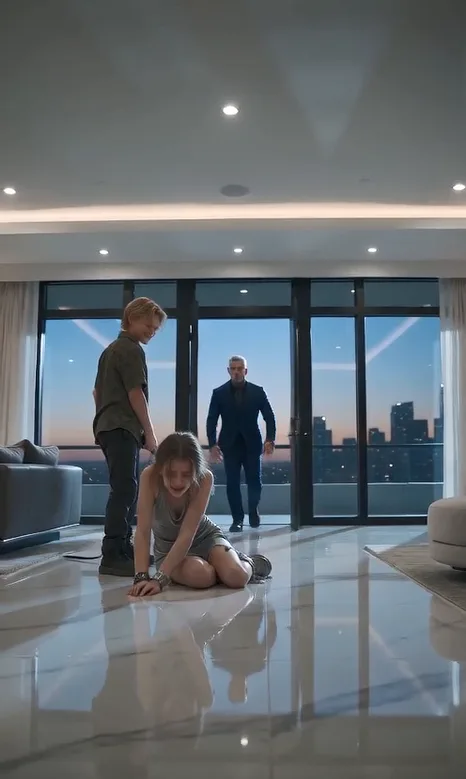
Easter Sunday began in complete silence.
The kind of silence that feels wrong before you even understand why.
I stood at my kitchen sink with my hands covered in soap, staring at a cup of black coffee that had gone cold almost thirty minutes earlier.
The house smelled like roasted ham, lemon cleaner, and the lilies Emily had brought me the previous weekend.
Outside, the last echoes of church bells disappeared into the cool Connecticut morning.
I remember thinking how peaceful everything looked.
Then my phone vibrated.
Once.
Twice.
I glanced toward the counter.
Emily.
My daughter.
I dried one hand on my jeans and answered immediately.
“Emily?”
For three seconds, there was nothing.
Only breathing.
Shaky.
Broken.
Afraid.
Then her voice came through.
“Dad.”
She whispered the word like someone was standing close enough to hear her.
“Please come get me.”
My fingers tightened around the phone.
“What happened?”
There was a pause.
Then a tiny sound.
A breath catching in her throat.
The sound of someone trying not to cry because crying might make things worse.
Then she said the words no father should ever hear.
“He hit me again.”
Everything inside me stopped.
Not slowed.
Stopped.
I had spent years learning how to remain calm when other people panicked.
I had stood in rooms where armed men screamed threats inches from my face.
I had watched buildings burn.
I had listened to desperate voices over secure radios while lives depended on the next sentence I spoke.
None of it prepared me for those four words.
“He hit me again.”
The last word mattered almost as much as the rest.
Again.
Not once.
Not an accident.
Not something I had misunderstood.
Again.
“Emily, listen to me.”
My voice changed without my permission.
The father disappeared for half a second, and the man I had spent fifteen years trying to forget stepped forward.
“Where are you?”
“Michael’s house.”
“I know that.”
I grabbed my truck keys.
“Where inside the house?”
“The upstairs sitting room.”
Her breathing shook.
“There are people everywhere.”
“I’m coming.”
“Dad, wait.”
I froze.
“What?”
“He knows I called you.”
A cold feeling moved through my chest.
“How?”
“I think he checked my phone.”
Then I heard a door open.
Emily stopped breathing.
A man’s voice came faintly through the speaker.
“Who are you talking to?”
Michael.
I recognized his voice instantly.
Smooth.
Controlled.
Educated.
The kind of voice that made strangers trust him.
“Emily?”
I heard her whisper.
“Dad.”
Then came a sharp breath.
A scream.
Something crashed.
The phone hit the floor.
The connection remained open.
I could hear classical music somewhere in the background.
Children laughing.
Glasses clinking.
People celebrating Easter.
And beneath all of it, I heard my daughter crying.
I was already out the door.
My truck started hard enough to shake the garage.
I backed into the street without remembering whether I had closed my front door.
Twenty-five minutes separated my house from Michael Harrington’s estate.
That morning, I made the drive in nineteen.
I did not remember most of it afterward.
I remembered red lights.
I remembered my hands locked around the steering wheel.
I remembered every warning sign I had ignored over the previous four years.
Michael correcting Emily at dinner.
Michael answering questions for her.
Michael deciding which friends were “good influences.”
Michael joking that Emily was terrible with money.
Michael persuading her to quit the nonprofit where she had worked for six years because, according to him, married women in their social circle did not need ordinary jobs.
I remembered the first Christmas after their wedding.
Emily had reached for a second glass of wine.
Michael had placed two fingers over the rim.
“That’s enough.”
He had smiled when he said it.
Everyone else had laughed.
Emily had laughed too.
But her eyes had not.
I remembered asking her about it later.
She had told me everything was fine.
That became her favorite sentence.
Everything is fine.
I should have learned that sometimes those three words mean exactly the opposite.
Michael did not destroy her overnight.
Men like Michael rarely do.
They dismantle someone slowly.
A comment here.
A warning there.
A little control disguised as concern.
A little humiliation disguised as humor.
A little isolation disguised as devotion.
Until one day, the person they hurt no longer recognizes themselves.
My truck turned onto the private road leading to the Harrington estate.
The iron gates were already open.
Luxury cars lined both sides of the drive.
The Harrington mansion rose behind flowering pear trees like something from a magazine.
White Easter tents covered the lawn.
Children searched for painted eggs beneath decorative banners.
Women in pastel dresses carried champagne glasses.
Men in linen jackets stood beside outdoor heaters discussing golf and investments.
Soft classical music played through hidden speakers.
Everything looked beautiful.
Everything looked expensive.
Everything looked safe.
I parked beside a black Mercedes and walked toward the front entrance.
I did not knock.
I did not wait.
I climbed the marble steps.
Before I reached the door, someone stepped directly in front of me.
Victoria Harrington.
Michael’s mother.
She was sixty-three and looked ten years younger because wealth had protected her from almost every inconvenience except aging.
She wore a pale lavender dress and diamonds large enough to catch the morning sun.
A mimosa rested in one perfectly manicured hand.
“Arthur Collins.”
Her smile contained no warmth.
“Still showing up where you don’t belong?”
“Where is my daughter?”
Victoria raised one eyebrow.
“Emily is resting.”
“Move.”
She gave a small laugh.
“You always create problems.”
I stared at her.
“Move.”
Her expression hardened.
“You really think you can walk into this house and ruin our Easter celebration?”
“My daughter called me and said Michael hit her.”
Victoria’s face did something interesting.
It did not show surprise.
It showed annoyance.
That told me more than any confession could have.
“She is emotional.”
“Move.”
“Arthur, you need to understand that marriage is complicated.”
“Move.”
“Emily has always been dramatic.”
I stepped forward.
Victoria placed one hand on my chest.
Then she pushed me.
Hard.
My foot slipped against the edge of the marble step.
For one second, my body reacted before my mind did.
Old instincts.
Old training.
My right hand moved automatically.
I stopped it.
I never touched her.
Because anger is loud.
Control is quiet.
And I had learned years ago that the person who loses control first usually gives the other side exactly what they need.
The front door opened behind Victoria.
Conversation inside the house died almost instantly.
A woman stopped with a plate halfway to her mouth.
A man lowered his champagne glass.
Someone near the staircase whispered my name.
I walked past Victoria.
Nobody tried to stop me.
I entered a room filled with nearly forty people.
Nobody asked why I was there.
Nobody asked where Emily was.
And then I saw her.
My daughter lay on a white carpet beside the living room sofa.
Her body was curled inward.
Her right cheek was swollen.
Purple discoloration had already begun beneath her left eye.
One hand covered her ribs.
The other was pressed against the carpet as if she had tried to stand and failed.