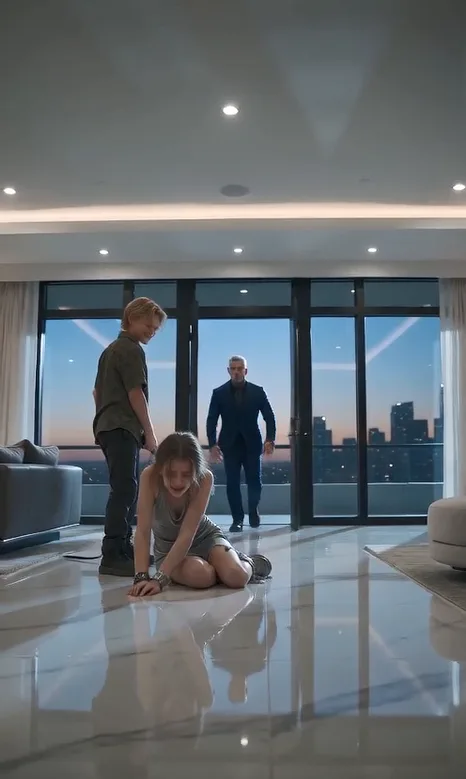
The first vehicle arrived seven minutes later.
It was not a police cruiser.
It was a dark gray government SUV with no visible markings.
A second vehicle followed ten seconds behind it.
Then a third.
Chief Daniel Brooks abandoned his paper plate before the first SUV had even stopped moving.
That reaction interested me.
In my experience, innocent men usually ask questions.
Guilty men start calculating exits.
Two women and three men stepped from the vehicles.
They wore ordinary clothes.
No tactical vests.
No dramatic display of weapons.
Only badges.
Credentials.
Professional faces.
The woman leading them was in her early fifties, with short dark hair and the kind of posture that told me she had spent a career entering rooms where people lied for a living.
I recognized her before she reached me.
Mara Vance.
Fifteen years had changed her hair.
Nothing else.
She stopped in front of me.
For half a second, the federal investigator disappeared and my former partner stood there.
“Arthur.”
“Mara.”
Her eyes shifted toward Emily.
Everything personal vanished.
“What happened?”
“Possible aggravated domestic asNextlt.”
“Recorded evidence exists on a phone inside the residence.”
“Local police chief is socially connected to the suspect.”
“Victim reports repeated abuse.”
Mara looked at Emily.
“Do you consent to medical transport and to speaking with federal investigators?”
Emily looked at me.
I gave her no answer.
That mattered.
For years, everyone around her had made decisions for her.
I was not going to become another man who did the same thing simply because I loved her.
Emily swallowed.
“Yes.”
Mara nodded.
“Then we move on her decision.”
Michael came down the steps.
“This is absurd.”
Mara turned toward him.
“Michael Harrington?”
“Yes.”
“Do not approach the vehicle.”
“This is my property.”
“Then staying exactly where I told you should be easy.”
Michael blinked.
Behind him, Victoria’s mouth tightened.
Chief Brooks finally reached the driveway.
“What agency are you with?”
Mara displayed her credentials.
“Office of Inspector General liaison task force.”
Brooks stared at the badge longer than necessary.
“This is a local domestic matter.”
“Maybe.”
Mara looked toward the house.
“Maybe not.”
Brooks glanced at me.
Recognition flickered across his face.
Not recognition of who I was now.
Recognition of something older.
Something he had probably heard.
Michael noticed.
“What is going on?”
Nobody answered him.
An ambulance arrived from the neighboring county rather than from Harrington.
That was deliberate.
I had requested extraction outside the immediate local chain.
Two paramedics approached Emily.
One examined her face.
The other checked her ribs and blood pressure.
Emily tried to minimize everything.
Victims often do that.
“It’s not that bad.”
The paramedic did not argue.
She simply asked, “On a scale from one to ten, what is your pain when you breathe?”
Emily hesitated.
“Seven.”
The paramedic’s face remained neutral.
“Then it’s bad enough.”
Michael attempted to move closer.
“Emily.”
She visibly stiffened.
Mara stepped between them.
“No contact.”
“She’s my wife.”
“She has asked to leave.”
“She’s confused.”
Emily looked at him.
Something changed inside her.
It was small.
But I saw it.
Fear was still there.
Yet beneath it, another emotion appeared.
Anger.
“I’m not confused.”
Michael’s expression hardened.
“Emily, don’t do this in front of everyone.”
For years, that sentence had probably worked.
Do not embarrass me.
Do not make a scene.
Do not tell people what happens when the doors close.
This time, Emily looked across the Easter lawn at dozens of silent guests.
Then she said, louder than before, “You hit me.”
No one moved.
Michael gave a short laugh.
“She’s hysterical.”
Emily’s voice shook.
“You hit me this morning.”
“Stop.”
“You hit me last Thursday.”
Michael’s jaw tightened.
“Emily.”
“You pushed me down the stairs in January.”
Several guests turned toward him.
Victoria stepped forward.
“That is enough.”
Emily looked at her.
“You knew.”
Victoria froze.
“You heard me crying in the bathroom at Christmas.”
“That is a disgusting accusation.”
“You gave me makeup.”
Victoria’s face lost color.
Emily’s voice grew stronger.
“You brought concealer into the bathroom and told me which shade covered purple bruises.”
A woman standing near the front door gasped.
Michael moved forward.
One of Mara’s agents blocked him.
“Step back.”
“This is family business.”
Mara studied him.
“Mr. Harrington, once violence becomes evidence, it stops being family business.”
The paramedics moved Emily toward the ambulance.
I started after her.
Mara caught my arm.
“Arthur.”
I stopped.
“What?”
“Tell me about the phone.”
“Recording was active.”
“Location?”
“Under the living room sofa.”
“Anyone touch it?”
“Michael kicked it farther underneath.”
Her eyes sharpened.
“You saw that?”
“Yes.”
“Anyone else?”
“Probably twenty people.”
Mara nodded.
“Good.”
She signaled two agents.
“Preserve the room.”
Chief Brooks stepped between them and the house.
“You need a warrant.”
Mara did not raise her voice.
“We have an exigent evidence-preservation situation involving an active recorded asNextlt allegation and suspected interference with evidence.”
“This is my jurisdiction.”
“Then help us.”
Brooks did not move.
Mara waited.
“So.”
Her voice stayed calm.
“Are you helping us preserve evidence, Chief?”
Brooks glanced toward Michael.
That single glance was enough.
Mara noticed it too.
He finally stepped aside.
One agent began photographing the entrance.
Another activated a body camera.
Everything became procedure.
That was the difference between anger and accountability.
Anger wanted to break Michael’s face.
Accountability wanted to build a record so complete that his money could not break the truth.
I rode in the ambulance with Emily.
At the hospital, imaging confirmed two cracked ribs.
She had a bruised cheekbone.
A sprained wrist.
Soft tissue damage along her shoulder.
No internal bleeding.
No skull fracture.
I sat beside her bed while a nurse documented every injury.
Emily stared at the ceiling.
“Dad?”
“Yeah?”
“How did I let this happen?”
I looked at her.
“You didn’t.”
“I stayed.”
“That doesn’t make you responsible for what he did.”
“I defended him.”
“That doesn’t make you responsible either.”
“I lied to you.”
“You were surviving.”
She turned her head.
Tears filled her eyes.
“Is that what this was?”
“Yes.”
“Because it didn’t feel like surviving.”
I understood that.
Survival rarely feels heroic while it is happening.
Sometimes survival is hiding money in a shoe.
Sometimes it is memorizing a phone number.
Sometimes it is smiling at dinner because telling the truth at that moment would make the next hour more dangerous.
Sometimes survival is whispering four words into a phone.
He hit me again.
Mara entered the room two hours later.
She carried an evidence bag.
Inside was Emily’s phone.
The screen was cracked.
But intact.
“We recovered it.”
Emily stared at the bag.
“Is the recording there?”
“Yes.”
“All of it?”
Mara looked at me.
Then back at Emily.
“More than you know.”
Emily frowned.
“What does that mean?”
“The recording started approximately twenty-three minutes before your father arrived.”
Emily’s face went pale.
“I started it when Michael followed me upstairs.”
Mara nodded.
“It captured the argument.”
“Did it capture him hitting me?”
“Yes.”
Emily closed her eyes.
Mara continued carefully.
“It also captured several conversations after your phone went under the sofa.”