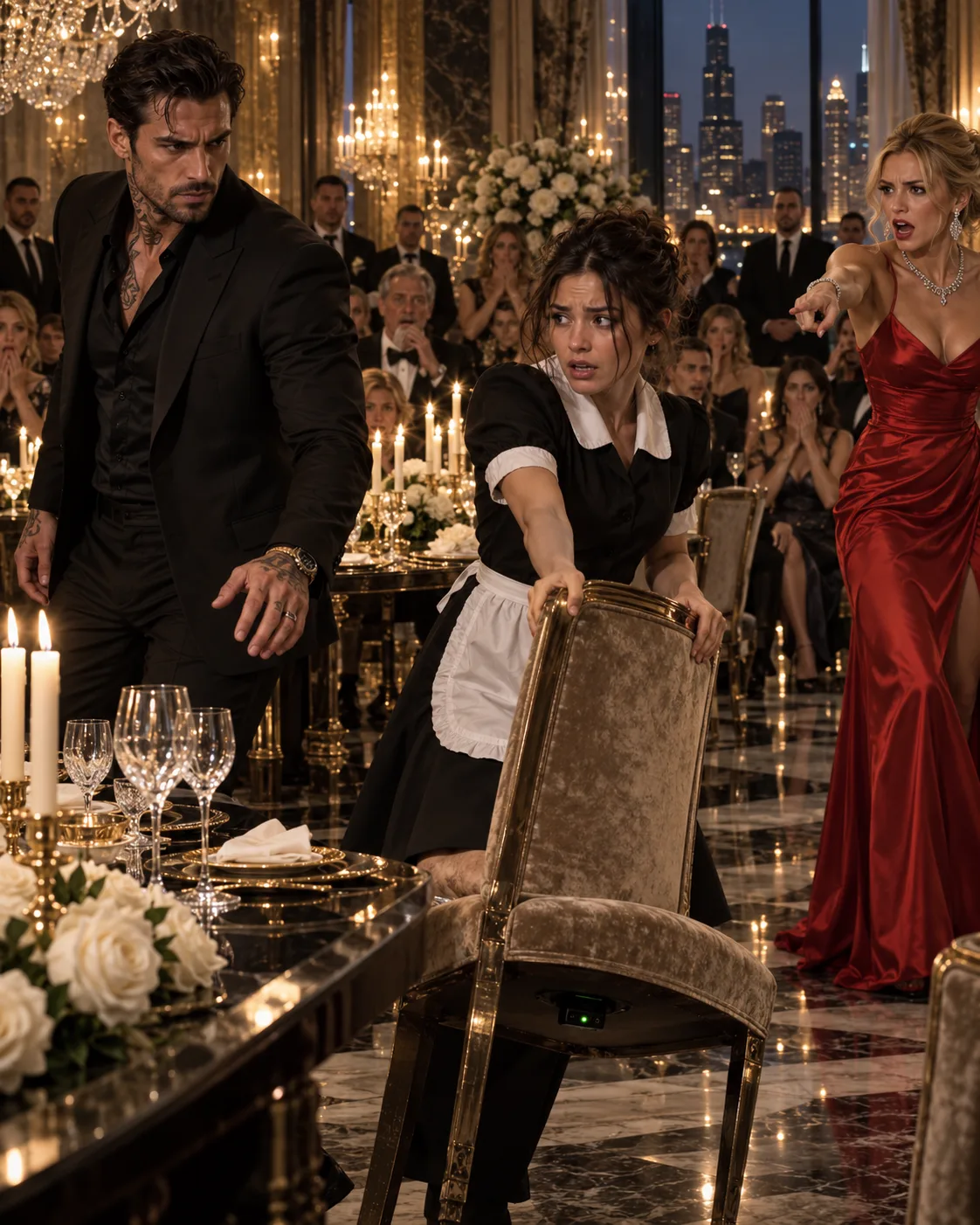
Chapter 15 - The Door Under the City
Darkness does not silence people.
It reveals them.
Someone screamed.
A man cursed.
Daniel shouted Luca’s name.
I reached for the wall and found air.
Then a hand closed around mine.
Luca.
“Grace.”
“I’m here.”
His grip was firm and warm, and in the confusion of the blackout, I understood why people trust dangerous men. Not because danger is beautiful. It is not. But because in the worst moments, certainty can feel like shelter.
Emergency lights flickered on, red and dim.
Silvio was gone.
So was the key.
The vault manager lay on the floor, alive but shaking, with a thin cut above his eyebrow.
Vanessa stood near the elevator, clutching her cheek.
“I didn’t help him,” she said.
Luca looked at her.
“Then help now.”
For once, she did not argue.
She kicked off her heels, lifted the hem of her gown, and ran toward the service corridor.
“He’ll go below. My father hates front exits.”
We followed.
Down metal stairs.
Past old pipes.
Through a basement corridor where the air smelled of damp concrete and money older than morals.
Vanessa knew the building too well.
Luca noticed.
“You’ve been here.”
She did not slow.
“My father brought me when I was sixteen. He said every family has a basement. The trick is making sure someone else lives in yours.”
No one answered that.
At the lower level, we found Silvio at a steel door marked PRIVATE ARCHIVE. Decker stood beside him, breathless, holding a flashlight and a stack of documents.
Silvio had the brass key in the lock.
But the door would not open.
He turned as we approached, furious.
“Why won’t it turn?”
I knew before anyone said it.
Because my father was a linen driver, not a fool.
I stepped forward.
“You need the second key.”
Silvio’s face changed.
“What second key?”
I reached under my collar and pulled out the small silver chain my mother had given me when I was twelve. On it hung a plain flat charm shaped like a button.
I had worn it for seventeen years.
For luck, my mother said.
For your father, she said.
I had never known the back twisted open until Evelyn’s words returned to me: The mirror remembers what the book forgot.
The mirror had shown me the brass key.
My mother had carried the silver one into my childhood.
I unscrewed the charm.
Inside was a tiny iron key.
Luca looked at it, then at me with something like wonder.
Silvio lunged.
Vanessa moved first.
She slammed into her father’s arm with her whole body. The brass key flew across the floor. Luca caught Silvio by the collar and drove him into the wall hard enough to knock the breath out of him, but he did not hit him again.
That mattered later.
It mattered to me then.
Daniel took Decker down with less poetry.
I picked up the brass key.
My hands shook as I inserted both keys into the two hidden locks.
The door opened.
Inside was not gold.
Not jewels.
Not the cinematic nonsense men pretend crime is about.
It was boxes.
Papers.
Tapes.
Photographs.
A quiet archive of ruined lives.
Thomas Parker had left me proof.
Sofia Moretti had preserved it.
Evelyn Shaw had guarded it badly, bravely, selfishly, and at last correctly.
Luca stood beside me as Daniel photographed everything.
On the top shelf was a tape labeled in my father’s handwriting:
For Grace, when truth is safer than silence.
I did not listen to it there.
Some inheritances deserve a kitchen table.
Silvio cursed until Daniel gagged him.
Decker offered deals before anyone accused him.
Vanessa sat on the floor in her red gown, barefoot and trembling, no longer a bride, not yet free.
I looked at her.
“You could have told the truth.”
She gave a small, broken laugh.
“I didn’t know how.”
For the first time, I believed her completely.
Months passed before the world understood what happened in that basement.
Some men went to prison. Some fled. Some died before they could be asked difficult questions, which I learned is another way powerful families keep punctuation tidy.
Luca Moretti survived the scandal, but not unchanged.
He stepped away from the pieces of his empire that could not stand in daylight. People said it was strategy. Maybe it was. But I saw him at his mother’s tomb one afternoon, speaking quietly to a stone, and I knew strategy was not the whole of it.
My mother kept her house.
Then, because she was my mother, she turned the front room into a fitting studio and took on too much work immediately.
The vault documents proved that Thomas Parker had never been a criminal.
He had been a witness.
A frightened, decent man who had tried to carry truth across a city built to crush it.
We moved his name.
Not his body.
His name.
A new bronze plate was placed in the Moretti mausoleum beside the old one.
Thomas Parker
Husband. Father. Protector.
A man who refused to carry lies.
My mother cried without hiding her face.
Luca stood behind us, hands folded, silent.
Afterward, I found him near the cemetery gate.
“You did what you promised,” I said.
“No.”
He looked at the wet trees.
“I intended to protect you. You protected yourself. I merely learned to stand near enough to be useful.”
That was the moment I loved him.
Not the moment I noticed him.
That had happened earlier, somewhere between the chair and the fire and the hospital room, though I had been too busy surviving to name it.
Love, when it came, was not a thunderclap.
It was quieter.
A man waiting outside my mother’s shop while I argued with a bride about lace.
A cup of coffee left beside me without instruction.
A question asked without ownership.
May I come in?
May I help?
May I stay?
One year after the engagement dinner that never reached dessert, Luca came to my mother’s shop before closing. He wore a navy coat, no bodyguards inside, and an expression that made my mother immediately pretend to find something urgent in the back room.
He placed a chair in the center of the fitting area.
The old chair from his dining room.
Not the bugged velvet one.
His original.
Restored.
“You brought furniture to a seamstress?”
“It seemed appropriate.”
I circled it.
On the underside, where no one would see unless they looked with care, a small brass plate had been added.
For the woman who moved the chair and made me hear the truth.
I touched the words.
Then I looked at him.
“You know this is a very strange courtship.”
His smile came slowly.
“I was raised poorly.”
“You were raised dangerously.”
“Yes.” He took my hand. “I am trying to become less so.”
That, I had learned, was the only kind of promise worth anything.
Not perfection.
Not rescue.
Not a man swearing he would never frighten the world again.
Only this:
I know what I was.
I know what I owe.
I am trying.
We did not marry quickly.
Women who have inherited secrets do not rush vows.
But we built something honest.
My mother said honesty was expensive but cheaper than lies in the long run.
She was right.
The lesson I carried from all of it was not that love saves you. That is too easy, and usually untrue.
The lesson was this:
Sometimes the smallest act of courage is not standing in front of a gun, opening a vault, or dragging a powerful man’s chair away from danger.
Sometimes it is simply refusing to sit quietly while a lie is given the best seat at the table.
THE END