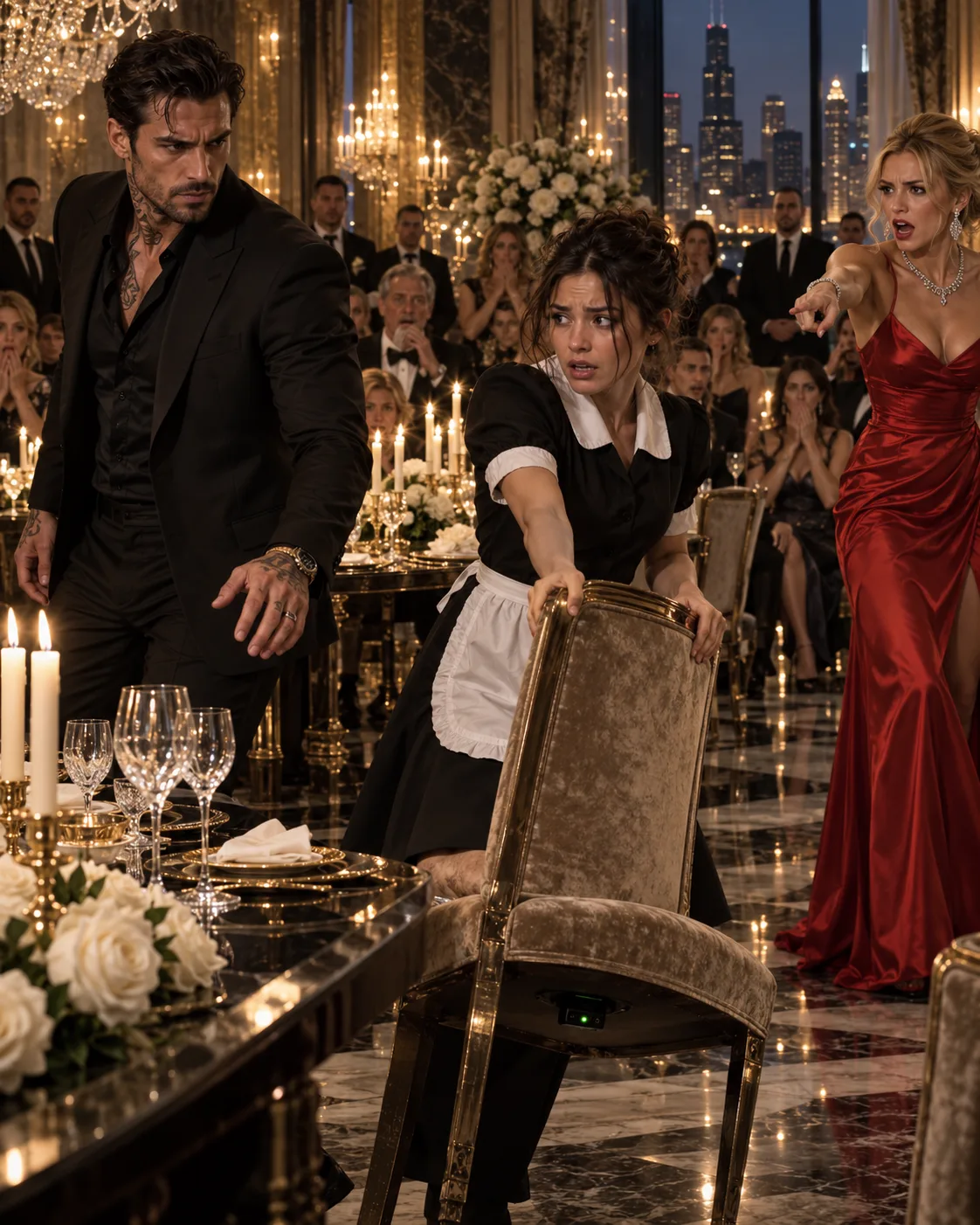
Ten years after the engagement dinner, Luca and I hosted twelve people for Thanksgiving.
Not thirty.
No chandeliers.
No white roses.
No secret meeting afterward.
Just family.
My mother.
My sister.
Her children.
Marco and his husband.
Miriam, who had retired and discovered she hated retirement.
Two friends from my company.
Luca’s professional CEO and his wife.
Normal enough.
I carried soup into the dining room.
Luca stood immediately.
“Need help?”
I looked at him.
“Yes.”
He took half the weight.
No heroics.
Then my niece Emma ran toward the head of the table.
“I want Uncle Luca’s chair.”
Luca laughed.
“Take it.”
She dragged it away.
And for half a second, his body froze.
Old memory.
Chair moving.
Green light.
Vanessa.
Everything.
I noticed.
“Still?”
He smiled.
“Apparently.”
Emma replaced his chair with a dining stool.
Terrible.
He looked at it.
Then at me.
“Safe?”
“I haven’t swept it.”
He laughed.
Sat anyway.
Progress.
After dinner, Mom found an old photograph on our bookshelf.
The Moretti mansion engagement dinner.
Taken before everything.
Luca in black.
Vanessa in red.
Me barely visible in the background carrying wine.
Mom stared.
“That you?”
“Yes.”
“You look twelve.”
“I was twenty-nine.”
“Same thing.”
Luca approached.
She pointed at Vanessa.
“That her?”
“Yes.”
Then at Luca.
“You had terrible taste.”
“Elaine.”
“What?”
He laughed.
No defensiveness.
Then Mom pointed at me in the background.
“You were there the whole time.”
I looked.
Almost invisible.
Black uniform.
Hair pinned.
Eyes on the table.
“Yes.”
That photograph bothered me once.
Now?
Not much.
Being background in someone else’s photograph did not make me background in my life.
Important.
Later, after everyone left, Luca and I cleaned the kitchen.
No staff.
We had help twice a week because neither of us wanted to spend Saturday deep-cleaning bathrooms.
Honesty.
But family dinner cleanup was ours.
Luca dried.
I washed.
Then he said:
“I found something.”
He opened a drawer.
Pulled out a small evidence-property receipt.
Not the transmitter.
That had been destroyed years ago after proceedings.
Just the receipt from when investigators took it.
Device description.
Serial number.
Date.
My name listed as discovering witness.
I stared.
“Why do you have that?”
“It was inside an old legal file.”
“Throw it away.”
He raised an eyebrow.
“That easy?”
“Yes.”
He dropped it in recycling.
Done.
No burning.
No safe.
No artifact.
Then he asked:
“Do you ever think about what would’ve happened if you didn’t move the chair?”
“Sometimes.”
“You’d have served dinner.”
“Yes.”
“I’d have sat.”
“Yes.”
“The meeting gets recorded.”
“Probably.”
“Adrian learns the sale terms.”
“Yes.”
“Maybe moves more money.”
“Maybe.”
He looked at me.
“And us?”
I smiled.
“There was no us.”
“There is now.”
“Now.”
I tapped the counter.
“Do not reverse-engineer destiny.”
He laughed.
“Right.”
Because that was important.
I did not endure Vanessa’s contempt so I could someday marry Luca.
I did not work as a housekeeper because the universe needed to place me beneath his chair.
My mother did not nearly lose her house so I could meet a mafia boss.
Pain is not organized around romantic payoff.
I was Grace Parker before Luca noticed me.
I had AV experience.
A job.
Bills.
A mother.
Plans I hadn’t fully named.
Vanessa’s microphone created a moment.
What we did afterward created everything else.
Luca asked:
“What do you think actually changed me?”
“Prison.”
He looked offended.
I laughed.
“Partly.”
Then thought.
“Maybe the audit.”
“Romantic.”
“No.”
“The number.”
“What number?”
“Remember the staff survey?”
He did.
Seventy-three percent of employees said they would not feel safe reporting misconduct involving someone close to Luca.
His face changed.
“Yes.”
“That.”
“Why?”
“Because the microphone showed you one betrayal.”
“The survey showed you the environment that helped betrayal survive.”
Luca nodded slowly.
Good.
He understood.
Then:
“What changed you?”
I thought about my mother’s house.
The certificate program.
Leaving domestic work.
Learning that helping Mom did not mean preserving a building she no longer wanted.
Learning that independence did not mean refusing every form of help.
Learning that a wealthy man asking permission could still receive no.
“My mother selling the house.”
Luca looked surprised.
“Not Vanessa?”
“No.”
“Not the bug?”
“No.”
“Why the house?”
“Because I had turned one promise into my entire identity.”
“I thought being a good daughter meant keeping something exactly as it was.”
“And?”
“Mom wanted a condo.”
He laughed.
“Humiliating.”
“Deeply.”
Then I continued.
“I think both of us had the same problem.”
“What?”
“We confused preserving structures with protecting people.”
Silence.
That landed.
Luca had preserved an empire full of bad relationships because family loyalty made them feel untouchable.
I had tried to preserve my mother’s house because memory made sale feel like betrayal.
Vanessa tried to preserve Bellini access because she thought marriage should merge power.
Thomas preserved his influence by controlling information.
Everyone protecting structures.
Not enough people asking who those structures still served.
Years later, Moretti Meridian looked different.
Smaller.
Publicly boring.
Professional executives.
Independent compliance.
Competitive vendor bids.
Luca chaired no day-to-day operating committees.
He hated quarterly governance packets.
Read them anyway.
Some old businesses were gone.
Some friendships too.
Marco remained.
Not because of blind loyalty.
Because he survived review and apparently enjoyed policy manuals more than anyone should.
Adrian served his sentence and later moved away from Chicago.
Vanessa rebuilt elsewhere.
Thomas lost his security licenses after conviction and regulatory findings.
Their lives continued outside ours.
Good.
The final punishment in real life is rarely permanent narrative relevance.
Sometimes people leave the story.
I moved further into hospitality technology.
At forty-two, I became a regional vice president.
The first time a young technician interrupted a boardroom setup because he thought a device was incorrectly configured, an executive snapped:
“Can’t this wait?”
I said:
“No.”
The technician explained.
He was right.
Nothing sinister.
Just a bad network setting.
Afterward, he apologized for interrupting.
I looked at him.
“Never apologize for stopping a room before the wrong thing happens.”
He had no idea why I said it that way.
Good.
Not every lesson needs autobiography.
One winter evening, I returned home carrying takeout soup.
Luca was reading at the dining table.
I set down the bag.
He stood.
“Bowls?”
“Cabinet.”
He reached for his chair to move it closer.
Then looked underneath.
Automatically.
I caught him.
He caught me catching him.
For three seconds we stared.
Then both started laughing.
Ten years.
Still there.
Not trauma exactly.
Memory.
He sat.
I poured soup.
No chandeliers.
No thirty guests.
No one calling me stupid.
No hidden green light.
Luca tasted the soup.
“Too salty.”
“You ordered it.”
“Then I was wrong.”
Progress again.
I looked at him across the table.
The man everyone once feared because he never needed to raise his voice.
The man who had learned that silence around power could mean obedience, loyalty—
or terror.
There was no way to know unless people were safe enough to speak.
That was what the chair taught him.
Not that maids are secretly brilliant.
Not that fiancées are secretly villains.
Not that every device under furniture contains a conspiracy.
Something simpler.
When the least powerful person in the room tells you something is wrong, status should not determine whether the evidence gets examined.
That night, Vanessa called me a stupid little maid.
She was wrong about stupid.
She was right about maid.
I was one.
There was nothing shameful in that.
The danger had been believing my job title made my observation worth less.
Years later, people sometimes told the story differently.
THE HOUSEKEEPER WHO SAVED THE MAFIA BOSS.
I hated that version.
I saved no one.
I moved a chair.
Luca looked.
Security preserved evidence.
Lawyers investigated.
Auditors followed money.
Courts imposed consequences.
Luca made choices afterward.
So did I.
That was less dramatic.
It was also true.
I reached across the table.
Luca looked at my hand.
“Something wrong?”
“No.”
I smiled.
“Move your chair.”
His eyes widened.
“Why?”
I kept my face serious.
“Just do it.”
He stood immediately.
Dragged the chair back.
Looked underneath.
Nothing.
Then he stared at me.
I started laughing.
“You are a terrible person.”
“Former stupid little maid.”
“Current terrible wife.”
“Accurate.”
He pulled the chair back into place.
Sat.
Then took my hand.
Not because I had rescued him.
Not because he owned it.
Because I left it there.
Choice.
That was all.
And after everything—
it was enough.