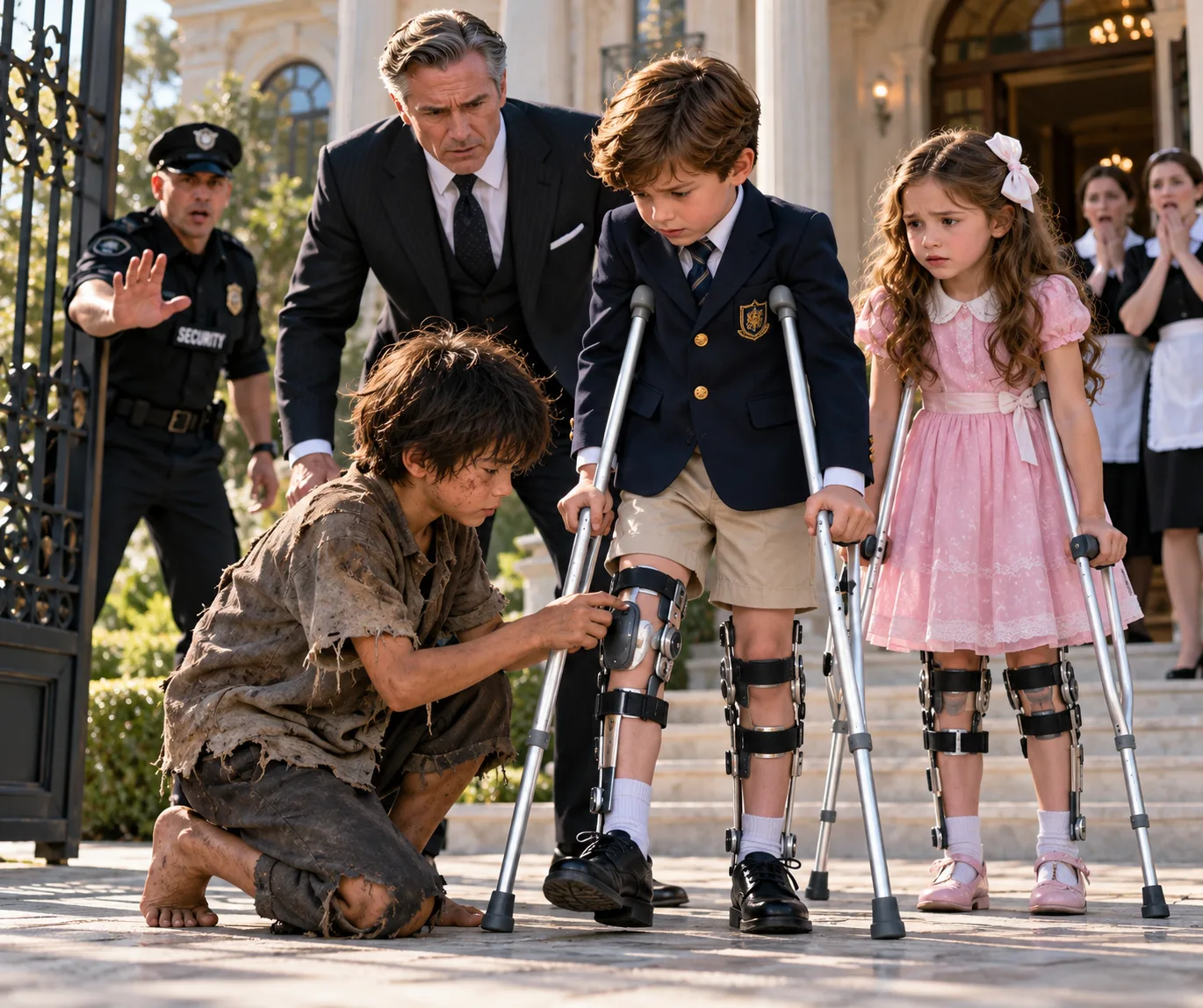
A year before anyone used the word disease, Ethan and Emily Whitmore ran so hard through the gardens that the staff complained about muddy footprints on the marble floors.
Alexander never stopped them.
He liked the noise.
It made the estate feel less like a museum built by dead relatives and more like a home.
Then Ethan began waking in the night with pain behind both knees.
At first, Alexander thought it was growing pain.
Ethan was eight, restless, always climbing something he had been told not to climb.
Three weeks later, Emily started limping.
That was the moment Alexander stopped sleeping.
The first doctor found nothing unusual.
The second ordered scans.
The third suggested inflammation.
Alexander flew specialists in from Boston, Chicago, and Los Angeles, then sent the children to private clinics where the waiting rooms had original paintings and coffee served in porcelain cups.
Every answer sounded different.
Every result looked the same.
Nothing explained why two healthy twins were losing strength in nearly identical ways.
Dr. Victor Hale arrived during the second month.
He was in his fifties, silver at the temples, soft-spoken, and so calm that frightened people trusted him before they realized they had made a decision.
He studied the twins' charts for nearly an hour.
Then he folded his hands.
"I think we're looking at a rare progressive neuromuscular disorder."
Alexander stared at him.
"You think?"
"The early stages are often difficult to catch."
"Then catch it."
Victor did not flinch.
"I intend to."
Within weeks, the children were wearing custom metal leg braces.
The devices were black, polished, expensive, and heavy enough that Ethan joked they made him look like a robot.
The joke lasted two days.
On the third day, Ethan cried during therapy.
Not loudly.
That was what frightened Alexander.
His son gripped the parallel bars until his knuckles whitened and tried to swallow the sound.
"Where?" Alexander asked.
Ethan touched the back of his knee.
"There."
Victor crouched beside him.
"Pressure is normal at first."
Emily looked up from the chair where a nurse was adjusting her own brace.
"Mine hurts there too."
Victor's eyes moved to her, then back to Alexander.
"Their bodies are adapting."
Alexander wanted to believe him.
Belief was easier than helplessness.
So when the twins complained, he repeated the doctor's words.
"You have to be strong."
He said it to Ethan on the stairs.
He said it to Emily in the therapy room.
He said it until the sentence began to sound like something another man had taught him.
The weeks became months.
Ethan stopped trying to race his sister.
Emily stopped asking when she could go back to ballet.
By winter, both children leaned heavily on wooden crutches.
Alexander spent millions.
He hired private nurses.
He converted a wing of the mansion into a treatment suite.
He installed a small medical office for Victor so the doctor could stay overnight when necessary.
His mother, Margaret Whitmore, praised every decision.
"You're doing everything a father can do," she told him.
Margaret was elegant, controlled, and never seen with a hair out of place.
She had practically raised the twins after their mother died and had attended almost every appointment.
When Emily cried, Margaret brushed her hair.
When Ethan grew angry, Margaret brought him books about explorers who survived impossible things.
Alexander trusted her almost as much as he trusted himself.
He trusted Victor because Margaret trusted Victor.
And when his older sister Vivian called from Switzerland, Margaret reassured her that the family had the best people money could buy.
Vivian was the public face of the Whitmore Family Foundation, photographed beside hospital wings and scholarship recipients.
She sent the twins gifts and cheerful video messages.
"Keep fighting," she told them.
One bright morning near the end of winter, Alexander stood in front of the mansion while Ethan and Emily practiced walking.
Ethan wore a navy blazer and shorts because he insisted he could dress "like a normal person" even if he could not walk like one.
Emily wore a pink dress and a white ribbon in her hair.
Their crutches pressed into the grass.
The metal braces clicked with every step.
Click.
Step.
Click.
Pain.
Emily stopped.
Alexander moved toward her.
"What is it?"
She looked down at the brace around her right leg.
"It did it again."
"Did what?"
Emily lowered her voice, as if the brace might hear her.
"It clicks before it bites."
Alexander frowned.
A guard near the gate shouted.
Then someone ran across the driveway.
Bare feet slapped against stone.
A ragged boy, thin and dirty, burst through the open gate with two security men behind him.
He did not look at the mansion.
He did not look at the cars.
He looked only at Ethan's legs.
The boy's face changed.
He dropped to his knees beside Ethan and grabbed the metal hinge behind his knee.
Alexander's blood turned cold.
"Take your hands off my son."
The boy looked up.
Fear filled his eyes.
But recognition was stronger.
"Sir," he whispered, "this thing isn't helping him."
Then he turned to Emily's brace.
He touched the same joint.
His face went pale.
"Hers is the same."
Emily gripped her crutches.
"Daddy?"
The boy stood slowly.
Alexander watched the boy's dirty fingers rest on the brace and saw the guards waiting for permission to drag him away.
A year of specialists had taught Alexander to recognize confidence, credentials, and expensive certainty.
The boy had none of those things.
What he had was terror.
Not terror of being arrested.
Terror of the metal touching Ethan's leg.
Emily shifted her weight and winced.
"Daddy, he's looking at it like Dr. Chen looks at bad X-rays."
Alexander almost corrected her, then stopped.
Children noticed expressions adults ignored.
Leo leaned closer without touching the brace again.
"Did it start hurting more after they tightened the knee joint?"
Ethan blinked.
"How did you know they tightened it?"
"Because the leather strap is newer than the lower one, and the hinge is sitting too far back."
The nearest guard looked at Alexander.
That was the first moment skepticism shifted into unease.
Leo pointed without contact.
"And there's a scrape mark under the plate. Somebody opens it a lot."
Alexander crouched.
He had watched nurses remove the braces dozens of times, but he had never looked at the tiny scratches around the inner screw heads.
He saw them now.
Fresh silver lines cut through black paint.
Something inside him broke quietly.
He had paid for every consultation, every scan, every device.
He had confused paying attention with paying invoices.
"Nobody touches the children," he told security.
Then he looked at Leo.
"You get one chance to explain everything you think you see."
Leo shook his head.
"I don't think I see it."
He looked at Ethan and Emily.
"I know what it does."
"If they keep wearing these," he said, "they may never walk normally again."