CHAPTER 1: THE CAKE AND THE EIGHTEEN THOUSAND DOLLARS
The moment my daughter-in-law deliberately sent my sixty-fifth birthday cake tumbling onto the patio, she thought she had humiliated me.
She had no idea she had just ended a full year of silence.
I saw Sloan’s elbow move.
That is the detail people kept asking me about afterward.
“Are you sure it wasn’t an accident?”
Yes.
I was sure.
I saw the tiny shift of her shoulder.
I saw her glance toward me first.
And most of all, I saw the faint smile that appeared at the corner of her mouth just before Brenda’s homemade lemon cake slid off the edge of the patio table.
Brenda had spent most of the previous evening making it.
She was my closest friend, my neighbor of seventeen years, and one of the few people who knew how much I had been dreading that birthday.
Not because I minded turning sixty-five.
Age had never frightened me.
What frightened me was the possibility that I would spend another year walking on eggshells inside the house my husband and I had worked thirty-two years to pay for.
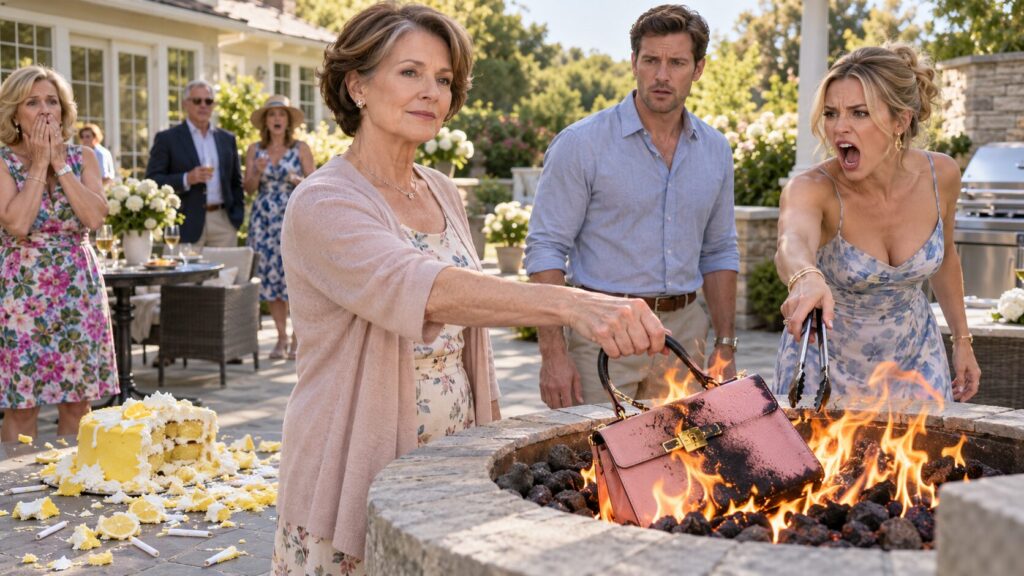
The cake hit the patio stones with a soft, wet crash.
Yellow frosting splattered across the gray pavers.
One layer broke cleanly in half.
Sixty-five white candles scattered in every direction, rolling beneath chairs and shoes.
The entire backyard went silent.
Brenda covered her mouth.
My neighbor Tom stopped in the middle of raising his beer.
His wife, Diane, stared at Sloan as though she couldn’t believe what she had just seen.
And my son Harrison stood beside the grill.
Thirty-five years old.
Six feet tall.
A grown man.
My only child.
He looked down.
That hurt more than the cake.
Sloan stared at the wreckage for perhaps two seconds.
Then she lifted one perfectly shaped eyebrow.
“Oops.”
Just that.
Oops.
No apology.
No attempt to pick up the plate.
No embarrassment.
She adjusted the bracelet on her wrist and took a sip of white wine.
Something inside me became very still.
For almost a year, I had told myself that keeping the peace was more important than winning small battles.
I had swallowed comments.
I had ignored slammed doors.
I had pretended not to notice when my things were moved.
I had stopped objecting when Sloan invited people into my home without asking.
I had stopped saying anything when Harrison sighed the moment I opened my mouth.
I had trained myself to ask permission before using spaces I owned.
Some people explode when they finally reach their limit.
I didn’t.
I became calm.
On the other side of the patio, beside the fire pit, Sloan’s Gucci handbag sat on a lounge chair.
She had shown it to nearly everyone that afternoon.
“Limited seasonal color,” she had told Diane.
“Harbor Rose.”
Later she told Brenda, “Harrison surprised me with it.”
I remembered looking at Harrison when she said that.
He had smiled, but not quite.
At the time, I had assumed he was distracted.
Now I walked across the patio.
I heard Brenda whisper my name.
“Carol?”
I didn’t answer.
I picked up Sloan’s handbag.
For the first time all afternoon, she looked concerned.
“What are you doing?”
I carried the handbag three more steps.
Then I placed it directly into the glowing embers of the fire pit.
For half a second, nobody moved.
Then Sloan screamed.
“Are you insane?”
Harrison finally found his voice.
“Mom!”
Smoke curled from one leather handle.
He rushed toward me.
“What are you doing?”
I looked directly into his furious face.
Then I used the same quiet voice Sloan had used.
“Oops.”
Brenda made a sound that was half gasp, half cough.
Tom turned away because he was trying not to laugh.
Sloan shoved past Harrison and grabbed the metal fire tongs.
She pulled the bag out, but one side was already scorched.
The handle had blackened.
A gold clasp had changed color from the heat.
“My bag!”
She looked at me with absolute disbelief.
“That cost twenty-five hundred dollars!”
I looked down at the remains of my birthday cake.
“Then you should take better care of your things.”
Her face went red.
“You did that on purpose.”
And there it was.
The sentence I had been waiting a year to hear.
I looked at her.
“So did you.”
The backyard became silent again.
Sloan stared at me.
Harrison stepped between us.
“Mom, stop.”
I almost laughed.
Stop.
That had become my son’s favorite word.
Stop complaining.
Stop overreacting.
Stop making things awkward.
Stop criticizing Sloan.
Stop bringing it up.
Stop making everything into a fight.
For twelve months, I had stopped.
That afternoon, on my sixty-fifth birthday, I decided I was finished.
I picked up one of the fallen candles.
Wax had sunk into the frosting.
I set it on the ruined cake.
“The party’s over.”
Harrison stared at me.
“What?”
“I said the party is over.”
People began gathering purses, jackets, casserole dishes.
Nobody argued.
Sloan was still holding the damaged handbag like an injured animal.
As Brenda walked past me, she squeezed my arm.
“You call me tonight.”
I nodded.
Then I stood at the patio door and watched every guest leave.
Everyone except the two people I wanted gone most.
Harrison and Sloan lived with me.
“Temporarily.”
That was the word we had used eleven months earlier.
They had been between apartments after Harrison’s company eliminated his department.
He had found another job within six weeks, but rents had increased, Sloan disliked every place they toured, and there was always some reason moving had to wait another month.
My house had four bedrooms.
I was widowed.
Of course I had said yes.
I would do it again.
That is the terrible thing about love.
Knowing how something ends does not always mean you would refuse to begin it.
I had wanted to help my son.
I had not realized that helping him would eventually require disappearing inside my own home.
That night, no one ate dinner.
I locked myself in my bedroom.
At 10:43, someone knocked.
Harrison.
“Mom.”
I closed the book I hadn’t been reading.
“What?”
“We need to talk about today.”
“No, we don’t.”
“Yes, we do.”
I opened the door.
His face was tight.
“Sloan is devastated.”
I almost admired the sentence.
Not angry.
Not embarrassed.
Devastated.
As if I had walked into a hospital and unplugged someone’s life support.
“My birthday cake is still on the patio.”
“You burned her purse.”
“She knocked my cake onto the ground.”
“She says it was an accident.”
“Then my hand slipped too.”
His jaw tightened.
“You’re being childish.”
Something changed in my chest when he said that.
Not because it was the cruelest thing he had ever said to me.
It wasn’t.
But because suddenly I heard him clearly.
Not as my little boy.
Not as the exhausted man I had spent a year excusing.
As an adult speaking to another adult.
And once I heard him that way, I stopped translating his words into something gentler.
“I’m going to bed,” I said.
“She expects an apology.”