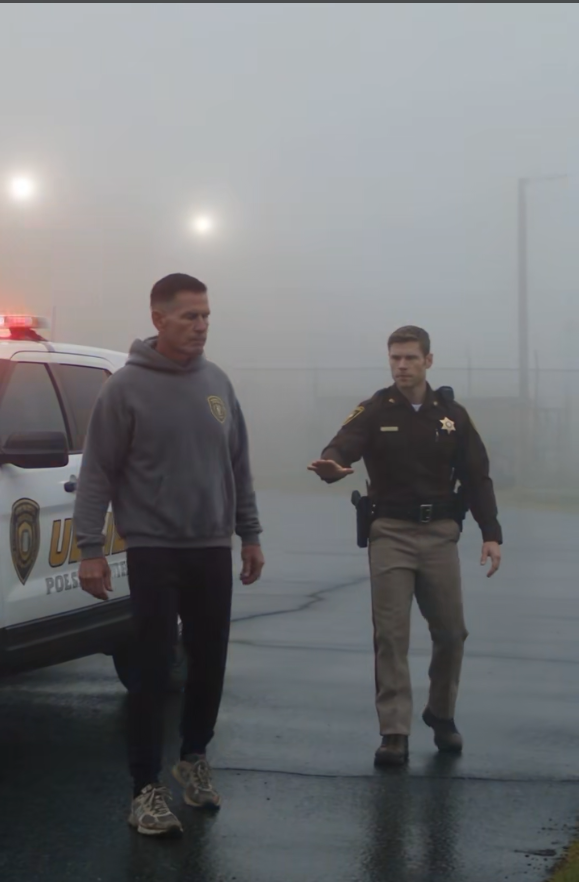
“Good.”
“Warehouse safety supervisor.”
I nodded.
“Less exciting.”
“Exciting is overrated.”
That almost became a smile.
Then he looked down at his coffee.
“I watched the body camera again.”
I waited.
“From Saturday.”
“What did you see?”
He rubbed both hands together once.
“Me.”
“That's usually how body cameras work.”
This time he did smile, briefly.
Then it disappeared.
“I kept waiting for the moment where you did something that justified what I thought.”
“And?”
“There wasn't one.”
“No.”
“You were irritating.”
“I've been told.”
“You kept telling me to verify.”
“Yes.”
“I thought you were challenging me.”
“I was.”
He looked up.
That answer surprised him.
“I was challenging your conclusion,” I said. “Not your authority to investigate.”
He nodded slowly.
“I didn't know the difference.”
“Do you now?”
“I think so.”
He stared at the table again.
“Voss was right about one thing.”
I said nothing.
“He knew what I wanted.”
“What was that?”
“To catch people.”
The coffee shop door opened behind us. Someone came in from the rain, bringing a gust of cold air.
Lawson continued.
“My dad was a deputy. Everybody talked about how he could walk into a room and know who was lying.”
“That true?”
“I don't know anymore.”
A pause.
“I wanted to be like that.”
“So you trained yourself to decide early.”
“Yes.”
“And confirmation felt like instinct.”
He looked at me.
“Yes.”
It was the most honest thing I had heard him say.
“Instinct has value,” I said.
He waited.
“But instinct is a question. Not an answer.”
Lawson nodded.
“I wish somebody had told me that.”
“Someone probably did.”
He gave a quiet laugh.
“Probably.”
We sat for another moment.
Then he said, “Why didn't you destroy me?”
I looked at him.
“What do you mean?”
“You could have.”
“No.”
“Yes, you could.”
“Maybe professionally.”
“That counts.”
“You did most of the professional damage yourself.”
He absorbed that.
“I thought you'd make an example out of me.”
“I did.”
His face changed.
I continued.
“Just not the example you mean.”
He waited.
“You are the example we now use when teaching young leaders what happens when certainty outruns evidence.”
He looked away.
“That isn't exactly comforting.”
“It wasn't intended to be.”
A few seconds passed.
Then I added, “But we also use the investigation as an example of why systems cannot depend on everyone making perfect decisions.”
He looked back.
“Meaning?”
“Meaning a good system should have caught your mistake before it became a pattern. Supervisors should have reviewed stops. Complaints should have connected. Dispatch anomalies should have been noticed. Our security personnel should have linked perimeter incidents. My own organization missed things.”
“You're saying it wasn't all me.”
“No.”
He seemed relieved.
I held up a hand slightly.
“I am also saying that none of that makes your choices someone else's fault.”
The relief vanished.
“Right.”
“Both things can be true.”
He nodded.
Then he took a slow breath.
“I am sorry.”
Not sir.
Not General.
No explanation after it.
No I didn't know who you were.
No if I offended you.
Just the words.
I believed him.
That did not erase Saturday.
It did not erase Ortega.
It did not restore his badge.
But apologies are not time machines.
Their value is smaller and harder.
They tell you whether a person can finally see the thing he did without changing its shape.
“I accept that,” I said.
His eyes lifted.
“Thank you.”
We stood.
Outside, the rain had stopped.
Lawson held the door as I left.
No salute.
That was appropriate.
Three months after the arrest, I ran the northern perimeter again.
Same gray hoodie.
Different shoes.
Mercer had strongly suggested I carry identification this time.
I did.
The morning was cold and clear.
No fog.
At Sector Four, new camera housings stood above the fence. Brush had been cut back. The service gate had a reinforced hinge assembly and upgraded lock.
I stopped where Lawson's cruiser had been.
Traffic moved occasionally on the county road.
For several seconds I could picture the whole scene exactly.
Red and blue lights.
Cold metal under my cheek.
Cuffs tightening.
A young deputy smiling because he thought he had found the simplest explanation.
Then the image passed.
I walked to the gate.
The replacement hinge was heavier than necessary.
Someone in maintenance had probably overcorrected after learning why the commanding general had been inspecting it.
I put one hand on the steel.
Solid.
From inside the installation, a military police vehicle approached.
It slowed.
The driver recognized me.
He began to lift a hand toward a salute through the windshield.
I shook my head and waved him on.
He grinned and continued down the road.
I took out the old notebook.
The warped pages barely closed properly anymore.
Under the original entry for Gate 4-N, I wrote one final sentence.
The fence was never the weakest point.
Then I closed the notebook, slipped it back into my hoodie, and kept running.