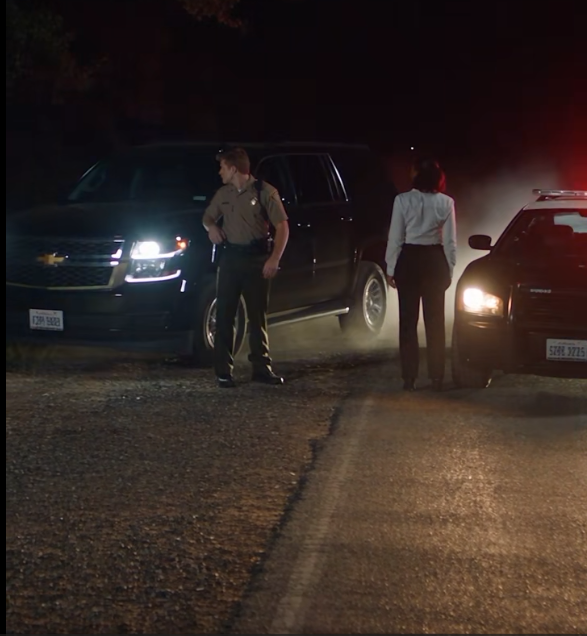
His second was assuming the helicopters were coming only for her.
The afternoon heat over Oak Haven shimmered above Interstate 89 like a sheet of warped glass, bending the road toward the horizon and turning the distant pines into wavering black silhouettes.
Sarah Hayes saw the speed-limit sign half a mile before she reached it.
SIXTY-FIVE.
Then, without warning:
FORTY-FIVE.
She eased her rented silver Chevrolet Malibu down to forty-four before the town limits sign slid past the passenger window.
No abrupt braking.
No drifting.
No nervous glance in the mirror.
Sarah had driven through enough small towns, military corridors, desert checkpoints, foreign capitals, and forgotten stretches of American highway to recognize the geography of a trap.
A faded billboard leaned beside the road ahead.
Behind it, barely visible beneath an oak tree, sat a tan sheriff’s cruiser.
Inside, Sheriff Boyd Cleary lowered his radar gun and frowned.
44 MPH.
Completely legal.
For several seconds, Boyd simply stared at the silver Malibu passing him.
Then he noticed the Washington, D.C., rental registration.
Then the driver.
A Black woman.
Alone.
Late forties, perhaps.
Hair pulled neatly away from her face.
Dark blouse.
No visible fear.
Boyd’s mouth tightened.
Oak Haven was the kind of place where everybody knew everybody, or at least knew who belonged.
And the woman in the Malibu did not.
He threw the cruiser into gear.
Sarah saw the movement in the rearview mirror almost immediately.
Thirty seconds later, red and blue lights filled the glass.
She exhaled once.
“Of course.”
She signaled, moved onto the shoulder, shifted into park, shut off the engine, lowered her window, and placed both hands high on the steering wheel.
Her father had taught her that ritual when she was sixteen.
Not because obeying every instruction guaranteed safety.
It did not.
He had made sure she understood that.
But because sometimes, in the space between authority and fear, calm was the only thing a person could control.
Boyd stepped out of his cruiser.
He was fifty-eight, thick through the waist, sun-reddened across the cheeks, with a silver mustache trimmed so precisely it looked measured. Mirrored sunglasses hid his eyes. His thumbs rested loosely near his gun belt as he approached.
“License and registration.”
Sarah looked at him.
“My license is in my wallet inside my purse on the passenger seat. Registration is in the glove compartment. May I retrieve them?”
Boyd stared at her for a moment.
“Go ahead.”
She moved slowly.
He watched every inch.
Sarah handed him the documents.
He inspected the license.
Then her face.
Then the license again.
“Sarah Hayes.”
He said it slowly, as if testing whether the name belonged to her.
“Long way from D.C.”
“I’m returning to Washington tonight.”
He tilted his head.
“I didn’t ask where you were going.”
Sarah said nothing.
He walked back to his cruiser.
Four minutes passed.
Seven.
Twelve.
Sarah waited.
When he returned, he carried neither ticket nor warning.
“You know why I stopped you?”
“No.”
“You crossed the center line.”
“I did not.”
The response came calmly.
Too calmly for him.
Boyd shifted his weight.
“I watched you do it.”
“My vehicle remained within its lane from the moment I entered the forty-five-mile-per-hour zone.”
Boyd leaned closer.
“You calling me a liar?”
“I’m describing what happened.”
“I clocked you speeding.”
“That is incorrect.”
His jaw tightened.
“You’ve got quite an attitude for somebody standing in my jurisdiction.”
Sarah’s expression did not change.
“I’m seated in a vehicle, Sheriff.”
Boyd’s nostrils flared.
Sarah continued, “If you intend to issue a citation, please do so. If you intend to detain me, I would like to know the legal basis.”
That did it.
The calm.
The precision.
The absence of pleading.
Boyd had spent thirty-three years surrounded by people who lowered their voices when he entered rooms.
He had learned to interpret fear as respect.
He mistook obedience for character.
And he considered any refusal to perform submission a personal insult.
“Step out of the vehicle.”
Sarah looked at him.
“For a traffic citation?”
“Step out.”
She opened the door.
Heat rolled across the asphalt.
Sarah stood slowly, keeping both hands visible.
Boyd motioned toward the hood.
“Turn around.”
“Sheriff Cleary,” Sarah said, “I strongly suggest that you reconsider what you’re about to do.”
He reached for her wrist.
“Are you threatening me?”
“No.”
He yanked her arm behind her.
“I am giving you a factual assessment.”
Metal closed around her wrist.
Then the other.
The cuffs bit too tightly.
Boyd leaned toward her ear.
“Resisting arrest. Disorderly conduct. Failure to comply.”
Sarah turned her head slightly.
“I complied with every instruction.”
“We’ll call it the attitude package.”
For the first time, something changed in Sarah’s face.
Not fear.
Not anger.
Recognition.
As though a puzzle piece had just slid into place.
“Very well,” she said.
Boyd smiled.
He thought she had finally surrendered.
He could not have been more wrong.
The Oak Haven Sheriff’s Department occupied a two-story brick building beside the courthouse, the post office, and a Confederate monument nobody in town seemed willing to discuss.
Deputy Toby Miller sat behind the booking desk when Boyd brought Sarah in.
Toby was twenty-six, thin, nervous, and still young enough to believe that wearing the uniform meant something better than simply belonging to the men who controlled it.
He looked at Sarah.
Then at Boyd.
“What happened?”
“Traffic stop.”
“For what?”
Boyd shot him a look.
Toby stopped talking.
Sarah was brought behind the counter.
“Empty your pockets.”
She did.
Wallet.
Lip balm.
A small folded paper containing airport parking information.
Rental-car keys.
A plain metal pen.
Then she removed a matte-black device roughly the size of a modern smartphone.
Toby frowned.
No brand.
No screen icons.
No charging port.
Just a recessed biometric pad and a thin encrypted-status strip.
Boyd picked it up.
“What’s this supposed to be?”
Sarah’s gaze shifted to his hand.
“A secured government communications device.”
Boyd laughed.
“Sure it is.”
“It contains protected systems.”
He turned it over.
“Looks like a fancy burner phone.”
“I strongly recommend that you place it on the counter and do not attempt to unlock, transmit from, dismantle, charge, connect, scan, or otherwise interfere with it.”
Toby looked at Sarah sharply.
There was no drama in her voice.
That bothered him more than drama would have.
Boyd dropped the device into a plastic evidence tray.
“Congratulations. Now it’s property.”
“It is not.”
“You’re in my jail.”
“That doesn’t alter ownership.”
Boyd grinned.
“You people from Washington really do think you own everything.”
Sarah held his gaze.
“No, Sheriff. I know exactly what belongs to whom.”
Boyd pushed the tray toward Toby.
“Log it.”
Toby hesitated.
“Sheriff—”
“Log it.”
Toby did.
Sarah was fingerprinted.
Photographed.
Searched.
Placed in a holding cell.
She never raised her voice.
Thirty minutes later, she asked for a phone call.
Boyd appeared outside the bars.
“Calling your lawyer or your mama?”
Sarah looked at the wall clock.
“Neither.”
Boyd unlocked the cell.
He escorted her to a desk phone on the booking counter.
Sarah lifted the receiver.
Then dialed twelve digits from memory.