He had lived his final twenty-seven years alone in a modest house outside Arlington, Virginia.
Sarah had found the envelope while clearing his desk.
No military markings.
No classified labels.
Just her name.
SARAH.
Inside was a handwritten letter.
If you are reading this, I finally ran out of time.
The sentence had made her sit down.
The letter was eight pages long.
Her father described an incident from 2004 in Oak Haven County.
A soldier had disappeared.
Private First Class Marcus Bell.
Twenty-two years old.
Black.
Recently returned from overseas training.
Official records showed Bell had deserted.
His vehicle had been found abandoned near Interstate 89.
Daniel Hayes never believed it.
He had been one of the officers tasked with reviewing Bell’s disappearance.
The investigation went nowhere.
Local witnesses contradicted one another.
Evidence vanished.
The sheriff’s department claimed Bell had been seen hitchhiking north.
Then the file was closed.
Daniel kept digging quietly.
Years later, he received an anonymous envelope containing three photocopied traffic citations.
All issued by Deputy Boyd Cleary.
All involving Black motorists.
All within two miles of the location where Marcus Bell’s vehicle had been found.
Daniel wrote that he had confronted Cleary privately during a military liaison meeting in 2008.
Cleary denied everything.
Then Daniel’s home was broken into.
Nothing valuable was stolen.
Only his notes on Oak Haven.
Sarah had read that section three times.
The final page contained a sentence that refused to leave her mind.
I could never prove what happened to Marcus Bell. But if you ever pass through Oak Haven, do not trust the sheriff.
Sarah had not told General Reed about the letter.
Not immediately.
She had gone through formal channels first.
She checked archived Department of Defense records.
State complaints.
Civil-rights reports.
Traffic data.
Nothing definitive.
There were complaints against Boyd Cleary.
Lots of them.
But never enough evidence.
Every arrest had been explained.
Every dash camera malfunctioned at the wrong moment.
Every complainant eventually withdrew, moved away, or lost credibility.
Sarah had almost convinced herself her father’s suspicion had consumed him.
Then she discovered something strange.
Boyd Cleary had signed Marcus Bell’s abandoned-vehicle report in 2004.
Not as sheriff.
As a deputy.
So Sarah had arranged a trip.
Officially, she was returning from a defense preparedness conference three counties away.
Unofficially, she chose the route through Oak Haven deliberately.
She expected to drive through.
Maybe stop.
Maybe visit the old location where Bell’s car had been found.
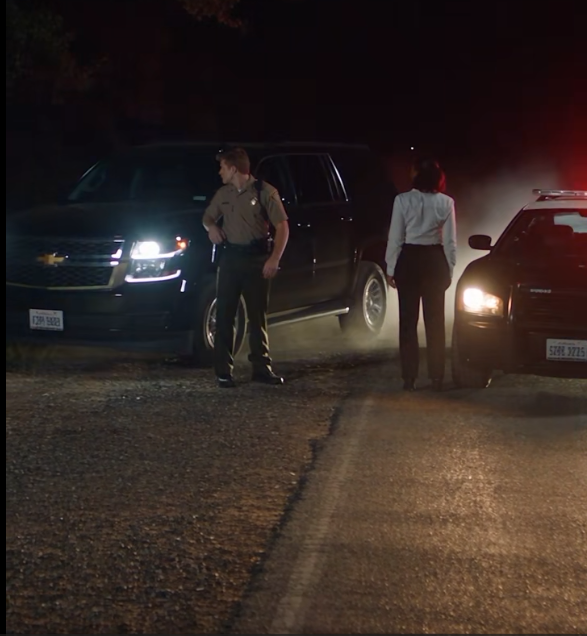
She did not expect Cleary to pull her over.
She certainly did not expect him to arrest her.
But the moment he said the words “attitude package,” she remembered them.
The phrase appeared in one of her father’s notes.
A witness claimed Deputy Cleary had used it in 2004.
Sarah had never told anyone.
That was why she used Integrity Black.
Not because a general had been arrested.
Because she had just heard a living man repeat language connected to a twenty-two-year-old disappearance.
General Reed listened inside Judge Price’s chambers while Sarah told him everything.
The judge sat behind her desk.
A state investigator named Elena Ruiz stood near the window.
Toby waited outside under instructions to preserve departmental systems.
Reed stared at Sarah.
“You deliberately drove through Oak Haven?”
“Yes.”
“You deliberately kept this from my office?”
“I did not want institutional weight contaminating an inquiry without evidence.”
“You’re a brigadier general.”
“I’m aware.”
“You could have gotten hurt.”
Sarah’s face remained still.
“So could every person he stopped before me.”
That silenced the room.
Ruiz opened Daniel Hayes’s photocopied notes.
“Marcus Bell.”
Sarah nodded.
“What do you know about him?”
“Twenty-two. Infantry. No disciplinary record. No known reason to desert. He had called his mother the morning he disappeared and told her he would see her the next day.”
Judge Price spoke softly.
“I remember that case.”
Sarah looked at her.
The judge’s face had changed.
“What do you remember?”
“People were afraid.”
“Of Boyd?”
Price looked away.
“Of more than Boyd.”
Ruiz turned.
“What does that mean?”
Judge Price hesitated.
Then someone pounded on the chamber door.
Toby entered.
His face was pale.
“We have a problem.”
“What?”
“The server.”
Ruiz frowned.
“What about it?”
“Someone’s deleting files.”
They ran.
The sheriff’s department server room was barely larger than a closet.
Toby sat at a terminal.
Lines of text crawled across the screen.
“Remote access.”
Ruiz leaned over him.
“Can you stop it?”
“I killed the outside connection.”
“Did it work?”
“I don’t know.”
A technician from Reed’s security team entered.
He plugged an isolated forensic system into the network.
“Deletion scripts were triggered twelve minutes ago.”
Sarah looked at Boyd’s office.
He was gone.
“Where’s Cleary?”
Toby stood.
“He was in the interview room.”
Ruiz swore.
They rushed toward the rear exit.
Empty.
Boyd’s cruiser was gone.
Ruiz grabbed her radio.
“State units, BOLO Sheriff Boyd Cleary. Do not approach alone.”
Sarah turned toward Toby.
“What was being deleted?”
He swallowed.
“Traffic-stop videos.”
“What years?”
“All of them.”
The technician shook his head.
“Not all. Search is targeted.”
He turned the screen.
A directory list appeared.
CASE_BELL.
Sarah stopped breathing.
Ruiz whispered, “He had a folder.”
Sarah stepped closer.
Inside were scans.
Old photographs.
Audio files.
A spreadsheet.
And one image that made her grip the edge of the desk.
Marcus Bell.
Young.
Smiling.
Wearing Army fatigues.
Standing beside a woman outside a gas station.
The woman’s face was partially obscured.
Sarah stared.
Something about her seemed familiar.
“What is this?”
Toby clicked file properties.
“Scanned in 2011.”
Sarah’s pulse quickened.
Her father had died believing no proof existed.
Yet Boyd had kept a private archive.
Why?
Ruiz opened the spreadsheet.
Names.
Dates.
License plates.
Traffic-stop locations.
Mostly Black and Latino drivers.
Some military.
Some federal employees.
Beside certain names were initials.
Numbers.
And one repeated notation:
D.H.
Sarah felt cold despite the summer heat.
“Daniel Hayes,” she whispered.
Reed looked at her.
“Your father?”
“I don’t know.”
The technician opened another file.
A photograph.
Daniel Hayes.
Taken from a distance.
Leaving a diner.
Date-stamped 2008.
Sarah felt the room contract.
Ruiz said, “Cleary was watching your father.”
“No.”
Sarah stared closer.
“Someone was.”
Because the photograph had not been taken by Boyd.
She recognized the camera angle.
She recognized the date.
And suddenly she remembered a detail from her childhood.
Her father had not visited Oak Haven alone in 2008.
Sarah had been with him.
She had been twenty-nine.
A major.
They were driving south after a family funeral.
Daniel had said he wanted coffee.
They stopped at a diner.
Sarah had gone inside.
Her father remained outside speaking to someone in a tan uniform.
She never saw the man’s face.
Until now.
Behind Daniel in the photograph stood a much younger Boyd Cleary.
But Daniel was not confronting him.
They were shaking hands.
Boyd’s cruiser was found forty minutes later.
Abandoned near a closed sawmill.
No Boyd.
No weapon.
No radio.
Only his sunglasses sitting on the driver’s seat.
Ruiz organized search teams.
Reed wanted Sarah evacuated.
She refused.
“This is now an active criminal investigation.”