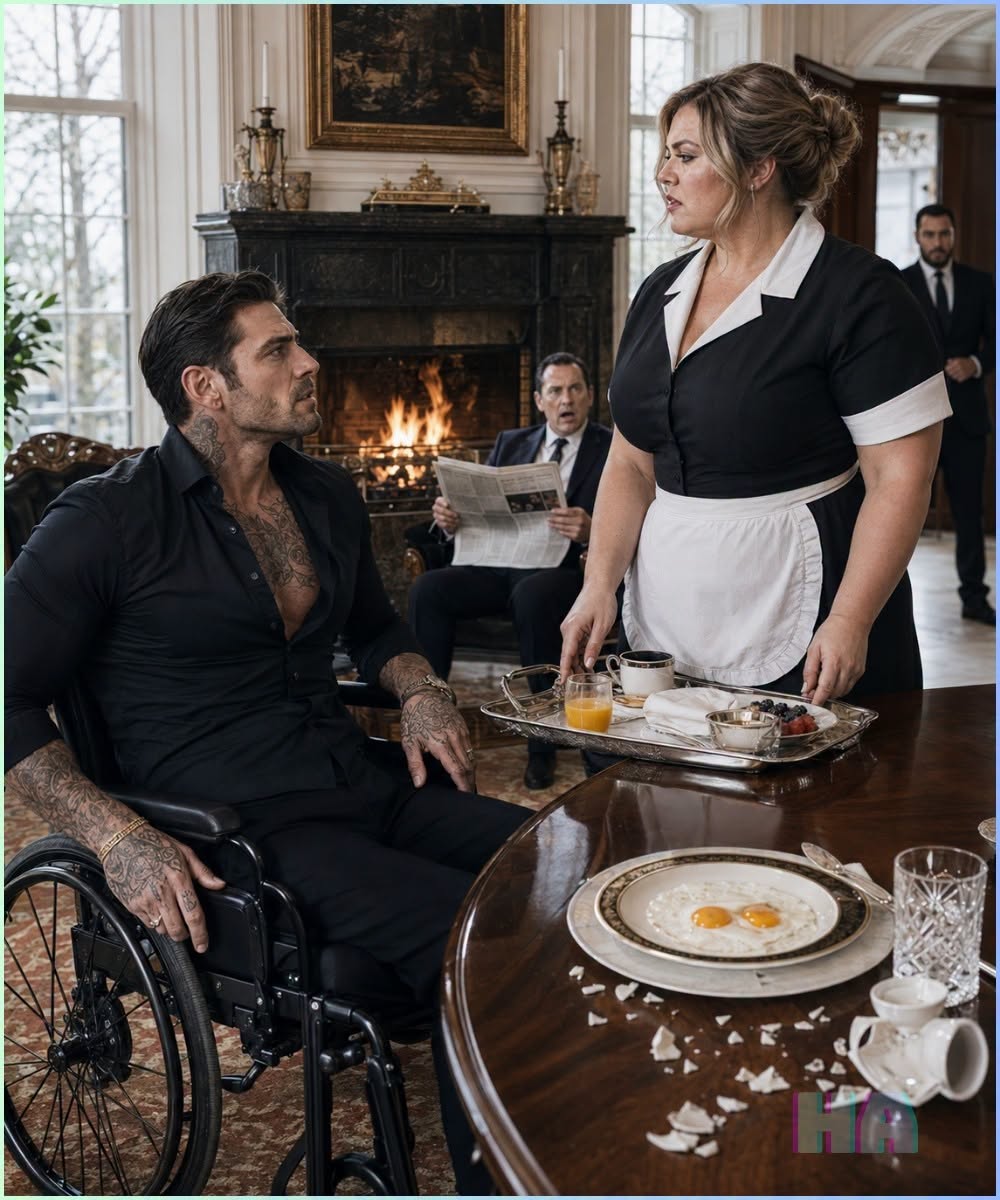
The next three months were a descent into hell.
The library was cleared of its antique rugs and furniture, replaced by parallel wooden bars, high-density foam mats, and heavy physical therapy equipment shipped directly from a private clinic in Switzerland.
Dr. Aris, a lean, gray-haired specialist with the cold demeanor of a surgeon, arrived every morning at seven. But it was Nora who stood at the end of the bars.
“Again,” she said.
It was three o'clock on a humid July afternoon. Sweat dripped from Vincent’s jaw, soaking the collar of his gray training shirt. His steel-and-carbon-fiber leg braces creaked under the weight of his upper body as he forced his right foot forward three inches.
The pain was a white-hot knife tearing through his lower spine, a blinding sensation that made his vision narrow into a pinprick of blackness.
“I can't,” he gasped, his fingers locked around the polished oak bars so tight his knuckles were white as bone. “The nerve... it’s dead.”
“It’s not dead,” Nora said, stepping right into his line of sight. She was wearing her usual dark uniform, her sleeves rolled up to her elbows, showing the strong, freckled forearms that had supported him a hundred times over the past weeks. “It’s lazy. Move the left foot, Vincent.”
“Nora—”
“Move it!” she commanded, her voice ringing out through the empty room like a whip crack.
With a roar of frustration that tore from his chest, Vincent drove his weight into his arms, lifted his left hip, and swung the braced leg forward.
Foot hit the mat.
Clang.
He was standing. Fully upright. Six-foot-two of solid steel and muscle, supported by the braces and his own sheer, unadulterated hatred of failure.
He was shaking violently, his chest heaving as if he had just run ten miles, but his head was four inches higher than hers.
For the first time in five months, Vincent Hale was looking down at Nora Hayes.
Nora didn't move back. She stood right in front of his chest, her hands raised two inches beneath his elbows, ready to catch him if the braces failed, her face flushed with the heat of the room.
“Look at that,” she whispered, her voice suddenly soft, breathless, rich with an emotion she couldn't quite hide. “Look at you.”
Vincent looked down at her face. Up close, he could see the sweat glistening on her collarbone, the rapid pulse fluttering in the side of her neck, and the fierce, incredible pride shining in her eyes—a pride that wasn't for his money, his power, or his name, but for him.
“Nora,” he rasped, his hand slipping off the bar and coming down to rest heavy and warm on her shoulder.
His weight shifted instantly. The right brace locked with a sharp metallic click, but the strain was too much for his exhausted lower back. He began to tilt forward.
Nora didn't step back. She stepped in.
She caught his massive frame against her body, her arms wrapping around his waist, her face buried into his shoulder as they sank together in a slow, controlled heap onto the thick foam mat.
They lay there in the center of the room, breathing in unison, the sound of their ragged air filling the quiet afternoon.
Vincent’s face was pressed into the soft crook of her neck. He didn't move. He didn't try to pull away. He lay there, feeling the heavy, rhythmic beat of her heart against his ribs, feeling the soft, generous curve of her hips pinned beneath his leg, smelling the crisp lavendar and sweet sweat of her skin.
“You held me,” he murmured into her hair, his voice rough and low.
“I told you,” she whispered, her fingers resting gently against the back of his neck, her thumb brushing the short hair at his hairline. “I don't drop things.”
Vincent raised his head slowly. His gray eyes were intense, dark, stripped of every defense he had spent forty years constructing. He reached out with his right hand—his trembling hand—and pressed his knuckles against her cheek.
The trembling stopped.
For five seconds, his hand was completely, perfectly steady against her skin.
Nora held her breath, her hazel eyes widening as she felt the cool, firm strength of his fingers trailing down her jawline to her chin.
“Vincent,” she whispered, using his first name without the 'Mr.' for the very first time.
Before he could speak, the heavy double doors of the library swung open.
Dominic stood in the doorway, a thick manila envelope in his hand. He froze, his eyes scanning the scene on the floor—the boss lying across the maid, her hand in his hair, his fingers on her face, both of them breathing as if they had just shared a bed.
Dominic didn't look shocked. He looked extremely, gravely serious.
“Vincent,” Dominic said quietly, stepping inside and closing the door behind him. “Morelli just bought the security contract for the harbor ball. They’re planning to bar the entrance to anyone in a wheelchair.”