Maybe that was enough.
Then he thought of the eleven addresses.
The teacher who had paid.
The couple who had removed their fence.
People who did not have videos.
People who had trusted official-looking notices because those notices came from an organization that was supposed to follow its own rules.
“What happens to the other enforcement cases?” Daniel asked.
The attorney said, “They would be reviewed.”
“By whom?”
“The board and counsel.”
“Privately?”
“Potentially.”
“Would homeowners be told why their fines were invalid?”
“If determined invalid, they would receive appropriate notice.”
Daniel looked at the treasurer.
“Would they get the report?”
The man hesitated.
“Probably not.”
Daniel nodded.
There was his choice.
Not between winning and losing.
He had already won his own dispute.
The choice was between resolution and record.
Between accepting a private correction that restored what should never have been taken from him, and insisting the system explain itself to everyone it had touched.
The second path would cost more.
It might create lawsuits.
Neighbors would accuse him of driving up dues.
Patricia would say he wanted revenge.
The association could spend months untangling decisions.
Daniel had spent years in systems where one wrong entry could propagate because people trusted what appeared on the screen.
The fix was never to quietly correct the final output.
You found the source.
You documented the failure.
You made sure the same false data could not simply reappear later under another name.
He looked at the attorney.
“I’m not signing that.”
The treasurer exhaled.
The secretary looked at him, but not with surprise.
The attorney said, “You understand there may be financial consequences for the association.”
“Yes.”
“Which you are a member of.”
“Yes.”
“You could personally pay part of those consequences through assessments.”
“I understand.”
“What do you want?”
Daniel thought for a moment.
“A full independent review of every enforcement action tied to those disputed approvals.”
The attorney listened.
“Every homeowner notified.”
She nodded slightly.
“Every unauthorized fine returned.”
Another nod.
“The board minutes corrected where decisions were represented as having happened when they didn’t.”
The treasurer shifted.
Daniel continued.
“And the recovered report goes to the police.”
The attorney’s expression changed.
“That final decision involves legal considerations.”
“Then consider them.”
“Mr. Mercer—”
“No.”
His voice remained quiet.
“You’re asking me to accept a written statement saying the notice about me was inaccurate.”
“Yes.”
“It wasn’t inaccurate.”
The attorney stopped.
“It was fabricated.”
No one spoke.
Daniel pointed toward the clubhouse.
“She wrote it before the event.”
The attorney said nothing.
“That’s not a wording problem.”
Daniel opened the door.
He looked back once.
“I don’t need Patricia destroyed.”
Then he glanced toward the room where eleven disputed cases had become real people.
“But I’m not helping her turn this into a misunderstanding.”
He returned to his seat.
Emily looked at him.
“What happened?”
“She offered to resign.”
“That sounds good.”
“It is.”
“And?”
“She wanted everything else quiet.”
Emily understood.
“What did you say?”
“No.”
A small smile appeared.
Rachel leaned over.
“Good.”
Daniel looked at her.
“You might say that less enthusiastically when the legal bill arrives.”
“I’ll complain about you at the mailbox.”
“Fair.”
The board returned five minutes later.
The treasurer took his seat.
Patricia looked at him.
He did not look away.
“The board has considered the proposed voluntary resolution,” he said. “We will not accept conditions restricting the ongoing review.”
Patricia’s expression hardened.
The treasurer continued.
“The motion remains to remove Mrs. Langford as president, suspend her board authority, preserve all records, conduct an independent review of affected enforcement actions, and provide relevant recovered materials to law enforcement and the association’s insurer.”
Patricia stood.
“You are exposing this association to enormous liability.”
The treasurer looked exhausted.
“Maybe.”
“You have a duty to protect the association.”
“Yes.”
“Then act like it.”
His reply was quiet.
“That’s what we should have done earlier.”
The vote was unanimous.
Patricia did not wait for homeowner applause.
She gathered her folder and walked toward the door.
At the aisle beside Daniel, she stopped.
He stood.
For a moment they simply looked at each other.
She seemed older than she had on his driveway.
Not broken.
Not defeated.
Just stripped of certainty.
“You could have ended this,” she said.
Daniel nodded.
“So could you.”
Her eyes moved toward Emily.
Then back.
“You think rules protect people like you.”
Daniel considered that.
“No.”
Patricia waited.
“I think people have to protect the rules.”
She gave a small, humorless smile.
“You’ll learn.”
Then she left.
Daniel watched the door close.
He suspected she believed that was the last word.
It wasn’t.
But not because he answered.
Because the record did.
Part VI — After the Badge
The police investigation lasted longer than the neighborhood expected.
There was no dramatic line of patrol cars at Patricia’s house.
No public handcuffing.
No satisfying cinematic reversal.
Reality was slower.
Statements.
Records requests.
Interviews.
Vendor contracts.
Device examinations.
The security employee maintained that he had believed Patricia expected a forceful display of authority. The company maintained that it had expressly prohibited detention or claims of police power.
Emily’s recording resolved one part.
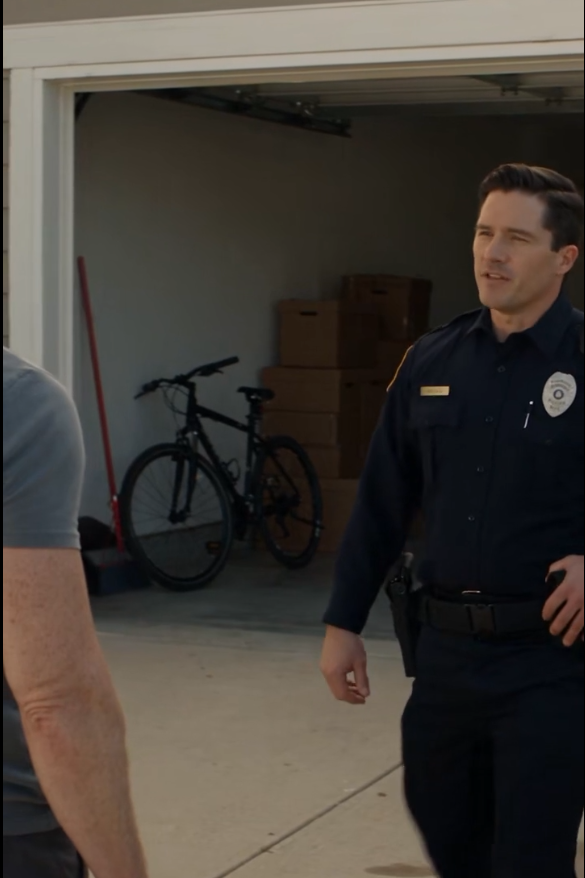
Whatever the man believed, he had threatened to put Daniel in cuffs over a civil HOA fine while allowing himself to be addressed as an officer.
The recovered emails resolved another.
Patricia had been warned about the limits of the contractor’s authority.
The prewritten incident report resolved the most important question.
Her defense had been that the confrontation unexpectedly went wrong.
The file showed she had prepared to characterize Daniel as aggressive before he had been given the opportunity to do anything at all.
Police requested a copy.
The board provided it.
Months later, prosecutors filed charges related to the contractor’s conduct and falsified records surrounding the incident. The exact outcome mattered less to Daniel than he expected.
By then the neighborhood had its own work to do.
The independent review examined all eleven disputed architectural cases.
Eight fines were found to have been imposed without documented board approval.
Six homeowners had already paid.
They received refunds.
Three residents had altered or removed improvements under notices based on unsupported enforcement decisions. The HOA agreed to cover reasonable restoration costs.
The board adopted a rule requiring enforcement votes to appear in minutes before fines above a specified level could be issued.
No single board officer could hire uniformed compliance personnel.
Architectural approvals could not be retroactively revoked without documented cause, notice, and appeal.
Records had to be retained through a centralized account rather than on one officer’s laptop.
None of the reforms were exciting.
Daniel liked them for exactly that reason.
Good systems rarely looked dramatic when they were working.
His own fine disappeared from the portal on a Tuesday morning.
$1,750 became $0.
The status beside his shed changed from VIOLATION — ACTIVE to APPROVAL CONFIRMED.
Daniel stared at the screen.
Then he called Emily.
She answered from upstairs.
“What?”
“Come here.”
“Why?”
“Just come here.”
She appeared thirty seconds later.
Daniel turned the laptop toward her.
She read the screen.
“That’s it?”
“That’s it.”
She squinted.