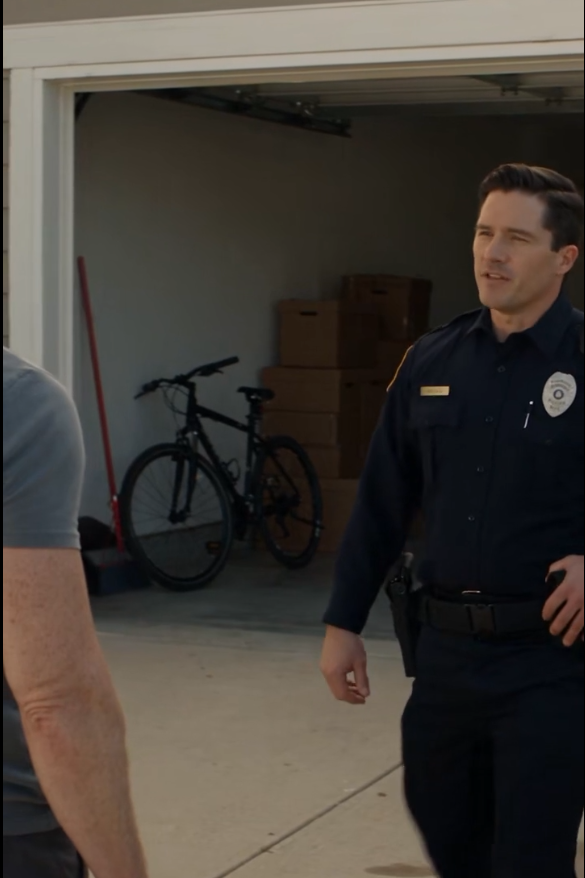
“Why?”
The answer came without hesitation.
“Because yesterday I thought we had a shed problem.”
The treasurer paused.
“Today I’m not sure what problem we have.”
Part IV — What Was Written Beforehand
Patricia did not attend the next board meeting.
She sent an email saying she had been advised to step temporarily away from administrative duties while the association reviewed “recent misunderstandings.”
Daniel read the sentence twice.
Misunderstandings.
A private contractor had threatened him with handcuffs.
The board could not identify the meeting where his fine had been authorized.
Files were missing after a preservation request.
And still Patricia had found a word soft enough to make everything sound like bad communication.
The neighborhood became quieter around him.
Not peaceful.
Careful.
People who had watched from windows now stopped Daniel while collecting mail or walking dogs. Some asked directly what had happened. Others approached sideways.
“Hope everything’s okay.”
“Heard there was some HOA confusion.”
“Patricia can be intense.”
Daniel gave the same response.
“The board is reviewing it.”
He refused to conduct the case on the sidewalk.
Rachel approved.
Emily did not.
“She sent a fake cop to our house,” she said one evening. “Why are we protecting her?”
“We’re not.”
“You won’t even tell people.”
“Tell them what?”
“The truth.”
“Which part?”
“All of it.”
Daniel set down the dish towel in his hand.
“The truth is still being figured out.”
“We have video.”
“We have video of one afternoon.”
“We know she lied about the fine.”
“We know the board can’t find the authorization.”
“That’s basically the same thing.”
“No, it isn’t.”
Emily folded her arms.
“You always do that.”
“Do what?”
“Make everything sound like court.”
Daniel studied her.
She looked away first.
He softened his voice.
“What do you want me to do?”
“Post the video.”
“No.”
“Why?”
“Because you’re in it.”
“So?”
“You’re fifteen.”
“I recorded it.”
“That doesn’t mean the whole neighborhood needs to watch you get scared in your own garage.”
Her face changed.
“I wasn’t scared.”
Daniel did not answer.
Emily looked down.
Then she said, quieter, “Not that much.”
“I was.”
That surprised her.
Daniel leaned against the counter.
“I knew something was wrong. I didn’t know how wrong.”
She watched him.
“When he touched the cuffs?”
“Yeah.”
“You didn’t look scared.”
“That wasn’t the job.”
“What was?”
“Getting you inside.”
“You failed at that.”
He laughed once.
“Completely.”
Emily’s mouth lifted.
Then Daniel became serious again.
“The video is evidence. Right now that matters more than making Patricia look bad online.”
“She already looks bad.”
“Probably.”
“Definitely.”
He picked up the towel.
Emily watched him for another moment.
“You think there’s more.”
“Yes.”
“So do I.”
The forensic review took twelve days.
Daniel hated every one of them.
He was not good at waiting when the missing information existed somewhere and someone else controlled access to it.
The Army had trained him to troubleshoot systems by isolating failures. Check the physical layer. Check power. Check routing. Check configuration. Remove assumptions one by one until the problem could no longer hide.
But this was not a radio network.
He could not open Patricia’s laptop.
He could not compel records.
He could not force the board to move faster.
So he did the only thing available.
He documented.
Every notice.
Every email.
Every version of the architectural rules.
Every date.
He created a timeline.
Shed approval.
First violation.
His response.
Patricia’s refusal.
Hearing request.
No hearing.
Fine.
Records request.
Additional warning.
Rachel’s pre-visit conversation.
Security visit.
Police call.
Escalation notice.
Preservation request.
Deleted files.
When the timeline was complete, one detail stood out.
The escalated compliance notice had been sent at 7:12 a.m. the morning after the incident.
Daniel returned to it again.
Its wording was strangely specific.
Homeowner became increasingly confrontational despite repeated attempts by the association’s authorized representative to de-escalate the encounter.
That had not happened.
The contractor had escalated.
Daniel had barely moved.
The notice continued:
Homeowner refused lawful compliance direction and challenged the representative’s authority in a manner that caused the situation to deteriorate.
Another sentence:
Outside authorities were contacted as a direct result of the homeowner’s refusal to cooperate.
Daniel stared at the paragraph.
It did not merely misrepresent the event.
It reversed it.
He opened Emily’s video.
At 00:43, Daniel asked for the man’s department.
At 01:02, Patricia told the “officer” not to debate.
At 01:11, the man reached toward his cuffs and said last warning.
At 01:27, Daniel asked for badge and ID.
At 02:10, Daniel said he was calling police.
Everything in the notice was backward.
He added a note to the timeline.
Three days later, the treasurer called.
“Can you come to the clubhouse tonight?”
“What happened?”
“I’d rather show you.”
“Who’ll be there?”
“Me, the secretary, association counsel, and an investigator retained by our insurance carrier.”
Daniel looked toward the clock.
“Patricia?”
“No.”
“Why not?”
Another pause.
“She’s been told not to access association records or represent the board pending review.”
Daniel said nothing.
The treasurer continued.
“Daniel?”
“I’m here.”
“Seven?”
“I’ll be there.”
The clubhouse felt different without Patricia sitting at the center.
The treasurer stood when Daniel entered.
The secretary remained seated beside a woman with a legal pad and a man Daniel assumed was the investigator.
They did not waste time.
The investigator explained that the association laptop had been examined because files appeared to have been deleted after Daniel’s preservation request.
Some deleted material had been recovered.
Daniel sat very still.
The investigator placed a printed page in front of him.
It was an email.
From Patricia to the private security contractor.
Dated four days before the driveway visit.
Subject: MERCER COMPLIANCE.
Daniel read.
The instructions were written in Patricia’s familiar clipped style.
Resident has demonstrated ongoing refusal to respect board authority. Uniformed presence requested. Make clear that continued noncompliance will have consequences. Do not engage in prolonged argument.
Daniel looked up.
“That’s bad.”
The investigator nodded.
“But not conclusive.”
“Because it doesn’t say police.”
“Correct.”
He placed another document on the table.
A reply from the contractor.
We can provide a uniformed compliance specialist. No law-enforcement authority represented. Any detention or physical enforcement is outside scope.
Daniel read that twice.
The contractor had warned her.
He looked at the investigator.
“So the company told her exactly what they could not do.”
“Yes.”
The investigator placed down another page.
A message from Patricia the next morning.
Understood. Visual authority is the objective.
The room stayed quiet.
Daniel felt a cold steadiness settle over him.
“Visual authority.”
The investigator nodded.
“There are additional communications. She asked whether the contractor could carry standard security equipment, including cuffs. The company replied that licensed personnel could carry equipment permitted by their policy but again stated that it could not be used to enforce HOA debt.”
Daniel looked at the treasurer.
“You didn’t know about these?”
“No.”
“The board?”
The secretary shook her head.
“No.”
The investigator continued.
“The employee who came to your home appears to have violated his employer’s written instructions when he threatened detention. That remains a separate issue. But there’s evidence Mrs. Langford intentionally selected the service because she believed the appearance of police authority would pressure you.”