For a moment Daniel almost felt sorry for her.
Then he remembered the Sunday incident report.
The treasurer explained that the meeting concerned Patricia’s authority as president, disputed enforcement actions, use of association funds for private security services, and preservation of association records.
He did not mention Daniel first.
That was important.
The issue no longer belonged to one homeowner.
Patricia was allowed to speak.
She stood.
“I know many of you are upset,” she began. “And I understand why.”
Her voice was controlled.
“I also know that incomplete information has circulated, creating the impression that I intentionally placed a resident in danger or attempted to impersonate law enforcement through a contractor. That is false.”
Daniel felt Emily shift beside him.
He did not look at her.
Patricia continued.
“My responsibility as president has always been to protect property values and enforce standards evenly. Mr. Mercer’s violation became unusually difficult because he repeatedly rejected normal resolution efforts.”
Rachel whispered, “Here we go.”
Daniel stayed silent.
Patricia described the security contractor as a licensed vendor hired to deliver notices in cases where confrontations were possible.
She said the contractor had exceeded his instructions.
She said she had never authorized an arrest threat.
Technically, that part might even have been true.
Then she addressed the deleted computer files.
“Routine cleanup occurred during a system migration. Any suggestion that I intentionally destroyed evidence is irresponsible.”
The treasurer looked down at his notes.
Patricia moved to the shed.
“The underlying architectural issue remains complicated. Mr. Mercer possesses a document that appears to approve his structure, but the prior committee’s process was inconsistent. My efforts were intended to resolve that inconsistency fairly.”
Daniel heard someone behind him mutter.
Patricia kept going.
She was good at this.
Not charismatic.
Precise.
She softened the edges of each fact until none seemed sharp enough to cut.
The police-style uniform became a vendor misunderstanding.
The missing votes became procedural inconsistency.
The deleted files became cleanup.
The preexisting approval became a complicated document.
The threats became an employee exceeding instructions.
By the time she finished, the story sounded unfortunate but survivable.
Then the treasurer spoke.
“Mrs. Langford, did you create an incident summary concerning Mr. Mercer’s property?”
Patricia did not answer immediately.
“I created many draft documents.”
“This one was titled Incident Summary — Mercer Property.”
“I’d need to see it.”
The treasurer handed her a copy.
She read the first page.
Daniel watched her.
Nothing obvious happened.
No dramatic collapse.
No sudden confession.
She simply read more slowly.
The treasurer said, “For the record, forensic examination shows this file was created Sunday evening, two days before the contractor visited Mr. Mercer.”
Patricia looked up.
“It was a template.”
A murmur moved through the room.
The treasurer lifted a hand.
“What kind of template?”
“For documenting anticipated compliance interactions.”
“Why does the template state that Mr. Mercer became confrontational?”
“Draft language.”
“Why does it state that law enforcement became involved?”
“Contingency language.”
“Before the visit?”
“Yes.”
Daniel felt Emily turn toward him.
He kept his eyes on Patricia.
The treasurer continued.
“The document was edited Tuesday at 3:18 p.m.”
“I don’t remember every edit.”
“The contractor arrived at approximately 4:37.”
“I understand the timeline.”
“At 3:18, you retained language saying law enforcement became involved.”
Patricia folded the document.
“I was preparing for multiple possible outcomes.”
The secretary spoke.
“Why?”
Patricia looked at her.
“Because Mr. Mercer had a documented pattern of resistance.”
Daniel’s voice came from the audience before he consciously decided to speak.
“Documented where?”
The treasurer looked toward him.
Patricia did too.
The room quieted.
Daniel stood.
“If I’m allowed.”
The treasurer nodded.
“Briefly.”
Daniel faced Patricia.
“You said I had a documented pattern of resistance. Show me the documentation from before you started creating it.”
Patricia’s eyes narrowed.
“You challenged every enforcement communication.”
“I asked for the rule.”
“You refused compliance.”
“I showed you an approval.”
“You disputed board authority.”
“I asked for the meeting minutes.”
“This is exactly what I mean.”
Daniel paused.
Then he nodded.
“Yes.”
Patricia seemed caught off guard.
Daniel continued.
“I asked you to prove the board had done what you said it had done.”
He pointed toward the document in her hand.
“And it hadn’t.”
She looked toward the board.
“The underlying governance issues are more complicated than Mr. Mercer is representing.”
“No,” Daniel said. “The paperwork is complicated. The issue isn’t.”
The treasurer did not interrupt.
Daniel kept his voice low.
“You told me the board invalidated my approval. There’s no vote.”
Patricia said nothing.
“You told me the fine was authorized. There’s no vote.”
Nothing.
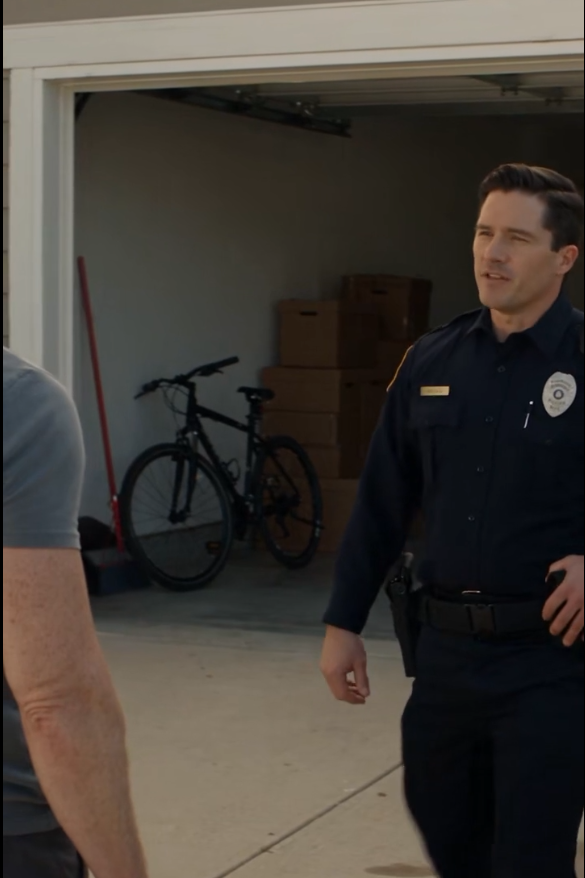
“You sent a security contractor in a police-style uniform after the contractor warned in writing that he had no law-enforcement authority.”
Her chin lifted.
“I did not instruct him to claim such authority.”
“You wrote ‘visual authority is the objective.’”
“That referred to professional presence.”
“You asked whether he could carry cuffs.”
“That was a vendor-equipment question.”
“You asked Rachel whether I had a history of aggression.”
“For safety.”
“Then before the visit, you wrote that I would become confrontational.”
Patricia’s composure thinned.
“I prepared for a predictable response.”
Daniel looked at her for several seconds.
“So that was the plan?”
“The plan was compliance.”
“No.”
He shook his head.
“The plan was to make whatever I did look like the reason you sent him.”
The room was still.
Daniel pointed toward the prewritten report.
“If I argued, I was hostile. If I paid, your fine looked legitimate. If I called the police, you had already written that outside authorities became involved because I refused to cooperate.”
Patricia’s lips pressed together.
Daniel’s voice remained calm.
“You didn’t document what happened. You wrote what needed to happen, then sent people to make the paper look true.”
For the first time, Patricia had no immediate answer.
The treasurer asked Daniel to sit.
He did.
The meeting continued.
The board presented the vendor emails.
Then the disputed enforcement spreadsheet.
Eleven properties.
Some residents recognized their addresses when the board described the review without identifying owners.
One woman in the back began crying quietly.
Not because the amounts were enormous.
Because she had paid.
Daniel learned that night that several residents had received fines based on old architectural approvals Patricia had unilaterally declared defective.
Some paid rather than fight.
Others removed fences, sheds, or exterior changes that previous committees had approved.
The board had signed routine financial reports without understanding how many enforcement decisions Patricia was making administratively.
She had not stolen the money.
That would have made the story simpler.
The funds went into HOA accounts.
Her motive had been control.
She believed prior boards had been too lenient.
She believed inconsistent architectural decisions weakened standards.
So she had begun correcting them.
At first, apparently, by reviewing old files.
Then by declaring certain approvals defective.
Then by issuing notices.
When homeowners asked questions, she treated the questions as resistance.
When the board did not move quickly enough, she began acting first and presenting enforcement as already decided.
The system had not broken in one dramatic act.
It had bent a little at a time.