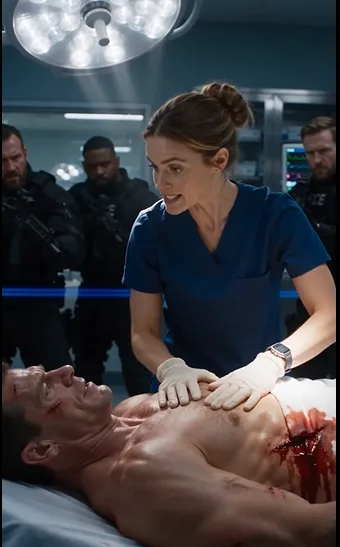
Richard Callahan has spent half his life making Chicago afraid to say his name, until a bullet leaves him helpless beneath the hospital lights and a young nurse orders his armed men out of the room without blinking. Emily Carter should have been just another face in the blur of pain and antiseptic, yet something about her last name awakens a memory Richard has spent years refusing to touch. As he digs into her past, he discovers that Emily did not enter his life by accident—and the truth waiting between their families could destroy the empire he inherited, the man he thought he was, and the fragile trust neither of them knows how to name.
The first thing I heard after coming back from the dark was a young nurse ordering my armed men out of the trauma room like they were noisy children.
Nobody talked to my people that way.
Nobody in Chicago spoke to Richard Callahan without fear.
Emily Carter didn't even blink.
"If one more of you brings a weapon past that blue line," she said, pointing toward the floor, "I stop the procedure and call hospital security."
One of my men laughed.
The laugh died when she turned her head.
She didn't raise her voice.
She didn't threaten him.
She simply looked at him as though she had already decided he wasn't important enough to argue with.
My eyes opened halfway beneath the white hospital lights.
The ceiling was a blur of fluorescent panels. Antiseptic burned the back of my throat. Something cold pressed against my skin, and every breath dragged pain through my ribs.
For a few seconds, I couldn't remember where I was.
Then I remembered the car.
The rain.
The flash of headlights behind me.
The sudden impact.
After that, nothing.
I tried to sit up.
A hand pressed firmly against my shoulder.
"Don't."
My vision cleared enough to see her.
Late twenties. Brown hair pulled into a tight knot. Navy scrubs. A cheap silver watch around one wrist. Sharp blue eyes that looked completely wrong in a room full of panic.
Not afraid.
That bothered me more than the bullet.
"Do you know who he is?" one of my men snapped.
Emily didn't even look at him.
"I know he's bleeding because all of you keep distracting the room. Unless you suddenly became surgeons, step back."
Silence settled over the trauma room.
I looked at the men around me.
They had faced down rival crews without flinching. They had walked into rooms knowing they might not walk out.
Yet this woman had managed to make all of them quiet with six words.
At thirty-four, I had spent years becoming the kind of man Chicago whispered about after midnight.
Restaurants cleared private rooms when I arrived.
Businessmen stopped negotiating when my name entered a conversation.
People lowered their voices when I walked past.
My father had taught me early that fear was useful.
Fear created distance.
Distance created control.
Control kept you alive.
But lying beneath those hospital lights, I realized something I hadn't understood when I was younger.
Fear also meant nobody ever looked closely enough to see whether you were drowning.
"What’s your name?" I rasped.
She finally looked at me.
"Emily Carter. And you're staying still, Mr. Callahan."
Most people hesitated before saying my last name.
She didn't.
Pain tore across my side again, and her hand tightened against my shoulder.
"Slow breath."
"I don't take orders."
"You do tonight."
One of my men stepped forward.
"Boss—"
"Quiet."
The word came from me.
Everyone obeyed.
Emily noticed.
I saw the tiny shift in her expression.
Not fear.
Calculation.
She filed the information away.
Then she returned to stitching the wound.
"Two more sutures," she told the resident beside her. "Watch the lower edge. He's got enough scar tissue here to explain half his bad decisions."
The resident nearly choked.
I stared at her.
Nobody joked about my scars.
Nobody joked about me.
Yet somehow, I didn't feel insulted.
I almost felt human.
She cleaned the wound, tied the final stitch, checked the pressure, and stepped back.
"You'll live," she said, "if you stop behaving like an idiot."
One of my men looked horrified.
I laughed.
Actually laughed.
It hurt badly enough that I immediately regretted it.
Emily raised an eyebrow.
"See? Dramatic."
"You always talk to patients this way?"
"Only the ones who think getting shot makes them impressive."
Then she adjusted my monitor.
"You need real rest, Mr. Callahan. Not mafia-boss rest where you spend six hours threatening people over the phone."
Even the resident looked like he was trying not to smile.
Emily stripped off her gloves and headed toward the door.
"Nurse Carter."
She stopped.
For one second, I almost thanked her.
The words reached the back of my throat.
Thank you.
Two ordinary words.
Two words I had somehow managed to avoid saying for most of my adult life.
Gratitude had always felt too much like vulnerability.
So I waited.
Emily looked at me once.
Then she walked out.
The door closed behind her.
Something about the room felt emptier afterward.
Victor Maas stepped beside my bed.
He was fifty-seven, calm, precise, and had been protecting me since my father was still alive. He had gray at his temples now, though he pretended not to notice it.
"We're tracing the shooter," he said.
My eyes stayed on the door.
"Find her."
Victor frowned.
"The shooter?"
"The nurse."
For the first time in years, Victor looked genuinely confused.
"Emily Carter?"
I turned toward him.
"Everything."
He studied my face.
"Why?"
I didn't answer immediately.
Because the truth was embarrassing.
Her last name had touched something buried in the back of my mind.
A woman crying in our kitchen.
My father's voice behind a closed office door.
A cardboard box carried out of the house late one winter night.
And a name.
Carter.
I had been seventeen.
Old enough to remember.
Young enough to believe my father when he told me it was none of my business.
"Just find out," I said.
Victor's expression changed.
He knew that tone.
When he left, I stared at the ceiling.
Hospitals were strange places.
They stripped men of everything they used to convince themselves they were powerful.
No expensive suit.
No office.
No guards.
No gun.
Just a hospital gown, a monitor, and the sound of your own breathing.
For the first time in years, I could hear my thoughts.
I didn't like what they sounded like.
My father had been dead twelve years.
Yet every decision I had made still seemed to orbit him.
I had inherited his businesses, his enemies, his reputation, his money.
I had also inherited his silence.
That night, I dreamed about the kitchen again.
I was seventeen.
My father stood beside the dining table.
Across from him was a woman I barely recognized.
She had red-rimmed eyes and both hands wrapped around a folder.
"I didn't take anything," she said.
My father didn't answer.
Then he looked at me.
"Go upstairs, Richard."
I obeyed.
I always obeyed.
When I woke, sunlight was pushing through the hospital blinds.
Victor was sitting beside the window.