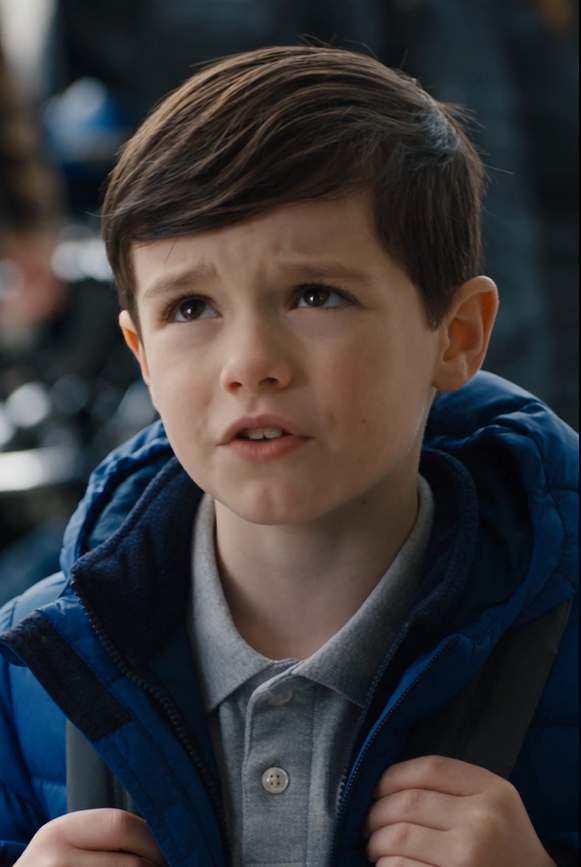
The first thing that frightened me was that Ethan didn’t cry.
Usually, my son cried over everything small enough to be fixed—a scraped knee, a broken toy, the internet freezing during cartoons. Those problems came with solutions. Comfort him, distract him, make him laugh again. But when Ethan became silent, when he withdrew into himself and moved through the house like he was trying not to take up space, I knew something deeper had reached him.
That afternoon, he stood quietly in the kitchen doorway still wearing his school clothes, his backpack hanging awkwardly from one shoulder.
Without a word, he handed me a paper.
At the top, bright cheerful letters announced:
“Father’s Day Celebration — Friday.”
Below it, smaller text explained:
“Each student must attend with their father or a registered male guardian. Students without a guest will report to supervised study.”
I stared at that sentence over and over.
Supervised study.
Not included differently.
Not accommodated.
Removed.
As though children without fathers present were a complication that needed managing.
I looked up at Ethan. He was studying my expression carefully, waiting to see whether this should hurt as much as he already suspected it would.
“Hey,” I said softly, kneeling beside him. “We’ll figure something out.”
He nodded, but it wasn’t hopeful. It was the kind of nod children give when they’re already bracing for disappointment.
That night he skipped dinner and went straight to bed without complaint.
The silence he left behind in the house felt unbearable.
Ethan’s father, Marcus, had been deployed overseas for nine months. Somewhere in the Middle East, sleeping in temporary shelters, carrying a rifle through places no one should have to fear. Whenever he managed to call, the connection crackled with static and delay. Sometimes the calls dropped entirely, and Ethan would continue holding the silent phone to his ear for several seconds afterward, unwilling to accept the conversation was over.
So when the school said “bring your father,” it wasn’t just insensitive.
It felt cruel.
The next morning, I called the school.
The receptionist answered with polished politeness, the kind that sounded practiced from repetition.
“I understand your concern,” she said, “but the policy applies equally to every student.”
Equally.
I nearly laughed at the word.
“My husband is deployed serving this country,” I said carefully. “My son shouldn’t be isolated because of that.”
“There are several students in similar circumstances,” she replied. “The supervised study environment will still be educational.”
Educational.
I hung up before anger pushed me too far.
That night, frustrated and exhausted, I wrote a short post in an online group for military spouses. Nothing dramatic. Just honest. I explained what the school planned to do and admitted I didn’t know how to help Ethan through it.
By morning, the post had spread everywhere.
Hundreds of shares.
Thousands of reactions.
And one message I couldn’t stop staring at.
It came from a man named Ray Bennett.
His profile picture showed an older biker with a gray beard, leather vest, and eyes that carried the unmistakable weight of military experience.
The message contained only four words:
“How many kids involved?”
I answered: “Fifteen.”
A minute later, Ray replied:
“Send me the school address.”
Friday morning arrived gray and quiet.
Ethan barely touched his breakfast.
As we walked toward the school entrance, he slipped his small hand into mine.
“Mom,” he asked quietly, “do I really have to go to the study room?”
The pain in that question nearly shattered me.
And before I could answer—
The ground beneath us began to vibrate.
Low at first.
Then louder.
The unmistakable thunder of motorcycles approaching together. The roar grew deafening, bouncing off the brick walls of the school. Around the corner came a wave of chrome and steel. Dozens, then scores, then hundreds of motorcycles. Big, heavy Harleys, their riders clad in leather, denim, and patches. Exactly two hundred of them filled the school parking lot in perfect, disciplined formation.
Ethan gasped, stepping slightly behind me, his eyes wide.
At the front of the pack, a massive black motorcycle came to a halt. The rider killed the engine, and like a rolling wave, the rest of the bikers followed suit. The sudden silence was heavier and more powerful than the noise had been.
The lead rider swung his heavy boot over the bike and removed his helmet. It was Ray. Up close, the lines on his face were deeper, etched by years and hardship, but his eyes were incredibly warm.
He looked at the line of stunned parents and silent children, then his eyes found me. He gave a single, respectful nod.
Behind him, one hundred and ninety-nine other bikers dismounted. They were men and women of all ages, but they all wore patches that told a similar story: Desert Storm, Operation Iraqi Freedom, Vietnam, Afghanistan. Combat veterans, every single one of them.
The school doors burst open, and the principal hurried out, his face pale and panicked.
"Excuse me!" he shouted, his voice trembling as he looked at the sea of leather and iron. "You can't park here! What is the meaning of this?"
Ray stepped forward. He didn't yell, but his voice carried the quiet, absolute authority of a man who had led troops through fire.
"We heard," Ray said, "that fifteen children were being sent to supervised study today because their fathers are deployed."
The principal stammered. "It's... it's a school policy for the Father's Day event. We just don't have the capacity—"
"You do now," Ray interrupted gently. He gestured to the veterans standing silently behind him. "We are the proxy fathers today. We're here for the fifteen."
Tears immediately blurred my vision. I looked down at Ethan. His mouth was slightly open in absolute awe.
Ray walked over and dropped to one knee right in front of my son, bringing himself down to eye level.
"You must be Ethan," he said softly.
Ethan nodded, gripping my hand tightly.
"My name is Ray. I served with the Marines. Your dad is Army, right?"
"Yes, sir," Ethan whispered.
"Well, us Marines usually like to give the Army a hard time," Ray smiled, the corners of his eyes crinkling. "But when one of our brothers is holding the line overseas, we step in to hold the line at home. If it's alright with you, Ethan, I'd be honored to sit with you today."
Ethan didn't just nod; he let go of my hand and threw his arms around the massive biker's neck. Ray hugged him back, his large, calloused hand gently patting the boy's back.
Fourteen other bikers stepped forward, finding the other kids whose fathers were deployed, offering hands, salutes, and gentle smiles. The remaining bikers stood in a silent, protective perimeter around the school entrance, forming a guard of honor for the children as they walked inside.
Inside the gymnasium, the atmosphere had completely shifted. The murmurs of confused parents faded into a reverent silence as the veterans walked in side-by-side with the children.
When it was time for the guest speakers, Ray stood up and walked to the microphone. The room was so quiet you could hear a pin drop.
"A lot of people think Father's Day is about who is in the room," Ray began, his gravelly voice echoing in the gym. "But for military families, love is often measured by the miles between you. In 1991, I was in the desert. My daughter was five. I missed her birthday, I missed her first day of kindergarten, and I missed Father's Day. It broke me."
He paused, looking down at Ethan, then across the room at the other fourteen children sitting tall beside their veteran proxies.
"I didn't know if my little girl understood why I wasn't there. I feared she felt abandoned, just like I know some of you kids felt when you were told you'd be sitting in a study room today."
Several teachers in the back row were already wiping their eyes. The principal stared at the floor, his face flushed with shame.
"But let me tell you a secret," Ray said, leaning closer to the microphone. "Your fathers aren't gone because they chose something else over you. They are gone because they are out there making sure the world is safe enough for you to grow up in. Their absence is the loudest, most fierce 'I love you' a father can ever give."
Ray looked out at the silent crowd.
"These children don't belong in a study room," Ray said softly but firmly. "They belong at the head of the table. Because while their parents are serving our country, these kids are serving, too. They serve every time they have to be brave while the rest of us get to be comfortable."
When Ray finished, there was a brief, stunned silence. Then, a mother in the front row stood up and started clapping. Then a father. Within seconds, the entire gymnasium was on its feet, giving a standing ovation. Tears streamed down the faces of parents and teachers alike.
Ethan looked up at Ray as the biker sat back down beside him.
"Thank you, Ray," Ethan said, his voice thick with emotion but entirely free of the sadness that had haunted him for days.
"No, Ethan," Ray replied, putting a heavy, warm hand on my son's shoulder. "Thank your dad for me."
That day, the school changed its policy permanently. No child was ever segregated on a parent's holiday again. And Ethan? He didn't cry that night. He went to sleep with a peaceful smile on his face, holding a small American flag patch Ray had taken off his own vest and given him.
He finally knew that even when his father couldn't be there, he was never, ever alone.
.
.
Please follow us if you like this story 💞🙏✨