Part I — The Story She Chose to Tell
The flight attendant had me put in handcuffs in first class before we ever arrived in Boston—and she had no idea at all why I had spent the last six weeks flying with her airline.
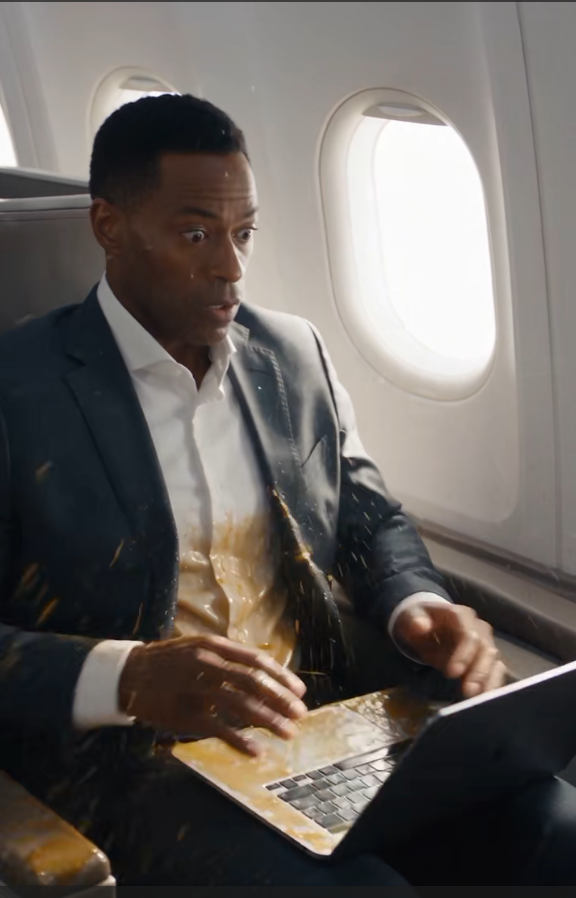
For ninety minutes, Brittany Miller called me aggressive, told the captain I had grabbed a beverage cart I had never touched, and turned an accidental coffee spill into a security matter while I stayed seated in 4B, my hands in plain sight and my voice deliberately controlled.
By the time a Massachusetts state trooper locked steel around my wrists on the jet bridge, I already knew the arrest itself could become the most powerful evidence my investigation had collected.
My name is Anthony Davis.
At 6:12 that morning, I was seated at Gate B22 in Atlanta with a black coffee in one hand and my boarding pass in the other.
Charcoal suit. White shirt. No tie. Laptop bag.
Nothing about the way I looked was intended to attract attention.
That was intentional.
For six weeks, I had been flying Meridian Atlantic Airways while presenting myself as an ordinary passenger. Twelve flights. Different routes. Different cabins. Different crews.
The investigation had begun after federal regulators found a pattern buried inside eighteen months of passenger complaints.
Eighty-six formal allegations involving discriminatory treatment.
Seventy-one filed by Black travelers.
Some involved unexplained seat changes. Others involved removal from premium cabins, security referrals, accusations of hostility, or passengers being described as threatening after asking questions that other customers asked without consequence.
Most complaints ended with the same phrase.
Insufficient evidence. Passenger misunderstanding of crew procedure.
Those six words appeared so often that, eventually, they stopped looking like findings.
They looked like a template.
Our assignment was narrow at first: determine whether Meridian employees were treating passengers differently because of race and whether the company's internal review process was designed to discover misconduct or bury it.
Then we found inconsistencies in crew reports.
Different passengers. Different airports. Different dates.
Same language.
"Escalating behavior."
"Noncompliance."
"Safety concern."
"Physical interference with service equipment."
Entire sentences repeated across reports written months apart by employees who supposedly had never worked together.
That expanded the investigation.
Now we were looking at whether employees had falsified operational reports, whether management had encouraged those reports to protect the company from civil-rights claims, and whether false statements had been transmitted to law enforcement.
Flight 2208 was supposed to be another observation.
Then I saw Kevin Johnson.
He was standing twenty feet from the gate desk with his wife and ten-year-old son. Dark blue sweater. Carry-on over one shoulder. Boarding passes folded in his hand.
I knew his name before I recognized his face.
His complaint had been one of the files that bothered me.
Six months earlier, he had purchased first-class tickets for a family trip. At boarding, an agent had insisted that his seat had been reassigned and suggested that his ticket had been issued "in error." When Johnson challenged the change, a supervisor wrote that he had become confrontational.
Meridian closed the complaint nine days later.
Insufficient evidence.
Now, at 6:31 in the morning, I watched another Meridian gate agent scan his boarding pass.
She frowned.
"Sir, is this your correct fare class?"
Johnson looked at her.
"It's what I purchased."
"Do you have your confirmation?"
He lifted the boarding pass slightly.
"It's printed right there."
The agent studied the screen again.
Behind him, his son looked down at the carpet.
Two white passengers approached the adjacent scanner.
"Good morning," another agent said brightly.
Beep.
"Have a great flight."
Johnson opened his phone.
His wife said nothing. Her face had the expression of someone who had seen this performance before and understood that intervening might make it worse.
He found the email.
Held it out.
The agent checked it, typed something, and finally returned his boarding pass.
"You're all set."
No apology.
No explanation.
Johnson nodded once.
"Thank you."
He took his son's hand.
I wrote one line in the small notebook on my phone.
6:31 — Johnson fare-class verification despite valid F boarding pass. White pax adjacent not challenged.
Then I boarded.
Brittany Miller stood at the aircraft door.
She greeted the white couple in front of me with a broad smile.
"Mr. and Mrs. Carrington. Back from Hilton Head already?"
The husband laughed.
"Unfortunately."
"How'd the golf game go?"
"Don't ask."
Brittany leaned slightly toward him.
"I'll make sure the champagne helps."
They laughed together.
Then I stepped forward.
Her expression changed.
Not dramatically. That would have been easy.
The smile simply stopped.
Her eyes went to my boarding pass.
Then my face.
Then back to the pass.
"Four B," she said.
No good morning.
No welcome aboard.
Nothing actionable.
But investigations like mine were built from patterns, not moments.
I moved into the cabin.
Behind Brittany, a younger flight attendant named Ashley Brown was arranging bottled water near the galley.
I had taken three steps when I heard Brittany speak quietly.
"Watch 4B."
Ashley glanced toward me.
"Why?"
"He's going to ask for an upgrade."
I stopped only long enough to place my bag in the overhead compartment.
My boarding pass was still in my hand.
4B.
First class.
I noted the time.
6:47.
Kevin Johnson and his family boarded several minutes later. Their seats were farther forward, across the aisle.
Brittany's tone with them was professionally neutral. Not openly rude. Not welcoming.
The distinction mattered.
Discrimination was rarely announced.
Most people understood better than that.
They learned to hide it inside discretion.
Who got questioned.
Who got watched.
Who received the benefit of uncertainty.
Who didn't.
Before departure, Brittany moved through first class offering champagne and water.
Rows one through three received drinks.
She served 4A, the man beside me.
Then she turned away.
I waited.
Not because I needed water.
Because I needed to know whether she would come back.
She didn't.
As the cabin prepared for departure, I raised a hand slightly.
"Excuse me."
Brittany looked over.
"Yes?"
"Could I have some water, please?"
A pause.
"Oh."
She picked up a bottle.
"What do you want?"
"Water, please."
She gave it to me.
"Here."
"Thank you."
I placed the bottle beside my laptop.
The flight left Atlanta without incident.
Thirty minutes later, Ashley brought the beverage cart into the cabin.
She was younger than Brittany, maybe late twenties, and during my previous observations I had learned to watch the difference between employees who initiated conduct and employees who simply adapted themselves to stronger personalities around them.
Ashley looked nervous around Brittany.
That alone meant nothing.
But it made me pay attention.
She stopped beside row four.
"Coffee?"
The passenger in 4A nodded.
"Please."
Ashley leaned across me.
Her hand slipped.
The cup tilted.
Coffee splashed over 4A's sleeve.
He jerked back.
His elbow struck the cart.
The cart shifted.
A second cup tipped, spilling across the edge of my laptop.
I lifted the computer immediately.
"Ma'am, could I please have some extra napkins?"
Ashley froze.
"I'm so sorry."
"It's okay. Just napkins."
Before she could reach for them, Brittany appeared from the galley.
Her eyes went directly to me.
Not to 4A.
Not to the spilled coffee.
Not to Ashley.