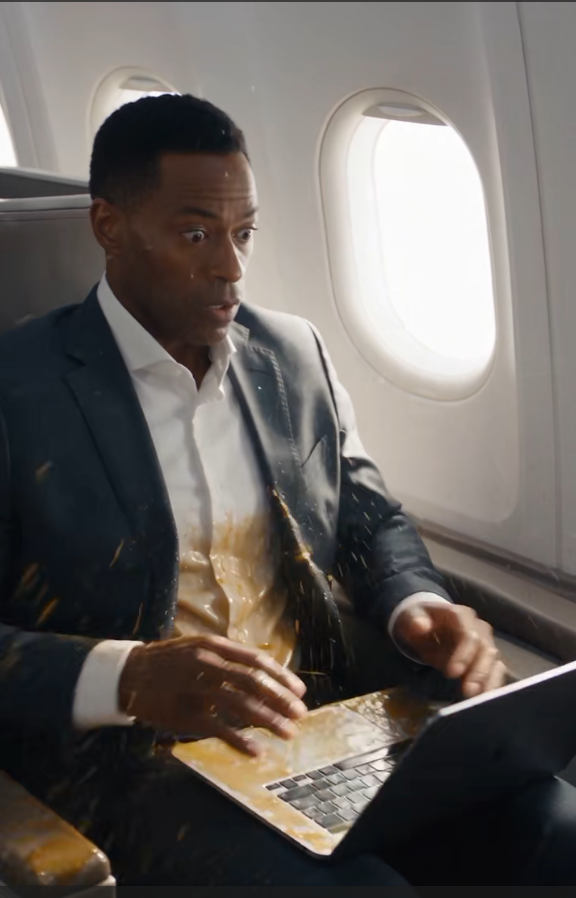
He called me laughing.
"They sent it to the wrong victim."
"Keep the packaging."
"You think they're going to ask for it back?"
"I think paperwork enjoys irony."
Kevin Johnson's case was reopened.
Investigators confirmed what the original internal records had shown: there had been no valid operational reason to question his first-class boarding pass or attempt to reassign him.
The airline sent him an apology.
He called me after reading it.
"You want to know the funny part?"
"Sure."
"They refunded the ticket."
"That's not funny."
"I didn't ask for the money."
"What did you ask for?"
"For them to tell my son why his dad had to prove he belonged in a seat he'd already paid for."
I said nothing.
Kevin continued.
"They offered travel credit."
I closed my eyes.
"Of course they did."
He laughed once.
Then his voice became quieter.
"My boy remembers you."
"From the flight?"
"Yeah."
"He saw the handcuffs?"
"He did."
I leaned back.
"Sorry."
"Why are you apologizing?"
"Kids shouldn't have to see that."
Kevin was quiet.
Then he said, "Maybe he needed to see what happened after."
I looked out my office window.
"What did you tell him?"
"That sometimes the person in handcuffs isn't the person who did something wrong."
A pause.
"And sometimes telling the truth takes longer than the lie."
That stayed with me.
Six months after Flight 2208, I returned to Atlanta for another assignment.
Different airline.
Different case.
I had an hour before boarding.
Without planning to, I walked toward Gate B22.
Nothing about it looked important.
Same blue seats.
Same charging stations.
Same bright screens showing departure times.
Travelers drank coffee and stared at phones.
A toddler pushed a toy airplane along the window ledge.
A businessman argued quietly through an earpiece.
Nobody knew what had started there.
That was normal.
Most turning points didn't come with markers.
My phone buzzed.
A message from Ashley.
She had enrolled in law school.
The text contained only seven words.
Turns out I still like arguing about reports.
I smiled.
Then another message appeared.
From Kevin.
A photograph.
His son, now eleven, sitting in an airplane window seat with a pair of headphones around his neck.
Below it:
He asked if seat 4B was available.
I looked at the picture longer than I expected.
Then I typed:
Tell him 4B has terrible coffee service.
Three dots appeared.
Kevin replied:
He says you should've asked for napkins.
I laughed aloud.
A woman across from me glanced up.
I put the phone away.
My boarding announcement began.
As I joined the line, I thought about Brittany for the first time in weeks.
For a long time, I had imagined the story of Flight 2208 as a story about a lie.
It wasn't.
The lie had been small.
Almost embarrassingly small.
A cart moved.
Coffee spilled.
A passenger asked for napkins.
A flight attendant decided she'd rather be obeyed than corrected.
Everything after that had been built to protect the decision before it.
That was how the larger system had worked too.
Not through one spectacular act of hatred.
Through thousands of little choices about whose version deserved belief.
Who had to prove where they belonged.
Whose frustration became aggression.
Whose mistake disappeared from the report.
Whose complaint became a safety issue.
Whose word counted.
The gate agent scanned my boarding pass.
"Good afternoon, Mr. Davis."
"Good afternoon."
She handed it back.
"You're all set."
I started down the jet bridge.
Halfway to the aircraft, I stopped.
There was nothing dramatic ahead of me.
No police.
No hidden confrontation.
Just another plane.
Another crew.
Another cabin full of strangers trusting a system they would rarely think about unless it failed them.
For years, Meridian's reports had worked because the official version arrived first.
That morning in 4B, for once, the truth had been given something lies usually had.
Documentation.
Timing.
Institutional weight.
I looked at my boarding pass.
Then at the faint reflection of myself in the jet-bridge window.
Charcoal suit.
White shirt.
Laptop bag.
Ordinary passenger.
Exactly as I had looked six months earlier.
The difference was that I no longer believed the handcuffs had been the most important evidence we collected.
The important evidence had come before them.
It was Brittany asking Ashley to change what she'd seen.
It was the deleted witness statement.
It was Kevin's altered complaint.
It was a manager warning employees not to create written comparisons.
It was every small decision made in rooms where nobody expected the passenger to ever see the record.
The handcuffs had only made the hidden process impossible to ignore.
I continued toward the plane.
At the aircraft door, a flight attendant smiled.
"Welcome aboard."
"Thank you."
I stepped inside.
And for the first time since Boston, I heard those words without wondering what would be written down if something went wrong.
Then I realized that wasn't quite true.
I would always wonder now.
Maybe that was the final thing Flight 2208 had changed.
Not just Meridian.
Not just Brittany.
Not even the eighty-six passengers whose complaints had finally been reopened.
It had changed the way I understood records.
A record was never merely paperwork.
It was memory with authority.
And when institutions decided whose memory became official, they decided something larger than who won an argument.
They decided whose reality survived.