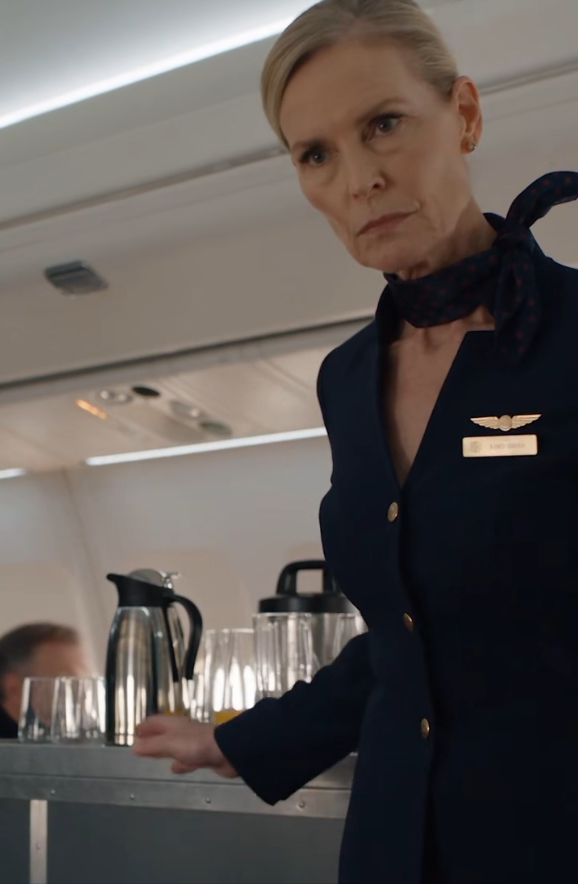
Part I — Seat 4B
The flight attendant had me placed in handcuffs in first class before we ever reached Boston, and she had no idea why I had spent the previous six weeks flying on her airline.
For ninety minutes, Brittany Miller called me aggressive, told the captain I had grabbed a beverage cart I never touched, and turned an accidental coffee spill into a security incident while I sat in seat 4B with both hands visible and my voice deliberately calm.
By the time a Massachusetts trooper locked steel around my wrists on the jet bridge, I already suspected the arrest itself might become the clearest evidence my investigation had collected.
My name is Anthony Davis.
At 6:12 that morning, I had been sitting at Gate B22 in Atlanta with black coffee in one hand and a boarding pass in the other.
Charcoal suit. White shirt. No tie. Laptop bag.
Nothing about me was supposed to attract attention.
That was intentional.
For six weeks, I had been traveling Meridian Atlantic Airways as an ordinary passenger. Twelve flights. Different routes. Different cabins. Different crews.
The inquiry had begun after federal regulators noticed a pattern inside eighteen months of passenger complaints.
Eighty-six formal allegations involving discriminatory treatment.
Seventy-one came from Black travelers.
Some involved seat reassignment. Some involved security referrals. Some came from passengers who said they had been described as aggressive after questioning treatment other customers received without explanation.
Most complaints ended the same way.
Insufficient evidence.
Passenger misunderstanding of crew procedure.
Those six words appeared so often that eventually they stopped looking like conclusions and started looking like a template.
I had been assigned to a joint federal civil-rights investigation examining whether employees were falsifying records, whether management knew complaints were being buried, and whether anyone had crossed the line from discriminatory service into criminal obstruction or false reporting.
Flight 2208 was supposed to be another observation.
Then Kevin Johnson arrived at the gate.
Black father. Wife. Ten-year-old son. First-class tickets.
I knew his name from a complaint file.
Meridian had closed his case in nine days.
I watched the gate agent scan Kevin's boarding pass, frown, and ask him to prove his fare class.
Kevin held out the pass.
The agent looked at it, then at him.
“Do you have the purchase confirmation?”
Kevin stared at her for half a second.
“My seat is printed right there.”
“I understand, sir. I just need to verify the fare.”
Two white passengers approached the neighboring scanner. Their passes beeped. The other agent smiled.
“Good morning. Welcome aboard.”
Kevin pulled out his phone.
His son stared at the carpet while his father searched an email to prove he had paid for the seat already printed on the boarding pass in his hand.
I noted the time.
6:31.
The exchange lasted less than two minutes.
That was what made incidents like that easy to dismiss later.
Two minutes was nothing.
Two minutes was also long enough for a ten-year-old boy to learn something about the way strangers could look at his father.
When the gate agent finally waved the family through, Kevin didn't argue.
He put one hand on his son's shoulder and walked toward the jet bridge.
I waited until the next boarding group began moving.
Then I boarded.
Brittany Miller greeted the white couple ahead of me by name.
“Mr. and Mrs. Caldwell. Back from the golf tournament?”
The husband laughed.
“Unfortunately.”
“Welcome back.”
Warm smile. Easy voice.
When I stepped forward, the warmth disappeared.
Her eyes moved from my boarding pass to my face.
Then back down.
No greeting.
No problem yet.
Just a data point.
Behind her, a younger attendant named Ashley Brown leaned against the galley.
As I passed, I heard Brittany whisper, “Watch 4B.”
Ashley looked confused.
Brittany added, “He's going to ask for an upgrade.”
I was already holding a first-class boarding pass.
Seat 4B.
Window.
I wrote down the time after I sat.
6:47.
Predeparture drinks came next.
Rows one through three received champagne or water.
Brittany served the man sitting beside me in 4A.
She skipped me.
I waited until she had taken two steps away.
“Excuse me. Could I get water, please?”
She turned as if she had forgotten anyone was sitting there.
“Oh.”
A short pause.
“What do you want?”
“Water, please.”
She handed me a bottle without answering.
None of that was enough to prove a case.
That was one of the hardest parts of this work.
You learned to distrust your own certainty.
A missed greeting could be distraction. A skipped drink could be an oversight. An odd comment could be clumsy humor.
The job wasn't to decide what something meant before the evidence did.
The job was to keep watching.
Thirty minutes after takeoff, Ashley pushed the beverage cart through first class.
The cabin had settled into the soft mechanical calm of cruise altitude. Laptop screens glowed. A man across the aisle had already reclined and fallen asleep.
Ashley stopped beside us.
“Coffee?”
The passenger in 4A nodded.
She lifted the pot.
Then everything happened in about three seconds.
Ashley leaned across me.
Her hand slipped.
Coffee hit the man's sleeve.
He jerked back instinctively and his forearm struck the cart.
The cart shifted toward my seat.
A second splash landed across the keyboard of my open laptop.
I lifted the computer immediately.
“Ma'am, could I get some extra napkins, please?”
Ashley froze.
Her face went pale.
“Oh my God, I'm sorry.”
Before she could reach for anything, Brittany appeared from the forward galley.
She looked at me.
Not the cart.
Not Ashley.
Not the passenger whose sleeve was wet.
“You grabbed the cart?”
I kept my hands around the edges of my laptop.
“No, ma'am.”
“Lower your voice.”
I hadn't raised it.
The man in 4A turned toward her.
“It wasn't him.”
Brittany didn't look at him.
“Sir, please stay out of this.”
“He didn't touch it.”
“Sir.”
There was something in her tone that made him stop.
Then Brittany turned toward Ashley.
“He's getting aggressive.”
That word changed the cabin.
Aggressive.
People stopped looking at the spilled coffee and started watching me.
The passenger across the aisle lowered his newspaper.
Someone behind us leaned into the aisle.
I felt the familiar pressure that comes when a situation has been defined for everyone before you are allowed to speak.
So I did the one thing training had taught me to do.
Less.
Less movement.
Less volume.
Less expression.
“I'm sitting here,” I said. “My laptop got wet. That's all.”
Brittany picked up the galley phone.
“Captain, we have a situation in 4B.”
Her eyes stayed on me while she talked.
She said I had refused instructions.
She said I had made physical contact with equipment.
She said I had raised my voice.
None of it was true.
Ashley stood behind the cart, holding a stack of napkins she had never handed me.
I looked at her.
For one second, our eyes met.
She knew.
I knew she knew.
But she said nothing.
Brittany ended the call and came back to my seat.
“Sir, you're going to remain seated for the rest of the flight.”
“I am seated.”
“Don't argue with me.”