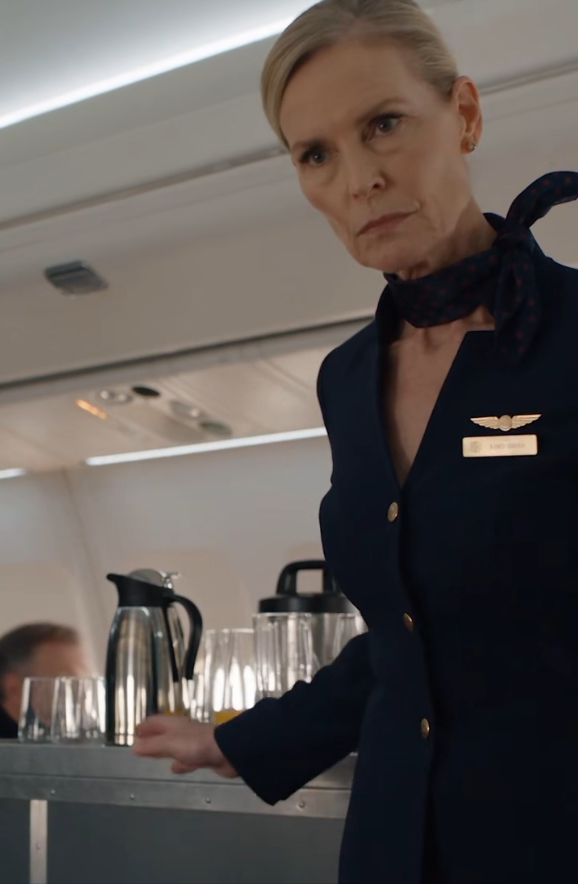
Ashley kept her job.
That decision was controversial inside the investigative team.
She had remained silent when she should have spoken.
She had revised her own first draft once before Brittany took over.
She had participated in earlier crew-consistency practices.
But she also cooperated, provided documents, and acknowledged her failures without pretending she had been powerless.
Her last interview was the shortest.
She sat across from me in the same room.
“You think I should have stopped it on the plane,” she said.
“Yes.”
She nodded.
“So do I.”
I closed the folder.
She waited.
I said, “Why didn't you?”
She stared at the table.
“I was afraid of being the person who didn't back the crew.”
“And now?”
A faint, tired smile.
“Now I'm afraid of being the person who does.”
That was not absolution.
It was something better.
Understanding with consequences.
Kevin's complaint was reopened.
Meridian sent him a new letter.
He called me after receiving it.
“You want to hear the funny part?”
“Sure.”
“They apologized for questioning my ticket.”
“That isn't funny.”
“No. The funny part is they offered travel credit.”
I laughed despite myself.
“How much?”
“Enough to insult me professionally.”
“What did you do?”
“I told them to keep it.”
He paused.
“Then my wife told me I was being stupid, so I called back.”
I laughed harder.
Kevin did too.
It was the first conversation we had that wasn't heavy.
Before hanging up, he said, “My son asked if the airline said we were right.”
“What did you tell him?”
“The truth.”
I waited.
“I told him they said they were wrong.”
Simple.
That was all he had wanted from the beginning.
Not a settlement.
Not a speech.
A record his son could understand.
They were wrong.
The man from 4A sent me one email after the case became partially public.
I had thanked him earlier for giving a statement.
His reply was only three sentences.
I almost stayed quiet because I had a meeting after we landed and didn't want the hassle. Then I realized that was exactly why she could say whatever she wanted. Glad I spoke up.
I read that message several times.
There were dozens of decisions in the case that looked insignificant when isolated.
Ashley writing the first draft honestly.
A passenger in 4A saying, “It wasn't him.”
A trooper preserving an incident report.
A version history nobody expected anyone to inspect.
A complaint filed even though we already knew the truth.
None of them solved the case alone.
Together they made denial increasingly expensive.
My own complaint was formally reversed four months after Flight 2208.
The new finding was twelve pages long.
I read the first page.
Then I skipped to the conclusion.
Meridian acknowledged that the evidence did not support the claim that I had physically interfered with the beverage cart or behaved aggressively toward the crew.
It acknowledged that employee reporting had contained material inaccuracies.
It acknowledged that my detention resulted from information that should not have been reported as established fact.
The language was careful.
Corporate.
Reviewed by lawyers.
Still, it mattered.
My supervisor found me reading it.
“Feel better?”
“A little.”
“Only a little?”
I looked at the page.
“They knew enough on day one.”
“Yes.”
“They just didn't treat what contradicted the crew as evidence.”
“No.”
I set the letter down.
He leaned against the door.
“You still think the arrest was the best evidence?”
I thought about that.
For months, I had believed it might be.
The cuffs had created a clean line between a false report and a real consequence.
Without the accusation, no detention.
Without the invented behavior, no law enforcement response.
It was powerful.
But it was not the clearest thing we found.
“No,” I said.
“What was?”
I turned the laptop toward him.
On the screen were two versions of Ashley's report.
The first:
Passenger did not make contact with cart.
The final:
Passenger physically interfered with cabin equipment.
Between them were thirteen minutes.
“That,” I said.
My supervisor looked at the screen.
“The edit?”
“The distance.”
“Between what?”
“What happened and what became official.”
He nodded once.
That was the case.
Months later, I returned to Atlanta for another assignment.
Not undercover.
Not Meridian.
Different airline.
Different investigation.
I arrived early.
Without thinking, I walked past Gate B22.
The place looked exactly the same.
Passengers clustered around charging outlets. A gate agent scanned boarding passes. Someone argued quietly into a phone. A child sat on the floor beside a rolling suitcase.
Nothing about the gate carried memory.
Places rarely do.
People carry it for them.
I stopped at a coffee stand and ordered black coffee.
When I turned back toward the concourse, I saw a father and a boy walking toward another gate.
For half a second the shape of them reminded me of Kevin and his son.
It wasn't them.
I watched anyway.
The father handed the boy a boarding pass.
The boy held it carefully as they joined the line.
A gate agent scanned it.
Beep.
They walked through.
No second question.
No phone pulled out.
No proof beyond the document already in his hand.
Ordinary.
That was the strange thing about fairness when it worked.
It was almost invisible.
No one applauded.
No one recorded it.
A child simply walked onto an airplane without learning a lesson he should never have needed.
My phone buzzed.
A message from my supervisor.
You boarding?
I typed back.
In five.
Then I looked at my own boarding pass.
Seat 4B.
I actually laughed.
Of all the seats.
At the aircraft door, the flight attendant glanced at the pass.
“Good afternoon, Mr. Davis.”
“Afternoon.”
“Welcome aboard.”
I walked down the aisle and sat beside the window.
A few minutes later, another attendant came through with predeparture drinks.
“Water or champagne?”
“Water, please.”
She handed me a bottle.
“Here you go.”
“Thank you.”
That was it.
No meaning.
No hidden significance.
No investigation.
Just water.
I set it beside my laptop and looked through the window as ground crews moved beneath the wing.
For a long time, I had thought the most important moment on Flight 2208 happened when the cuffs closed around my wrists.
I had been wrong.
The most important moment had come earlier, almost too quietly to notice.
A cart moved.
Coffee spilled.
A woman decided who must have caused it.
Another woman knew she was wrong and stayed silent.
A witness chose not to.
Then a company took all of those fragments and decided which version deserved to become permanent.
That was where the real power had been.
Not in the accusation.
In the record.
The cabin door closed.
I looked down at my hands resting freely on the laptop.
Then I thought of the line that had ended so many complaints.
Passenger misunderstanding of crew procedure.
For months, Meridian had used those words to tell people they had misunderstood what happened to them.
In the end, the misunderstanding belonged somewhere else.
They had mistaken a system that protected its own story for a system that protected the truth.