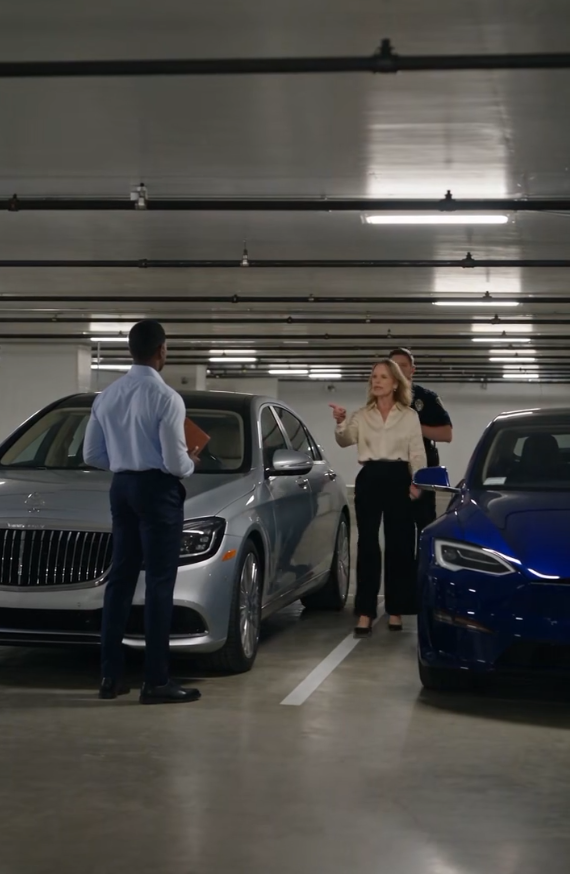
Marcus frowned.
“Is she on such a committee?”
“There’s an informal neighborhood group. It has no enforcement authority.”
“Does the building present it as official?”
“No.”
“Then why does she think it gives her authority?”
The manager looked uncomfortable.
“You’d have to ask her.”
Marcus nodded.
“I expect someone will.”
Diane’s meeting lasted nearly an hour.
She arrived with printed copies of emails about package theft, photographs of a broken car window from ten months earlier, and a list of dates when the garage gate had malfunctioned.
The manager let her finish.
Then she said, “None of that explains why you told police Marcus was trying to force his way into the building.”
“He was using something on the security panel.”
“A credential issued by us.”
“It wasn’t working.”
“That doesn’t mean he was forcing anything.”
Diane straightened.
“I used the word force colloquially.”
“You said he was ‘messing with the security door.’”
“He was.”
“He tapped an electronic pass.”
“He wouldn’t show me identification.”
“You had no authority to demand it.”
“I was protecting the building.”
“From a resident’s son.”
“I didn’t know that.”
“He told you.”
“After I challenged him.”
The manager looked at her steadily.
“Why did you challenge him?”
Diane opened her mouth.
Nothing she had brought answered that.
She glanced at the papers spread across the table.
“He looked unfamiliar.”
“So?”
Diane’s jaw tightened.
“You’re trying to make this into something it wasn’t.”
“I’m asking why unfamiliar meant unauthorized.”
“This is a secure building.”
“Many authorized people are unfamiliar to you.”
Diane’s face hardened.
“You know what this is really about.”
The manager did not answer.
“He’s a federal judge, and now everyone is terrified.”
“No.”
“Please.”
“No one knew he was a judge when I issued the passes. No one knew when his mother signed the lease. And nothing in our policy gives judges special access.”
Diane leaned forward.
“Then why am I being treated like I committed a crime?”
“You aren’t.”
“I’m being investigated.”
“We’re reviewing a resident complaint.”
“From a federal judge.”
“From the son of a resident.”
Diane looked away.
The manager gathered the papers.
“You are entitled to report suspicious conduct. You are not entitled to invent facts to make conduct sound suspicious.”
“I did not invent anything.”
The manager opened her laptop.
“We received the police incident number. If the body-camera footage confirms your account, that will matter.”
Diane stood.
“And if it doesn’t?”
The manager looked up.
“Then that will matter too.”
Two weeks after the garage incident, Marcus received a formal notice that the police review had moved beyond the initial stage.
He read it at his desk between hearings.
No conclusion.
No discipline.
No accusations.
Only a request for an interview.
Marcus nearly declined.
His written complaint already contained everything.
Then he thought of his mother’s sentence.
Act like the man you expect people to be when they’re standing in your courtroom.
So he went.
The investigator met him in a conference room away from the precinct floor.
“Thank you for coming, Judge Reed.”
“Marcus is fine for this.”
The investigator nodded.
“Marcus.”
They reviewed the sequence.
Then came the question Marcus had expected.
“Do you believe Officer Hayes treated you differently because you’re Black?”
Marcus took his time.
“I know Mrs. Mercer did.”
The investigator did not interrupt.
“She saw an unfamiliar Black man using an access credential. She assumed I was unauthorized. When I gave her an explanation, she treated the explanation as evasion. When I declined to produce identification to a private citizen, she treated that as evidence.”
“And Hayes?”
Marcus looked through the glass wall toward a hallway.
“He arrived after she had already defined the situation for him.”
“That doesn’t answer the question.”
“No.”
Marcus rested his hands on the table.
“I can’t testify to what was in his head. I can testify to what he did.”
“And what was that?”
“He accepted her certainty faster than he tested my explanation.”
“Do you think race played a role?”
“I think you should answer that from the evidence.”
The investigator watched him.
“You’re a judge.”
“Not here.”
“You evaluate evidence.”
“In cases assigned to me.”
“I’m asking your view.”
Marcus considered the wording.
“Then my view is that bias is rarely kind enough to announce itself. People want it to arrive with a confession. Usually it arrives as a shortcut.”
The investigator wrote something down.
Marcus continued.
“Mrs. Mercer made one. Officer Hayes made another. Whether they were the same shortcut is your question, not mine.”
The investigator nodded.
“What outcome do you want?”
Marcus looked at him.
“I already wrote that.”
“I know. I’m asking now.”
“The same review you would conduct if I worked at a grocery store.”
“That’s difficult.”
“Why?”
“Because everyone involved knows who you are now.”
Marcus leaned back.
“That’s the entire problem.”
The investigator was quiet.
Marcus went on.
“The officer apologized after he learned I was a federal judge. Suppose I had been a delivery driver visiting my mother. Suppose I worked nights at a warehouse. Suppose there was no courthouse number to call. At what point would my explanation have become worth checking?”
The investigator did not answer.
Marcus looked down at his wrists, though the marks were long gone.
“If the lesson is ‘be careful who you handcuff,’ then nothing useful comes from this.”
“What should the lesson be?”
“Be careful why.”
Part IV — Consequences
Officer Hayes asked to speak with Marcus before the department completed its review.
Marcus initially refused.
Not out of anger.
Because he did not want the conversation to become evidence of reconciliation before anyone had decided what required repair.
Hayes sent the request again through official channels.
This time Marcus agreed.
They met in a courthouse conference room, not chambers.
Hayes arrived in civilian clothes.
Without the uniform, he looked younger.
Marcus noticed that and disliked himself for noticing it.
Authority aged people.
Vulnerability reversed the effect.
Hayes sat across from him.
“Thank you for meeting with me.”
Marcus nodded.
Hayes placed both hands on the table.
“I’m not here to ask you to withdraw the complaint.”
“Good.”
“I’m not here to explain it away.”
Marcus waited.
Hayes looked toward the window.
“I watched the footage.”
“I assumed you had.”
“More than once.”
Marcus said nothing.
“The first time, I was looking for what I did right.”
Marcus’s eyes shifted toward him.
Hayes gave a humorless smile.
“There’s training language for everything. Safety. Control. Uncertainty. Officer discretion. You can find words that make almost any five seconds sound reasonable.”
“And the second time?”
“I looked for what you did wrong.”
Marcus leaned back slightly.
Hayes continued.
“You didn’t give me much.”
“That must have been disappointing.”
The dry remark surprised a brief laugh out of Hayes.
Then his face settled again.
“The third time I watched what Mercer did.”
Marcus waited.
“She told dispatch you didn’t belong there before she knew who you were. Then when you gave her information that could prove you belonged, she treated the information itself as suspicious.”