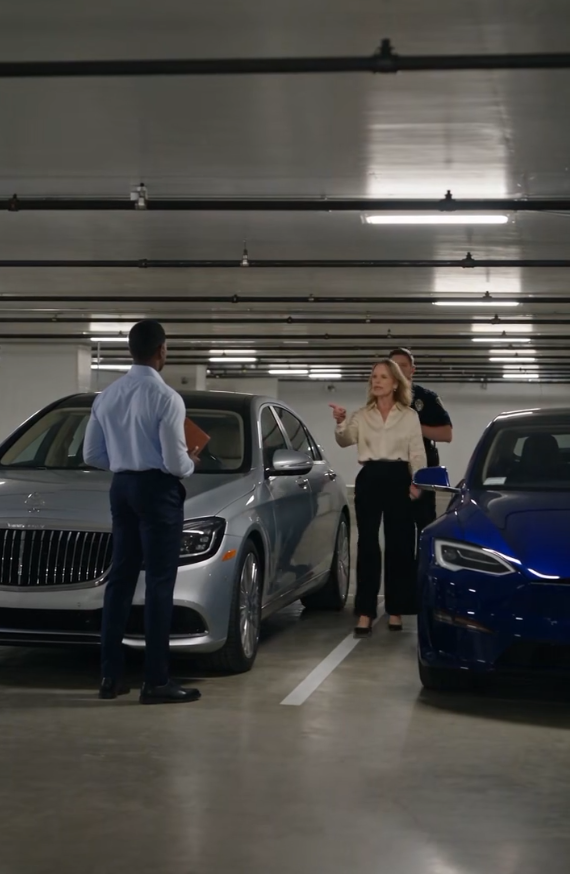
“And if I hadn’t filed?”
“Ninety days.”
“What happens after?”
“It can be deleted under retention rules.”
Marcus stared at his computer screen.
The investigator said, “Your footage is preserved.”
“I know.”
The answer sounded different now.
He remembered the first thing he had told Hayes.
Keep recording.
Then later:
Do not let that recording disappear into a routine report.
Marcus thanked the investigator and ended the call.
He called his mother.
She answered, “Did you find out?”
“How did you know what I was calling about?”
“You only call at eleven-thirty in the morning when you’re annoyed or traveling.”
“I’m not traveling.”
“So?”
Marcus smiled despite himself.
“The footage could have been deleted after ninety days if no complaint had triggered preservation.”
Evelyn went quiet.
Marcus continued.
“I knew to ask for preservation.”
“Yes.”
“A lot of people wouldn’t.”
“No.”
Marcus looked at the file on his desk.
“That’s what the story is.”
His mother’s voice softened.
“Now you’re getting somewhere.”
Part V — The Hearing
The story became public because Diane filed a complaint of her own.
She alleged that building management had disciplined her unfairly under pressure from a powerful resident’s son.
The filing named Marcus.
It described him as a federal judge fourteen times.
Marcus counted.
The local newspaper found the filing.
By noon, a reporter had called courthouse communications.
By two, the headline existed.
FEDERAL JUDGE HANDCUFFED AFTER RESIDENT REPORTS HIM IN MOTHER’S GARAGE.
Marcus hated it on sight.
The article was factually careful.
That almost made it worse.
It described the courthouse call, the body camera, Hayes’s suspension, Diane’s building warning.
Online, the incident simplified immediately.
Some readers called it obvious racial profiling.
Others said Marcus had used his title to avoid arrest.
Some insisted Diane had done exactly what responsible residents should do.
Others demanded she be evicted.
Hayes’s name circulated.
So did Diane’s.
Marcus declined interviews.
Then a television station obtained an excerpt of the body-camera footage through a public-records request.
The clip lasted forty-three seconds.
Marcus watched it once.
Diane: “Why are you still talking to him? Put him in cuffs!”
Hayes: “Turn around.”
Marcus: “Officer, before you do that, I’m asking you to verify the property manager’s statement.”
Hayes: “I said turn around.”
Cuffs.
Then Marcus looking toward the camera.
“Please make sure that camera keeps recording.”
The clip ended.
It spread in hours.
Marcus received hundreds of messages.
He read almost none.
One, however, came through courthouse channels from a legal-aid director he knew professionally.
Not about litigation.
About the body-camera retention issue.
The message was brief:
Your complaint preserved the footage. Most people don’t know they have to move that quickly. If you speak publicly, talk about that.
Marcus stared at the sentence.
His mother had already said the same thing.
The department announced that its civilian oversight board would discuss the incident at its next public meeting because of the attention surrounding the footage and because Hayes’s case raised questions about restraint and verification policy.
Marcus was invited to speak.
So was Hayes.
Diane requested time as an affected civilian.
Marcus almost declined.
Public hearings had a predictable weakness: everyone arrived wanting the record to carry their version of themselves.
Victim.
Defender.
Reformer.
Scapegoat.
Marcus preferred courtrooms because evidence had rules.
Then he remembered the ninety-day clock.
He accepted.
The hearing room was not dramatic.
No marble columns.
No seal behind a judge.
Just a municipal chamber with rows of molded chairs, microphones, water pitchers, and a clock mounted too high on the wall.
Marcus arrived alone.
His mother had refused his offer to stay away.
“This happened in my building,” she said.
“You don’t have to sit through cameras.”
“I taught eighth grade for thirty-one years. I can survive cameras.”
She sat in the second row.
Diane sat across the aisle with a lawyer.
Hayes sat near the front in uniform.
Marcus noticed the uniform before he noticed the man.
That, too, seemed worth remembering.
The board chair explained that the hearing was not a criminal proceeding. The department’s disciplinary findings regarding Hayes were complete. The purpose was policy review.
Marcus listened.
That framing mattered.
The board first played the body-camera footage from the beginning.
Not the viral forty-three seconds.
All of it.
Diane’s voice came through the speakers before Hayes entered frame.
“He doesn’t belong here.”
Then Hayes arrived.
The board watched the exchange.
The failed credential.
The explanation.
The request to contact management.
The cuffs.
The courthouse number.
The clerk’s confirmation.
The release.
Then the property manager arriving and verifying everything Marcus had said.
The video ended.
The room stayed quiet, not because anyone was shocked, but because complete sequences have a way of exhausting slogans.
Hayes spoke first.
He did not read a statement.
“I made an investigative decision before I had done enough investigation.”
His voice was steady.
“I had a complainant giving me a confident account. I had a man who didn’t live in the building. I treated those two facts as if they answered questions they did not answer.”
A board member asked, “Why the handcuffs?”
“I’ve asked myself that.”
“And?”
Hayes glanced toward Marcus.
Then back at the board.
“Because I wanted control faster than I wanted clarity.”
The chair asked whether he believed race influenced his decision.
Hayes took a moment.
“I can’t point to a thought I had and say, that was it.”
A few people shifted in their seats.
Hayes continued.
“But I can say I gave more weight to one person’s assumption than the evidence supported, and I gave less weight to another person’s explanation than it deserved. I’ve had to ask myself why.”
“What’s your answer?”
“I don’t think bias always feels like hostility.”
Marcus looked at him.
Hayes’s hands were resting flat on the table.
“Sometimes it feels like confidence,” he said. “You think you already understand the scene.”
No one applauded.
Marcus was grateful.
The board chair nodded.
“What would you do differently?”
“Call management.”
A few restrained smiles appeared.
Hayes did not smile.
“Before touching him. Before deciding that asking for verification was resistance. Before treating uncertainty as danger.”
He finished and returned to his seat.
Diane spoke next.
Her lawyer advised her to read from prepared remarks.
She did for the first minute.
She described the building’s prior security concerns. The controlled garage. Residents’ expectations. Her belief that she had a responsibility to notice unfamiliar people.
Then she put the pages down.
“I know what everyone thinks of me.”
Her lawyer shifted slightly.
Diane kept going.
“You’ve seen forty seconds online. Now you’ve seen the whole video. I was wrong that his mother didn’t live there. I accept that.”
Marcus watched her.
“But I did not know who he was.”
The phrase hung in the room.
Diane seemed to hear it only after saying it.
One board member leaned toward the microphone.
“Why would who he was matter?”
“I mean I didn’t know he was authorized.”
“Those are different things.”
“Yes.”
“Which did you mean?”