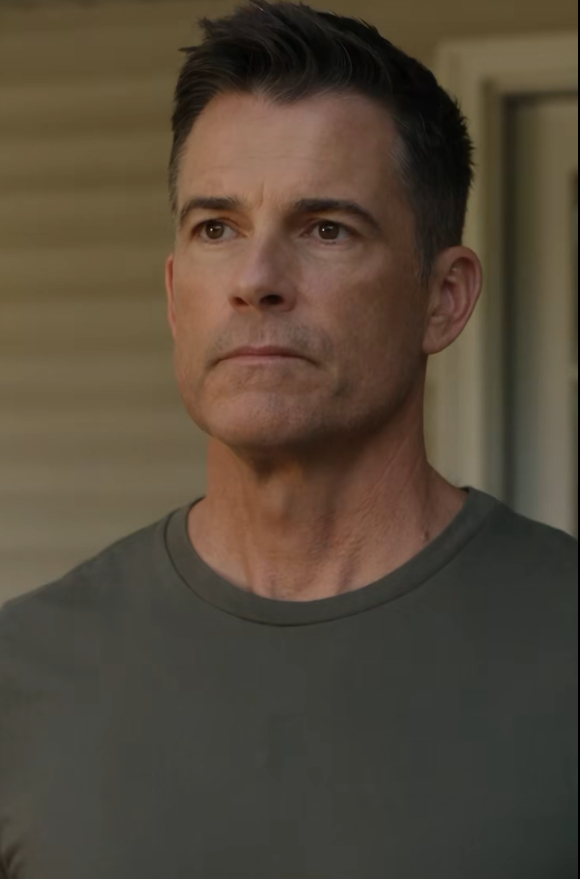
The gun was already pressed into my ribs when I realized the man holding it had made the worst mistake of his life.
Not because I was stronger than him.
Not because I could disarm him.
Not even because I had spent fourteen years putting fugitives in handcuffs for the United States Marshals Service.
His mistake was much simpler.
His body camera was recording.
The tiny red light above his shirt pocket blinked once.
Then again.
Six feet behind me, my eleven-year-old daughter stood frozen on the porch, both hands wrapped around a glass pitcher of lemonade.
The man leaned closer.
I could smell mint gum.
"One more step, hero," he whispered, "and your daughter watches you drop."
At the curb, Gloria Whitcomb folded her arms.
Pearl earrings.
White pantsuit.
Perfect blond helmet of hair.
The expression of a woman watching a restaurant manager remove a customer she didn't like.
"Maybe next time," she said, "you'll learn to obey community rules."
My daughter made a sound that cut through me worse than the gun barrel.
"Dad."
I kept my hands open.
"Lily, put the pitcher down."
Her fingers tightened around the handle.
"Dad—"
"It's okay."
It wasn't.
But children don't always need the truth first.
Sometimes they need something sturdy enough to stand on until the truth becomes survivable.
"Put it down, sweetheart."
The bottom of the pitcher touched the porch boards with a quiet click.
Nobody across the street moved.
Two neighbors stood in their driveways pretending to check their mail.
Another watched through half-closed blinds.
Three HOA board members remained seated in Gloria's white golf cart.
And beside them stood the nervous little man with the clipboard who had been following Gloria around since eight that morning.
The fake officer shoved the muzzle harder into my side.
"Wallet. Slowly."
I looked at Gloria.
"You want him to see my identification?"
She actually laughed.
"For once in your life, Mr. Brooks, cooperate."
"All right."
I told the man exactly where the credential case was.
Left rear pocket.
I waited until he ordered me to move.
Then I used two fingers.
Very slowly.
I pulled out the leather case.
Opened it.
The gold star caught the sunlight.
The man's eyes dropped.
His face changed before he finished reading.
UNITED STATES MARSHAL.
Technically, the wording beneath identified my current appointment as Deputy United States Marshal, but judging by the blood draining out of his face, the distinction didn't matter.
His gun moved half an inch away from my ribs.
Behind him Gloria said, "What is that?"
The man stared at me.
Then at the credentials.
Then back at me.
For the first time, I saw what he actually was.
Not a cop.
Not an officer.
Not even a particularly convincing bully.
He was a frightened man wearing a costume.
I lowered my voice.
"Take your finger off the trigger."
His eyes flicked down.
It was resting along the frame, which at least told me someone had given him rudimentary training.
"Now lower the weapon."
Gloria's voice sharpened.
"Mercer, don't listen to him."
And that was when the man with the clipboard finally moved.
He stepped backward from Gloria.
Reached into his pocket.
Pulled out his phone.
His hand was shaking so hard I could see it from fifteen feet away.
"I saved them," he said.
Gloria turned.
"What?"
His eyes met mine.
"I saved every notice she made us send."
The entire street seemed to go silent.
Gloria's face changed.
Not much.
Just enough.
"Calvin," she said carefully, "put your phone away."
He didn't.
"I saved the invoices too."
Mercer glanced at her.
"What invoices?"
Gloria snapped, "Shut up."
That was the second mistake.
Because when guilty people believe they still have power, they often start organizing the evidence out loud.
Calvin swallowed.
"There are two sets of books."
Gloria moved toward him.
I said, "Don't."
She stopped.
Not because she suddenly respected me.
Because she finally understood exactly who was standing in front of her.
Mercer lowered the gun completely.
"Man, I didn't know."
"Set it on the ground."
"I swear she told me—"
"Ground."
The pistol hit the asphalt.
"Now step away."
He obeyed.
I didn't draw my own weapon.
There was no need.
I reached for my phone instead.
But before I could dial, Lily spoke behind me.
"I already called."
I turned my head.
She held up her little emergency phone.
Her mother and I had given it to her after Rebecca started treatment.
Three buttons.
Mom.
Dad.
Lily's finger was still resting on the red one.
From somewhere beyond the subdivision gate came the sound of sirens.
Gloria stared at her.
And my daughter, who had spent six months learning to be afraid of words like biopsy, infusion, scan, and recurrence, stared straight back.
That was the moment Gloria Whitcomb lost control of Pine Hollow Estates.
She just didn't know it yet.
Nine days earlier, all we had wanted was quiet.
My wife, Rebecca, had been fighting cancer for almost a year.
There are words doctors use that sound clean and clinical until they belong to someone you love.
Margins.
Progression.
Response.
Metastatic.
Stable.
Uncertain.
Each one becomes a weather system inside your house.
Rebecca hated when people called her brave.
"I'm not brave," she told me once after vomiting into a hotel ice bucket on the drive home from treatment. "I'm just not dead yet."
That was Rebecca.
Dry humor.
No patience for pity.
Beautiful even when she was furious that I thought she was beautiful.
Her oncology clinic had transferred her into a treatment program at a facility near Pine Hollow, so we rented a house ten minutes away.
I took temporary reassignment to the district office.
Lily transferred schools.
We told ourselves three months.
Maybe four.
Just get through treatment.
Then go home.
The rental was plain but pleasant.
Gray siding.
White shutters.
Three bedrooms.
A maple tree out front.
And a covered porch wide enough for the one possession Lily insisted we bring from storage.
Her mother's old porch swing.
It wasn't valuable.
At least, we didn't think it was.
Heavy oak.
Faded green paint.
Brass chains.
The left armrest had a dent from when Rebecca had dropped a flowerpot on it as a teenager.
Rebecca's parents had owned it before she was born.
When she was pregnant with Lily, she'd spent entire evenings sitting on it with a bowl of strawberries balanced on her stomach.
After Rebecca got sick, Lily became strangely attached to it.
Children do that when the world stops making sense.
They choose one object and make it the border between before and after.
"If Mom sees it when she gets home," Lily told me, "she'll know this is home too."
So Saturday morning I hung the swing.
At 8:17, Lily sorted washers and bolts while I held a socket wrench between my teeth.
Then the white golf cart arrived.
Three women in tennis visors.
One nervous man with a clipboard.
And Gloria.
She stared at the swing like I had suspended a dead animal over the porch.
"You are installing an unauthorized exterior fixture."
I looked at the swing.
Then at her.
"It's a porch swing."
"It is visible from the street."