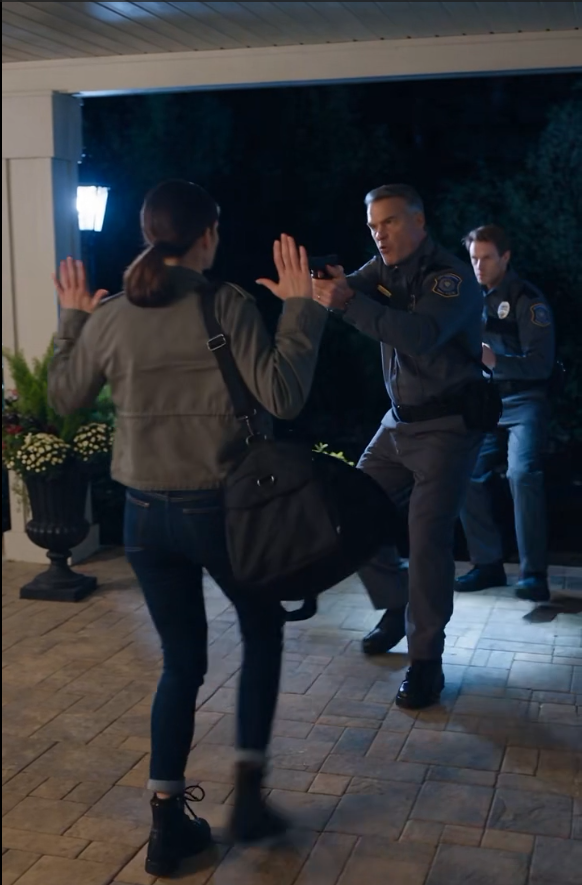
Her mother had spent most of Amy’s childhood yelling about muddy footprints. Years after we lost her, Amy still kicked her shoes off automatically within thirty seconds of walking through my front door.
Not tonight.
I leaned against the counter.
“You don’t have to do that with me.”
“Do what?”
“Pretend nothing happened.”
“I’m not pretending.”
“Then what are you doing?”
She looked at the tea.
“Coming down.”
The words were so quiet I nearly missed them.
I pulled out the chair opposite her.
For a while, neither of us spoke.
The refrigerator hummed.
A car passed beyond the front windows.
Amy finally removed one boot, then the other.
She set them side by side beneath the table.
That simple motion affected me more than I expected.
She was home.
Actually home.
Not the woman standing under tactical lights with federal credentials in her hand.
My daughter.
“I’m sorry,” I said.
Amy frowned.
“For what?”
“I should’ve come outside sooner.”
“No.”
“I was right there.”
“And if you had walked between us, you would have made the scene harder to control.”
“You were the one with the gun in your face.”
“Exactly.”
I looked at her.
She lifted the mug but didn’t drink.
“You didn’t cause it,” she said.
“I let him become this.”
That got her attention.
“What?”
“Not tonight. Before tonight.”
“Amy—”
“Dad, what does that mean?”
I rubbed a hand over my face.
“It means Marcus has been escalating for years. Everybody complains. Nobody wants the headache of challenging him. He writes ridiculous reports. Follows delivery drivers. Questions teenagers walking home. Last spring he stopped one of the gardeners and made him empty his pockets because somebody had lost a set of hedge clippers.”
Amy’s expression sharpened.
“And the HOA kept him?”
“The board said he was thorough.”
“Did anyone file a complaint?”
“People complained.”
“With police?”
“No.”
“In writing?”
“I don’t know.”
“That isn’t the same thing.”
“I know that now.”
She studied me for a moment.
“What else?”
I hesitated.
Amy caught it immediately.
“What else?”
“There was an incident a few months ago.”
“With a gun?”
“No. At least I don’t think so.”
“What happened?”
“A college kid was visiting his parents. Marcus stopped him near the pool after midnight. The kid got mouthy. Marcus put him against a fence and searched his backpack.”
“Did Marcus have consent?”
“I doubt it.”
“Police called?”
“The parents threatened to.”
“And?”
“They backed down.”
“Why?”
I gave her a tired look.
“Because they live here.”
Amy leaned back.
“That answer doesn’t make sense.”
“It does if you understand Willow Ridge.”
“Explain it.”
So I did.
I told her how the HOA controlled everything from exterior paint to parking permits. How disputes that should have been stupid became personal because everyone involved had to see each other again at the mailbox or annual picnic. How board elections turned into small civil wars.
And how Marcus had made himself useful.
If a resident complained about teenagers jumping the fence near the retention pond, Marcus found them.
If somebody’s package disappeared, Marcus spent hours reviewing gate logs.
If contractors entered through the wrong access point, Marcus stopped them.
People disliked him, but they also liked that their gated community felt watched.
Protected.
That was the word the board always used.
Protected.
Amy listened without interrupting.
When I finished, she asked, “Protected from what?”
I had no answer.
My phone buzzed.
An email notification.
Subject: IMPORTANT SECURITY INCIDENT — WILLOW RIDGE.
I opened it.
Amy watched my expression.
“What?”
I handed her the phone.
The message had been sent to every resident by the HOA shortly before one in the morning.
It was brief.
There had been “an encounter involving a nonresident individual and Willow Ridge security personnel.” Local authorities had responded. There was “no continuing threat to residents.” The HOA would conduct “an internal review.”
No names.
No mention of a firearm.
No mention that the “nonresident individual” was the homeowner’s daughter.
No mention that she was federal law enforcement.
Amy read it twice.
Then handed back the phone.
“That was fast.”
“Marcus must have called the board.”
“Probably.”
“You’re not angry?”
“I’m interested.”
That was Amy’s word for angry.
“What are you thinking?”
“They’re establishing language before facts are established.”
“You mean they’re covering for him.”
“I mean they’re creating a version.”
That distinction mattered to her.
Evidence before conclusions.
Always.
I wished I had learned the habit earlier.
The next morning, Willow Ridge woke up pretending nothing had happened.
Sprinklers clicked over lawns.
A landscaping crew worked near the front entrance.
Someone jogged past my house before seven.
But by eight fifteen, three neighbors had texted me.
By nine, there were nine messages.
By ten, a woman I barely knew called to ask whether Amy had “provoked security.”
I hung up on her.
Amy was in the guest room making a work call.
I could hear only fragments.
“Yes.”
“No injury.”
“Local jurisdiction has it.”
“No, I did not draw.”
A pause.
“Because I didn’t need to.”
Another pause.
“Yes, sir.”
She sounded fifteen years older on those calls.
Afterward she came into the kitchen dressed in a plain black sweater and jeans.
“Your office?”
“Yes.”
“What did they say?”
“They’ll coordinate if local investigators need verification or documentation.”
“Does this affect your job?”
“No.”
I nodded.
Then asked the question I had been avoiding.
“What exactly does tactical operations commander mean?”
Amy smiled faintly.
“You’ve had six years to ask.”
“You usually say you work operations.”
“I do.”
“That’s not an answer.”
“It’s the answer I’m allowed to give.”
“You were allowed to tell Marcus.”
“I told him I was FBI. The rest came out when police asked my assignment.”
I waited.
She sighed.
“I supervise teams that support high-risk federal operations.”
“What kind?”
“The kind I don’t discuss at breakfast.”
I looked at the coffee pot.
“So if Marcus had done something—”
“Dad.”
“No. I want to understand.”
She was quiet.
“If he had fired, my training would have mattered.”
“That’s not what I mean.”
“I know.”
We looked at each other.
She reached across the counter and touched my wrist.
That was all.
At eleven thirty, Nolan appeared at my front door.
No uniform.
No flashlight.
He wore a gray sweatshirt and looked as though he hadn’t slept.
Amy was sitting in the living room.
I opened the door only halfway.
“Nolan.”
“Can I talk to you?”
“About last night?”
His eyes shifted past me.
Amy stood.
Nolan saw her and went pale.
“I didn’t know you were still here.”
Amy approached but stopped several feet from the doorway.
“You can come inside if you want.”
Nolan hesitated.
“Is this official?”
“No.”
“Are you recording?”
“No.”
He looked at me.
“Are you?”
“No.”
That appeared to matter.
He stepped inside.
I closed the door.
Nolan stayed standing.
“Marcus was suspended this morning.”
“Good,” I said.
Nolan flinched at the force in my voice.
Amy remained neutral.
“By the HOA?”
“Yes. Pending review.”
“Were you suspended?”
“No.”