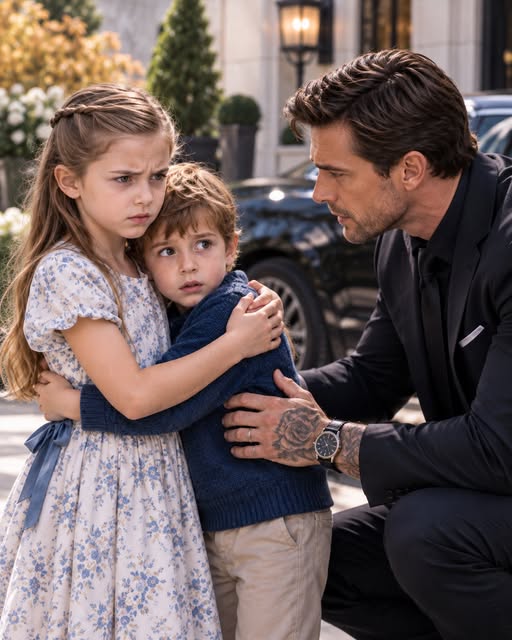
Emma refused to get into my car.
I couldn’t blame her.
From her perspective, a stranger had appeared wearing a suit that probably cost more than everything she owned, surrounded by men in black coats and expensive vehicles, and announced that he intended to solve her life.
Children who had been abandoned learned suspicion faster than multiplication.
“I can walk,” she said.
“It’s four miles.”
“I walk farther.”
That sentence bothered me more than it should have.
Joshua stood beside the open SUV door.
“You can sit with me.”
Emma looked at him.
Then at me.
“You promise Greg isn’t there?”
“He isn’t.”
“You promise?”
“Yes.”
She finally climbed inside.
I sat across from them while Marcus drove.
Joshua talked nonstop, partly because he was five and partly because he sensed silence frightened Emma.
He told her about his bedroom.
His dinoNextrs.
His terrible drawing of a dragon that he insisted was excellent.
Our elderly Labrador, Charlie.
The pancake chef who came on Sundays.
Emma listened as if Joshua were describing another planet.
“You have a chef?”
“Daddy burns pancakes.”
“I burned them once,” I said.
“Three times.”
“Traitor.”
Joshua giggled.
Emma almost did.
Then she looked out the window and became quiet again.
My house stood in the West Hills behind tall gates and enough trees to make the city disappear.
It wasn’t a mansion I had built for myself.
Sarah had chosen it.
She had loved the windows.
The garden.
The ridiculous amount of space.
After she died, the house stopped feeling impressive.
It simply became large.
Too large.
Joshua ran inside.
Emma remained on the front step.
My housekeeper, Rosa, approached.
She had worked for me fourteen years and possessed the rare ability to tell me exactly what she thought without fearing the consequences.
Her eyes settled on Emma.
Then narrowed at me.
“Who is this?”
“Emma.”
“That explains nothing.”
“I’ll explain later.”
Rosa crouched.
“Hello, sweetheart.”
Emma stared at her.
“Are you a police lady?”
“No.”
“A social worker?”
“No.”
“What are you?”
Rosa smiled.
“The woman who tells Mr. Anderson when he’s wrong.”
Joshua shouted from inside.
“She does!”
I sighed.
Emma smiled again.
Progress.
Within an hour, a pediatrician I trusted had arrived, along with Natalie Brooks, a child welfare specialist my attorney contacted through official channels.
That part mattered.
There were lines even I refused to cross.
Emma needed protection, but she also needed documentation, medical care, and a legal path out of whatever nightmare Greg had created.
Natalie was in her forties, wore sneakers instead of heels, and spoke to Emma without using the artificial sweetness adults often used with children.
“I’m not taking you anywhere tonight,” she said after introducing herself.
Emma studied her.
“Promise?”
“As long as you’re safe here, yes.”
Emma looked at me.
“Is he safe?”
Natalie glanced over.
“I’m still deciding.”
Rosa laughed from the doorway.
I didn’t.
Ten minutes later, Natalie was interviewing me in my library.
“You understand your reputation creates complications.”
“My reputation didn’t leave her in a park.”
“That isn’t what I said.”
“Then say what you mean.”
She crossed one leg over the other.
“You may have influence. I don’t care. Emma’s welfare comes before your feelings.”
I stared at her.
Then nodded.
“Good.”
She seemed surprised.
“I expected more argument.”
“Would it help Emma?”
“No.”
“Then I don’t care.”
Something changed in her expression.
Not trust.
But perhaps the possibility of it.
The doctor found dehydration, mild malnutrition, several old scrapes, and a respiratory infection beginning from exposure.
Nothing life-threatening.
That should have relieved me.
Instead, I became angrier.
Because it meant Emma had been suffering slowly.
Quietly.
One cold night at a time.
Rosa gave her a bath.
She emerged wearing Joshua’s old blue pajamas, sleeves rolled at the wrists.
Joshua objected.
“Those have rockets.”
“So?”
“They’re mine.”
“You haven’t worn them in two years.”
He considered this.
“Emma can have them.”
“Very generous.”
He whispered to her, loudly enough for everyone to hear, “There are planets on the butt.”
For the first time, Emma laughed.
A real laugh.
It lasted maybe three seconds.
Then she covered her mouth as if laughter required permission.
That broke my heart more effectively than tears could have.
Later, after Joshua went to bed, I found Emma standing in the hallway.
“There are too many doors,” she said.
She was staring down the second floor where guest rooms stretched in both directions.
“That’s true.”
“How do you know which one is yours?”
“I’ve lived here a long time.”
“What if I forget?”
“We’ll put something on your door.”
“Like what?”
“What do you like?”
She thought seriously.
“Stars.”
“Stars it is.”
Rosa found glow-in-the-dark stickers in Joshua’s craft drawer.
Emma watched us put them around the guest-room door.
She touched one.
“Do they stay?”
“For a while.”
“I mean the room.”
I understood.
“Yes.”
“For tonight?”
“For as long as you’re allowed to be here.”
Her face fell slightly.
I hated that answer.
But Natalie had warned me against making promises I couldn’t legally guarantee.
Emma climbed into bed.
Then immediately climbed back out.
“What’s wrong?”
She looked embarrassed.
“Can I keep some food?”
“There’s food downstairs.”
“What if someone eats it?”
“We have enough.”
She didn’t move.
I went downstairs, made a small basket with crackers, fruit, cereal bars, and bottled water, and placed it beside her bed.
Only then did she relax.
I turned off the lamp.
“Daniel?”
“Yes?”
“Why are you helping me?”
I leaned against the doorway.
“Because you helped Joshua.”
“What if I hadn’t?”
That stopped me.
Because there was only one acceptable answer.
“I should still help you.”
She nodded slowly.
“Okay.”
I started closing the door.
“Daniel?”
“Yes?”
“Greg gets mad when people ask questions.”
I opened the door again.
“What does that mean?”
She pulled the blanket higher.
“He said Mama left him things.”
“What things?”
“I don’t know.”
“Did he hurt you?”
Her eyes darted away.
Not an answer.
Not exactly.
But enough to make every muscle in my body tighten.
“He yelled.”
“Did he hit you?”
“No.”
Relief came too quickly.
Then she added, “He grabbed sometimes.”
I forced myself to stay calm.
“Thank you for telling me.”
“Are you mad?”
“Yes.”
Her eyes widened.
“Not at you.”
She studied my face.
Then whispered, “Okay.”
I closed the door.
Marcus was waiting downstairs.
One look told me he had news.
“Office.”
We went inside and shut the door.
“What did you find?”
“Gregory Mason, thirty-eight. Several addresses over the last decade. Petty theft charge eight years ago. Fraud investigation that never went anywhere. Worked at three tire shops, two garages, currently unemployed.”
“And Emma?”
Marcus placed a folder on my desk.
“Her mother was Rebecca Carter. Thirty-one when she died. Cancer.”
I sat down.
“Family?”
“Rebecca’s parents are deceased. No siblings. Emma’s father isn’t listed on the birth certificate.”
“Greg?”
“Never married Rebecca. No legal guardianship.”
“So he had no right to abandon her because he had no right to be responsible for her in the first place.”